 Auguste RodinFrench, 1840–1917
St John the Baptist
May one see it?
Yes, receiving visitors

Victoria and Albert Museum
RoomSculpture, Room 21, The Dorothy and Michael Hintze GalleriesLondon, United Kingdom
On public display.
- Checked
- 7 days ago
- In this state since
- Sep 25, 2026
- Source
- The museum's own collection data
About the sculpture
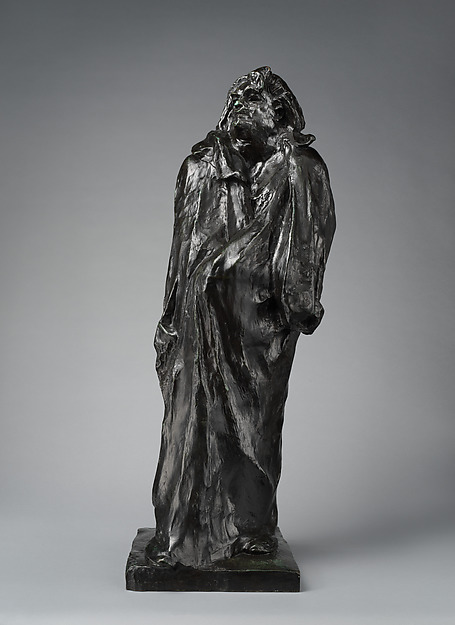
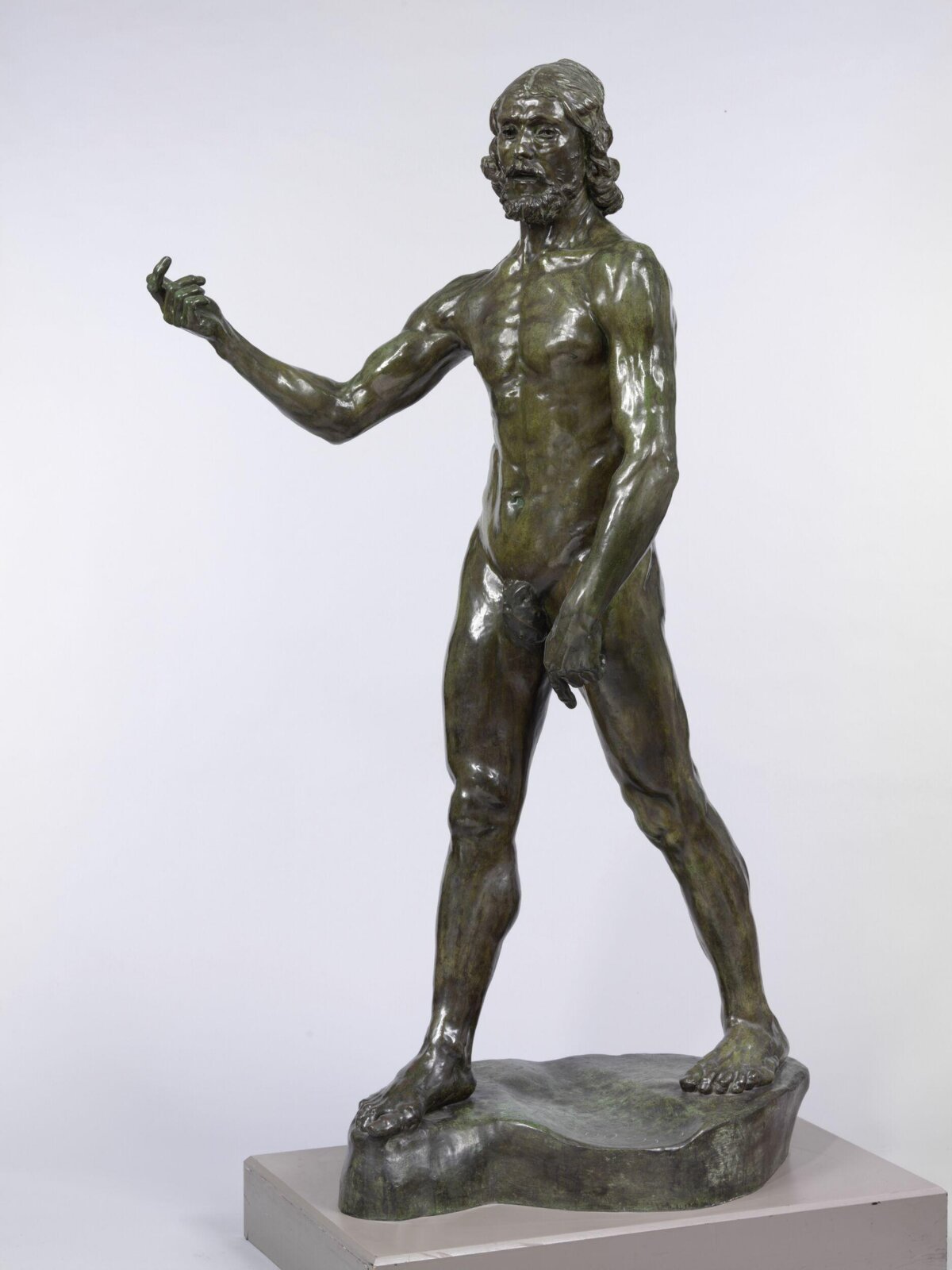
St John the Baptist was Rodin's second large bronze figure study. Begun in 1878, the head was exhibited independently in the Paris Salon of 1879, followed by the whole figure in plaster in 1880 (with a cross, later abandoned) and in bronze the following year. It was acquired by the French state in 1884 for the Luxembourg Gardens in Paris. An early model for the figure, lacking the head and arms, was later exhibited as the Walking Man.
Read on
To counteract the damning criticism of casting from the live model that greeted his first figure, The Age of Bronze, the figure of St John the Baptist was made slightly over life-size. Rodin did not set out to make a religious subject, but the naturally awkward yet forceful pose of his untrained model, an Italian labourer from the Abruzzi named César Pignatelli (the head was taken from a separate model), suggested to him a raw mystical character appropriate to the Baptist. This bronze, the first work by Rodin to enter an English public collection, was presented to the Museum in 1902 by a committee of the sculptor's supporters who had set up a subscription to acquire one of his pieces for the nation.
To acknowledge the successful campaign, Rodin was invited to a celebration at the Café Royal, after which students from the Slade and South Kensington Art Schools pulled Rodin's carriage through the streets of London in homage to the artist. St John the Baptist thus became the official symbol of Rodin's dominant influence on establishment sculpture of the early 20th century. The Museum's collection of Rodin's sculpture was later substantially increased by the gift of 18 works from the artist himself in 1914.
Victoria and Albert Museum
Particulars
- Accession number
- 601-1902
What it shows
In the catalog
Sources
- Victoria and Albert Museum: the museum's own open data · fetched 7 days ago
- Image: Victoria and Albert Museum — © Victoria and Albert Museum, London
Meanwhile, in the life of Auguste Rodin
The whole life1880
Receives the commission for “The Gates of Hell”
His first state commission was a sculptural portal for a planned Museum of Decorative Arts; with it Rodin received two studios on the Rue de l'Université. The museum was never built and “The Gates of Hell” remained unfinished: they were first cast in bronze after the master's death.
1880
The 1880 Salon: third prize
Rodin showed “St. John the Baptist”, which won third prize. In the same Salon “The Age of Bronze” was exhibited a second time, now cast in bronze.
c. 1880 – 1881
Juliette Adam's salon and first recognition
Rodin was received at the salon of the writer Juliette Adam, where he was presented to Gambetta; Gambetta recommended him to Antonin Proust, the minister of fine arts, who bought “St. John the Baptist” for the state. It was the first recognition to reach a sculptor who was already forty.
1881
London: meeting William Ernest Henley
Rodin's friend Alphonse Legros introduced him in London to the poet William Ernest Henley, who did more than anyone to win him a British audience. Through Henley Rodin met Robert Louis Stevenson and Robert Browning.
1882
“St. John the Baptist” at the Royal Academy
A bust of St. John the Baptist, a version of the statue bought by the French government, was shown with success at the Royal Academy. A year earlier Henley, who had become editor of the Magazine of Art, had published several articles on Rodin there.
1883
Meets Camille Claudel
Standing in for Alfred Boucher, who was away, Rodin supervised his students' course and met the eighteen-year-old Camille Claudel. She became his assistant, model, lover and creative rival.