 Viktor Vasnetsov1848–1926
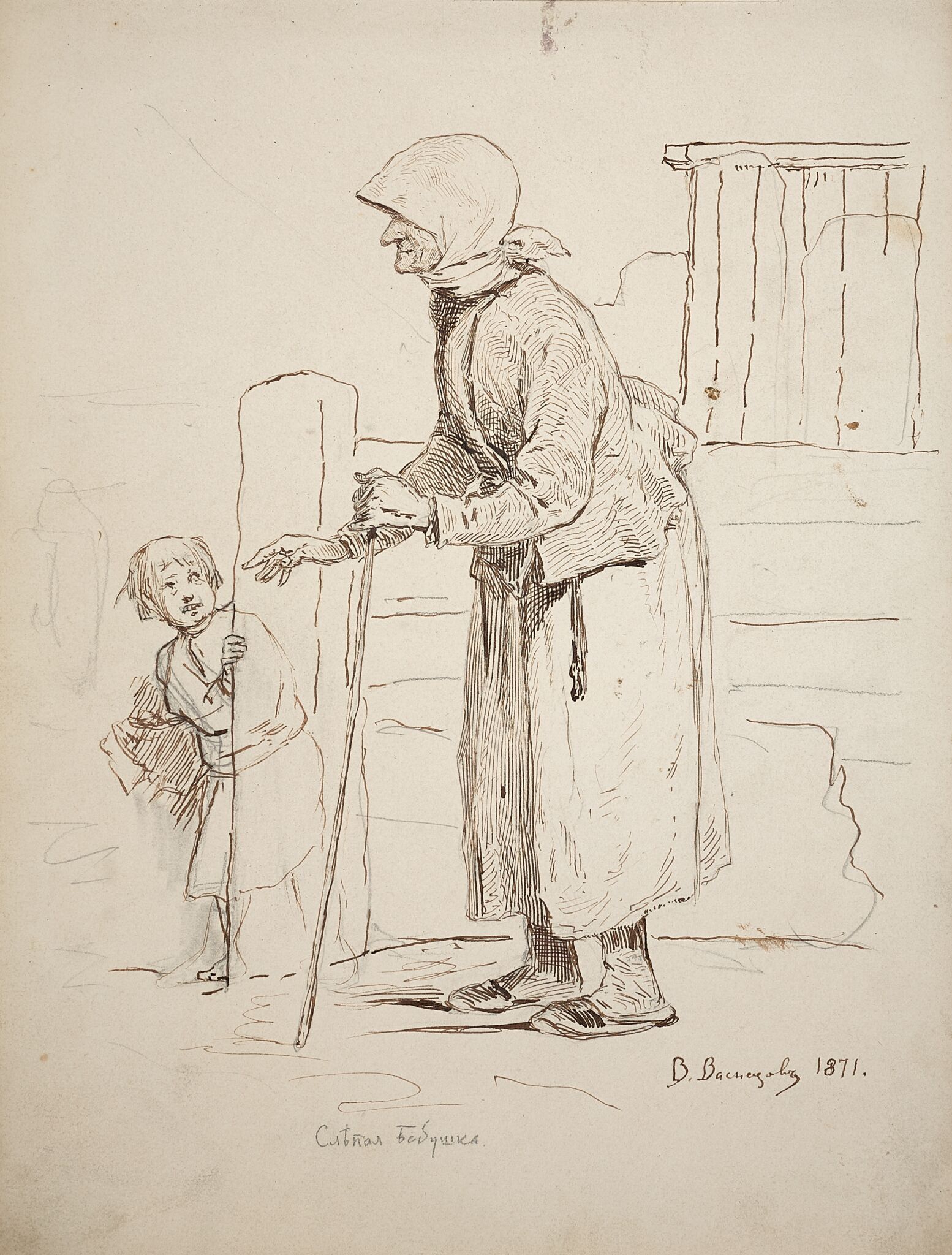
Слепая бабушка
May one see it?
Unknown: the museum keeps its counsel

Tretyakov Gallery
Moscow, Russia
The owner is known. Whether it is on view today, the museum does not say, and we were not trained to guess.
- In this state since
- Sep 28, 2026
- Source
- The museum's own collection data
About the work
In the museum's own words — the original
Виктор Михайлович Васнецов вошел в русское искусство как мастер бытового жанра. Персонажи его первых произведений – односельчане, простой крестьянский люд, обыватели. Еще до поступления в Академию художеств он выполнил в Вятке серию из 75 рисунков, иллюстрирующих русские пословицы и поговорки, собранные местным этнографом Н. Трапицыным. В этих рисунках сказалась способность талантливого юноши замечать и метко отображать характеры людей и явления окружающей его жизни. В поле зрения художника оказались повседневные житейские сцены: крестьянский обед в поле, богомольцы у сельской церкви, нищие у крестьянской избы, беседа хозяина с батраком. Рисунок «Слепая бабушка» появился в 1871 году, когда Васнецов по болезни сделал перерыв в учебе в Санкт-Петербургской Академии художеств и вернулся на родину поправлять здоровье.
Read on
Тематически и по стилистике рисунок продолжает выполненную ранее серию: карандашный рисунок с небольшим количеством персонажей и жизненностью выбранной сцены. В рисунке запечатлена сцена со слепой старушкой и шаловливым мальчуганом. Протянутая вперед старческая рука, мелкие шажки правдиво передают неуверенную походку слепого человека преклонного возраста. Рисунок, хотя и не лишен юмора, выдает сочувствие художника наблюдаемой сцене.
Tretyakov Gallery
Particulars
- Accession number
- ДМВ Г-2353
Sources
- Tretyakov Gallery: the museum's own open data · fetched 5 days ago
- Image: Tretyakov Gallery — © State Tretyakov Gallery
Meanwhile, in the life of Viktor Vasnetsov
The whole life1868–1876
Friendship with Repin and the “evenings” at Antokolsky’s
In St Petersburg he grew very close to Ilya Repin; he attended the “evenings” at the apartment of Repin and the sculptor Mark Antokolsky, where the student Ivan Savenkov read bylinas in a slow chant, in the northern accent so familiar to Vasnetsov — and so his interest in early Russian culture and folk epic finally took shape.
1868–1876
Friendship with Arkhip Kuindzhi
In St Petersburg he grew especially close to Arkhip Kuindzhi: the taciturn Vasnetsov found the key to his reserved nature, and when Kuindzhi painted “Ukrainian Night” he exclaimed that it was the very night Gogol had spoken of — “now we see it”.
1870
He meets Pavel Chistyakov
Pavel Chistyakov, back from Rome, saw Vasnetsov’s drawing “A Prince’s Icon-painting Workshop” at an Academy exhibition, asked to be introduced to its author and soon made him a regular pupil; Vasnetsov remembered his teacher as “an enemy of the formula” who could show each pupil the road to his own development.
1870
His father dies; his brother Nikolai becomes guardian
In 1870 his father, Mikhail Vasilyevich, died; the elder brother Nikolai became guardian of the younger children, and for some years their aunt Elizaveta Shilyaeva lived with the younger brothers.
summer 1871
He meets his future wife, Alexandra Ryazantseva
In the summer of 1871, home in Vyatka on academic leave, he met Alexandra Ryazantseva in the local library — a merchant’s daughter who would become one of the first women from Vyatka with a higher medical education; he was struck by “her eyes — stern and extraordinarily kind”.
1873–1875
He leaves the Academy before graduating
In 1873, a year before the end of the course, he almost stopped attending the Academy and went only to Chistyakov’s studio: Chistyakov told him he had already got from the Academy all it could give, and Kramskoi advised the same; on 4 (16) February 1875 he was formally discharged, receiving a certificate that listed two small silver medals and one large one.