 Gustave DoréFrench, 1832–1883
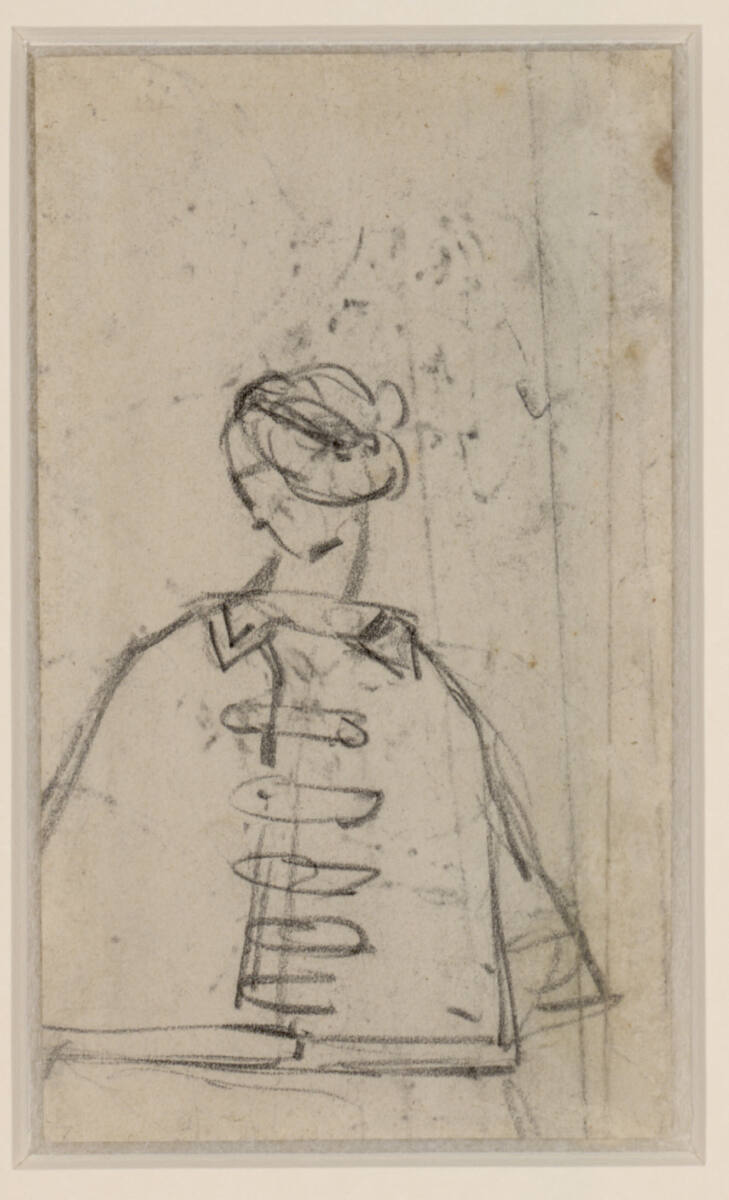
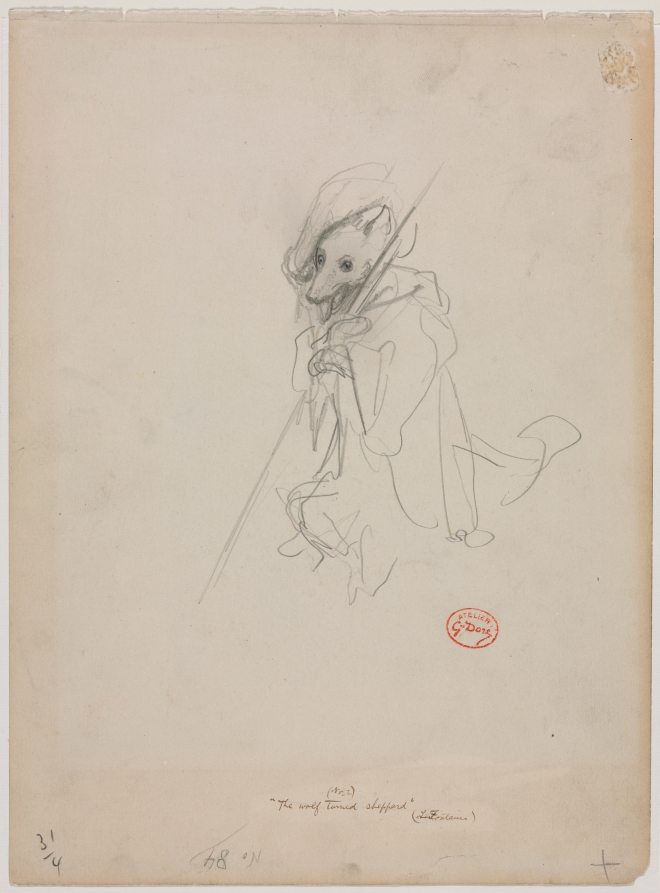
Sketch for "The Wolf Turned Shepherd" (recto)
Can I see it?
Not on view at present
Where is “Sketch for "The Wolf Turned Shepherd" (recto)” now? Collection: The Cleveland Museum of Art, Cleveland. Not on view at present. Checked September 29, 2026.

Cleveland, United States
It belongs to the collection, but is not on display at present.
- Checked
- In this state since
- Source
- The museum
About the work
“The Wolf Turned Shepherd” is a fable in which a disguised wolf approaches a flock of sheep while their shepherd sleeps. The wolf is ultimately discovered while impersonating the shepherd, waking the flock’s caretaker with its howl. Gustave Doré’s early sketch focuses on the wolf’s piercing gaze, highlighting his cleverness and overconfidence. Doré was among the most successful and versatile illustrators of the mid-1800s, and his illustrations for The Fables of La Fontaine—to which the final version of this drawing belongs—contributed to his fame. First published in France in 1867, the book was soon reissued in other countries.
The Cleveland Museum of Art
Details
- Accession number
- 1956.37.a
In the catalog
Sources
- The Cleveland Museum of Art
- Image: The Cleveland Museum of Art — Museum open access
In the life of Gustave Doré
The whole life1860s
“Don Quixote” illustrated by Doré
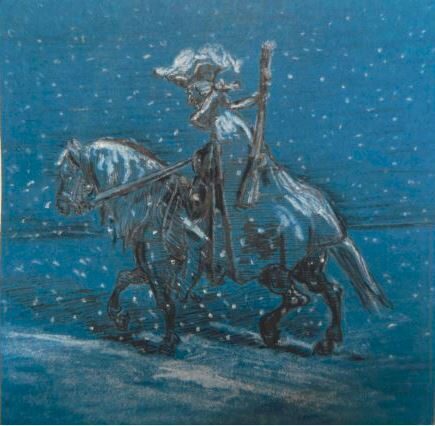
In the 1860s Doré illustrates a French edition of Cervantes's “Don Quixote”; his depictions of the knight and his squire, Sancho Panza, become so famous that they influence subsequent readers', artists' and stage and film directors' ideas of the physical “look” of the two characters.
1860s
Dante, Perrault and Baron Munchausen
The 1860s bring Doré's illustrations to Dante's “Inferno” and “Paradiso”, to Charles Perrault's fairy tales and to the adventures of Baron Munchausen.
1866
The illustrated Bible is a great success
Doré's illustrations for the Bible (1866) are a great success.
1866 · Award
Knight Commander of the Order of Carlos III
1867
A major exhibition in London and the Doré Gallery
In 1867 a major exhibition of Doré's work is held in London; it leads to the foundation of the Doré Gallery in Bond Street.
1869
A contract for “London: A Pilgrimage”: £10,000 a year
In 1869 Blanchard Jerrold suggests that he and Doré work together on a comprehensive portrait of London, modelled on “The Microcosm of London” by Rudolph Ackermann, William Pyne and Thomas Rowlandson. Doré signs a five-year contract with the publishers Grant & Co: he is to stay in London for three months a year and receives the vast sum of £10,000 a year for the project.