 Mikhail Vrubel1856–1910
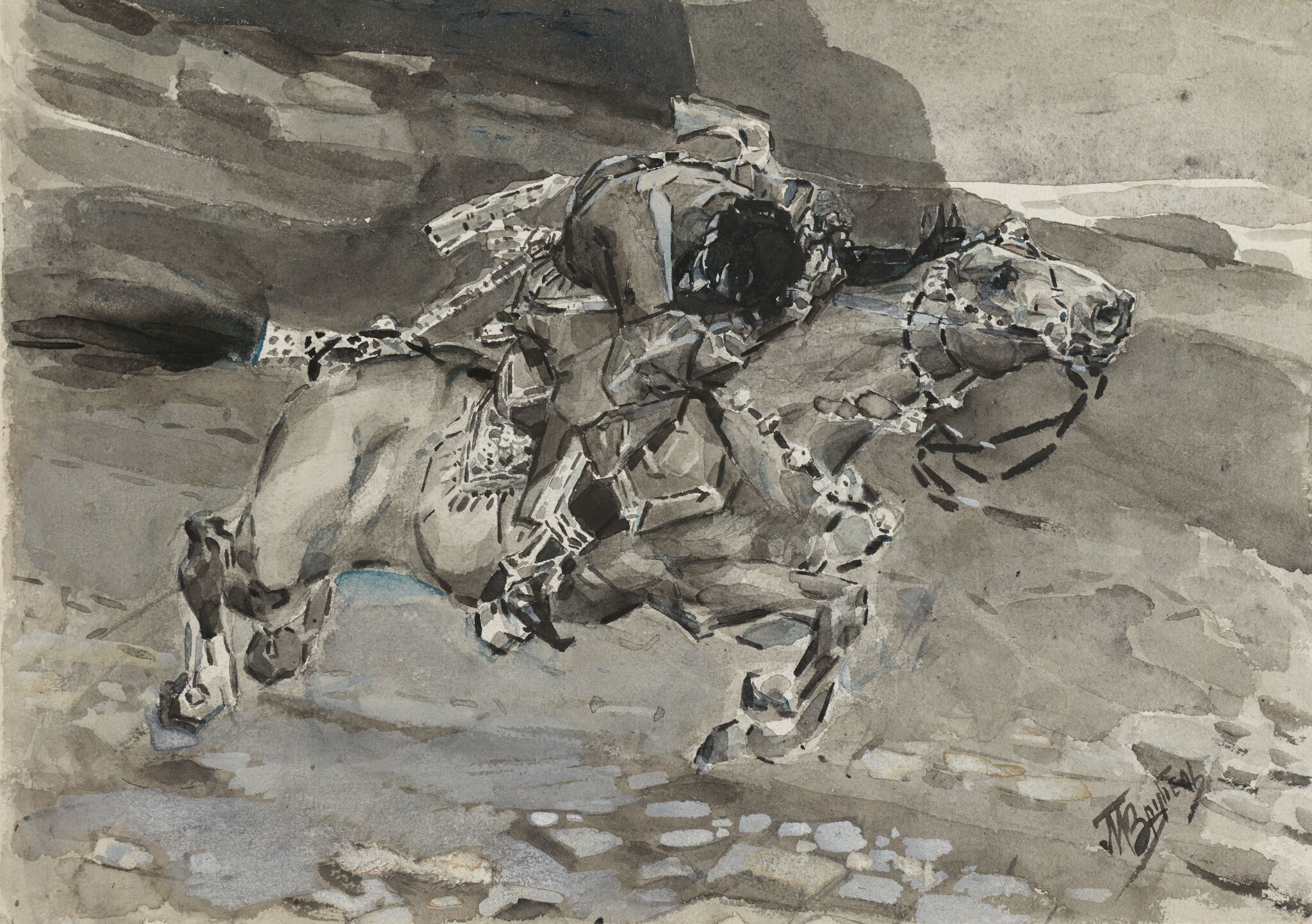
Скачущий всадник
Can I see it?
Unknown
Where is “Скачущий всадник” now? Collection: Tretyakov Gallery, Moscow. Unknown.

Moscow, Russia
The owner is known; whether it is on view today is not.
- In this state since
- Source
- The museum
About the work
Museum text in Russian
Работая над иллюстрациями поэмы Врубель создает два рисунка на один и тот же сюжет– когда убитого в перестрелке «властителя Синодала» несет в бешенном галопе по горным тропам его карабахский конь. Первый эскиз-вариант не вошел в издание, но именно в нем намечен основной мотив композиции – беспрепятственное движение, безудержный полет всадника на коне, позднее зеркально повторенный в эскизе одноименного декоративного панно «Полет Фауста и Мефистофеля» (1896) для оформления Готического кабинета в особняке А.В. Морозова в Москве. В следующей работе усиливает художник композицию, проработав не только пластику летящих всадника и коня, но и добивается зрительного эффекта кружащейся, летящей навстречу их бегу земли.
Художник точно следует тексту поэмы, прорисовывая фигуру всадника:
«Ремнем затянут ловкий стан;
Оправа сабли и кинжала
Блестит на солнце; за спиной
Ружье с насечкой вырезной.
Read on
Играет ветер рукавами
Его чухи, — кругом она
Вся галуном обложена.
Цветными вышито шелками
Его седло; узда с кистями ».
Но, резко «кадрируя» изображение, «граня» форму, противопоставляя между собой два прямо противоположных потока движения, Врубель в этой композиции достигает высот искусства грядущего двадцатого века: «творя легенду, как творили ее древние народы, обожествляя людей и очеловечивая богов. “Мифологичность” Врубеля, смелость его фантазии, решительность вымысла – все это были черты нового искусства. Врубель утверждал их, противопоставляя себя общепринятым нормам и обрекая тем самым себя на долгое одиночество и непризнание»- по мнению известного искусствоведа Д.В. Сарабьянова, художник в своем творчестве прорабатывал приемы, которые будут востребованы в авангардной живописи 1900 – 1910-х годов.
Tretyakov Gallery
Details
- Accession number
- 10041
In the catalog
Sources
- Tretyakov Gallery
- Image: Tretyakov Gallery — © State Tretyakov Gallery
In the life of Mikhail Vrubel
The whole lifesecond half of the 1880s
His father sees the first “Demon”, which is destroyed
While painting Kiev’s churches, Vrubel was simultaneously turning to the image of the Demon. His father, visiting Kiev, was horrified by his son’s poverty — “no warm blanket, no warm coat” — and disgusted by the first version of the “Demon”; the artist destroyed the painting, as he did much else he made in Kiev.
second half of the 1880s
His designs for St Volodymyr’s Cathedral rejected
Prakhov brought Vrubel into the decoration of St Volodymyr’s Cathedral but rejected his own designs — among them at least six versions of “The Lamentation at the Tomb”: their originality would have wrecked the unity of the ensemble, and for such murals, Prakhov remarked, one would have to build a church “in a completely special style”. Vrubel was left with minor work — ornaments and “The Days of Creation” in one of the ceiling panels after sketches by the Svedomsky brothers.
September 1889
The move to Moscow
After rushing to Kazan to his gravely ill father, in September Vrubel went to Moscow to see friends — and stayed for fifteen years; most likely he was drawn there by an infatuation with a circus horsewoman. He settled in Konstantin Korovin’s studio on Dolgorukovskaya Street; a plan for the two of them to work together with Serov came to nothing, as relations with Serov did not work out.
December 1889
Meeting Savva Mamontov
Korovin introduced Vrubel to the industrialist and patron Savva Mamontov, and in December the artist moved into his house on Sadovaya-Spasskaya Street. Mamontov became his steady patron, though Mamontov’s wife openly called Vrubel “a blasphemer and a drunkard”, and the painter soon moved to a rented flat.
July 1890
Abramtsevo: a passion for ceramics
Having come to Abramtsevo to bid farewell to his friend A. Mamontov, who died on 20 July aged 22, Vrubel stayed on and fell passionately for ceramics — soon he proudly wrote to his sister that he was running a “factory of tiles and terracotta decorations”. For the first time in his life he was no longer a hanger-on in wealthy households and earned well: stove designs, a majolica chapel over A. Mamontov’s grave, a design for an extension to the Mamontovs’ Moscow house.
10 April 1891
Illustrations for Lermontov’s “Demon”
The jubilee two-volume Lermontov, illustrated by 18 artists of whom Vrubel alone was completely unknown to the public, was passed by the censor on 10 April 1891. The press savaged Vrubel’s black-watercolour sheets for their “coarseness, ugliness, caricature and absurdity”, and he became convinced that “true art” is understood by almost no one.