 Mikhail Vrubel1856–1910
Сирень
May one see it?
Unknown

Tretyakov Gallery
Moscow, Russia
The owner is known; whether it is on view today is not.
- Source
- The museum
About the painting
In the museum's own words — in Russian
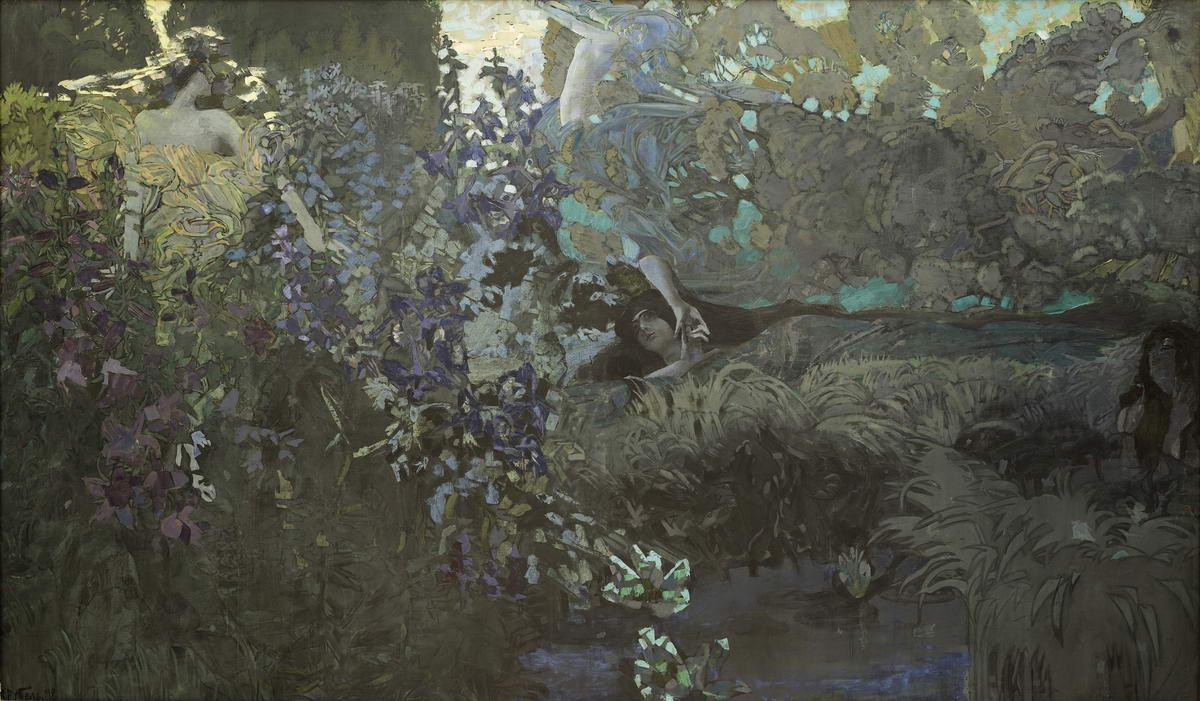
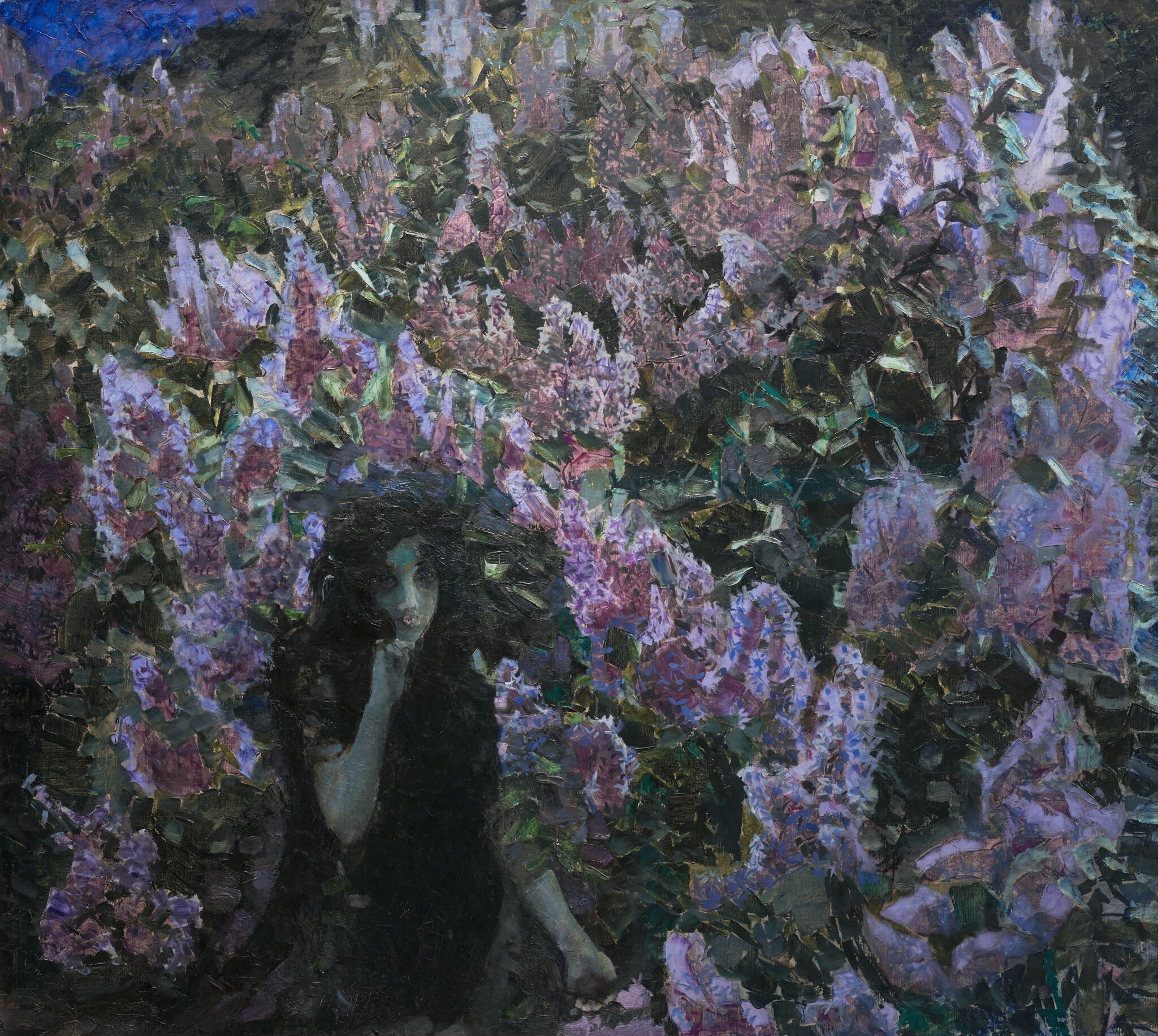
Картина «Сирень» была написана Михаилом Врубелем на хуторе Ивановское Николая Ге в Черниговской губернии. Художник, вместе с женой Надеждой Забелой-Врубель, бывал здесь летом в 1897, 1898, 1900 и 1901 годах, навещая семью Екатерины Ге, сестры Надежды Ивановны. Среди исследователей творчества Врубеля утвердилось мнение, что эта картина представляет собой первый вариант одноименного произведения 1901 года. Этому есть основание. Сам художник говорил о ней как об эскизе. И если представленный на полотне 1901 года женский образ на скамье обозначен им как Татьяна, то соответственно женская фигура среди ветвей роскошного куста сирени, освещенного луной, на картине 1900 года – она же.
Read on
Существует и другое мнение, которое гласит, что фиолетово-лиловое душистое марево на фоне яркой зелени листьев пробудило в воображении художника ускользающий и как будто растворяющийся в кустах сирени образ юной нимфы Сиринги, убегающей от влюбленного в нее Пана. Речной бог для спасения нимфы превратил ее в куст благоухающей сирени. Неутешный Пан услышал в шелесте ветвей прощальную песнь прекрасной девы и сделал из них сирингу, в русском переводе с древнегреческого - свирель. Год назад Врубель написал в Хотылёво, орловском имении Тенишевых, где он гостил с Надеждой Ивановной, картину «Пан» (1899). На ней устрашающий хозяин лесов с пронзительно печальным и добрым выражением ярко синих глаз изображен с неизменной свирелью. Теперь же бурно цветущая сирень на хуторе Ге снова напомнила художнику греческий миф о Пане и Сиринге.
Иное мнение о персонаже в картине возникает при внимательном прочтении письма Врубеля к Владимиру фон Мекку от 22 июля 1900 года. В нем художник сообщает: «Пишу 2 сюжета: “К ночи” и одну “Ночь”». По-видимому, под «Ночью» подразумевается картина «Сирень», в которой как раз передано ощущение пряного аромата сирени в прозрачных сумерках летней лунной ночи. Логика размышлений приводит к «расшифровке» образа, запечатленного на картине. Это – Никта, богиня ночи в греческой мифологии. Экстатический образ, персонифицирующий ночную темноту. Известны изображения Никты в мировом искусстве – всегда в черном покрывале или длинной черной накидке, прикрепленной к волосам. Так и в картине Врубеля, где Никта выступает душой этого фантастического пейзажа.
Широкой, быстрой и точной кистью воссозданы гроздья сирени. Составляющие их звездочки цветков образуют орнаментальную вязь на фоне затененной глубины ветвей, листьев и темно-синего неба с одиноко сияющей звездой. Художник пользуется мастихином помимо кистей, придавая формам соцветий особую «граненость», схожую с кристаллами сверкающих драгоценных камней. Сложность и разнообразие примененной Врубелем техники позволяет передать нежность цветов, переливающихся при свете луны разнообразными оттенками лилового, голубого, фиолетово-синего. Гроздья пребывают в постоянном движении, сравнимом с ритмом музыкального произведения.
Выражение «громадного личного мира» Врубеля посредством пейзажа, пропущенного сквозь призму его души, мифотворчество мастера в трактовке природы полностью отвечало исканиям художников эпохи символизма.
Tretyakov Gallery
Particulars
- Accession number
- 11054
In the catalog
Sources
- Tretyakov Gallery
- Image: Tretyakov Gallery — © State Tretyakov Gallery
Meanwhile, in the life of Mikhail Vrubel
The whole lifesummer 1898
First symptoms of illness
During a summer stay in Ukraine the first symptoms of his future illness appeared: his migraines grew so severe that he took phenacetin in huge quantities — up to 25 grains or more, according to his sister-in-law. A previously unknown irritability set in too, especially when someone disagreed with his opinion of a work of art.
January 1898
“Morning” at Diaghilev’s exhibition
In St Petersburg Ilya Repin advised Vrubel not to destroy his panel “Morning”, which a client had turned down, but to show it at an exhibition. So the canvas went into Sergei Diaghilev’s exhibition of Russian and Finnish artists at the museum of the Stieglitz School.
summer 1900
A gold medal at the Paris World’s Fair
In midsummer the Vrubels learned that he had won a gold medal at the Exposition Universelle for the fireplace “Volga Svyatoslavich and Mikula Selyaninovich”; his ceramics and majolica were shown in the Handicrafts Pavilion. Serov won the Grand Prix that year, and Korovin and Malyavin gold medals.
1 September 1901
Birth of his son Savva
Nadezhda Zabela-Vrubel gave birth to a son, Savva — a sturdy baby with a cleft lip; for his sake she left the stage for a time, and the family’s keep fell entirely on Vrubel. In the thick of his work on the “Demon” the artist painted a large watercolour portrait of his six-month-old son in a pram.
1902
Bekhterev’s diagnosis
In St Petersburg Vrubel went on repainting the “Demon” without pause, ruining it in his friends’ view, and his family took him to the psychiatrist Vladimir Bekhterev, who diagnosed “incurable progressive paralysis” — tertiary syphilis; the artist himself was told nothing. In Moscow, although the collector Vladimir von Meck bought the painting for 3,000 roubles, he grew worse still: he drank and squandered money, and his wife and son tried to take refuge from him with relatives in Ryazan.
April 1902
First hospitalisation
In early April, with symptoms of acute mental disorder, Vrubel was admitted to F. A. Savey-Mogilevich’s private clinic; until August his condition was so grave that even his wife and sister were not allowed to see him. In September he was moved to Vladimir Serbsky’s clinic at Moscow University, and Serbsky confirmed the diagnosis, establishing that the infection dated back to 1892.