Abu'l Hasan
Shah Jahan
May one see it?
Not receiving at present

Victoria and Albert Museum
London, United Kingdom
It belongs to the collection, but is not on display at present.
- Checked
- In this state since
- Source
- The museum
About the painting
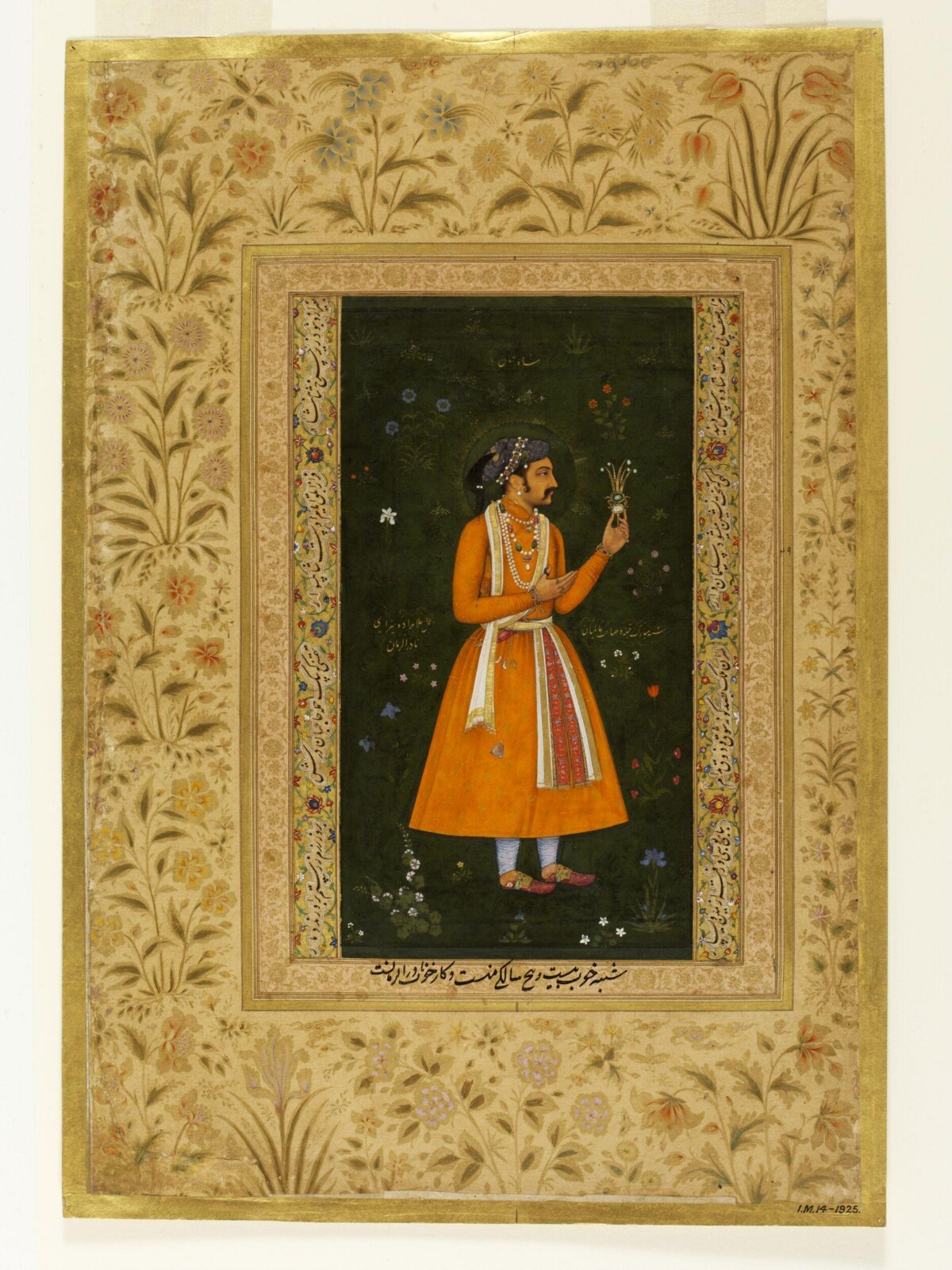
This portrait of prince Khurram, the eldest son of the Mughal emperor Jahangir (r. 1605-1627) was almost certainly painted when Jahangir bestowed upon him the title Shah Jahan, meaning 'King of the World'. Shah Jahan retained the title when he succeeded his father as emperor in 1628.
In later years, Shah Jahan added the Persian inscription in black ink in the border, noting that it is 'a good likeness of me in my twenty-fifth year and it is the fine work of Nader al-Zaman [= the leading artist of the reign, Abu'l Hasan]'.
Read on
The minute inscription in Nasta'aliq calligraphy in gold beginning on the right of the green ground, under Shah Jahan's hand, and continuing on the left beneath his right elbow may be translated: Blessed likeness of the qibla [the direction of Mecca] and master of mankind / the work of the [artist] born in hereditary palatial service Nadir al-Zaman. The title 'Shah Jahan' is written above his head in gold.
Victoria and Albert Museum
Particulars
- Accession number
- IM.14-1925
What it shows
In the catalog
Sources
- Victoria and Albert Museum
- Image: Victoria and Albert Museum — © Victoria and Albert Museum, London