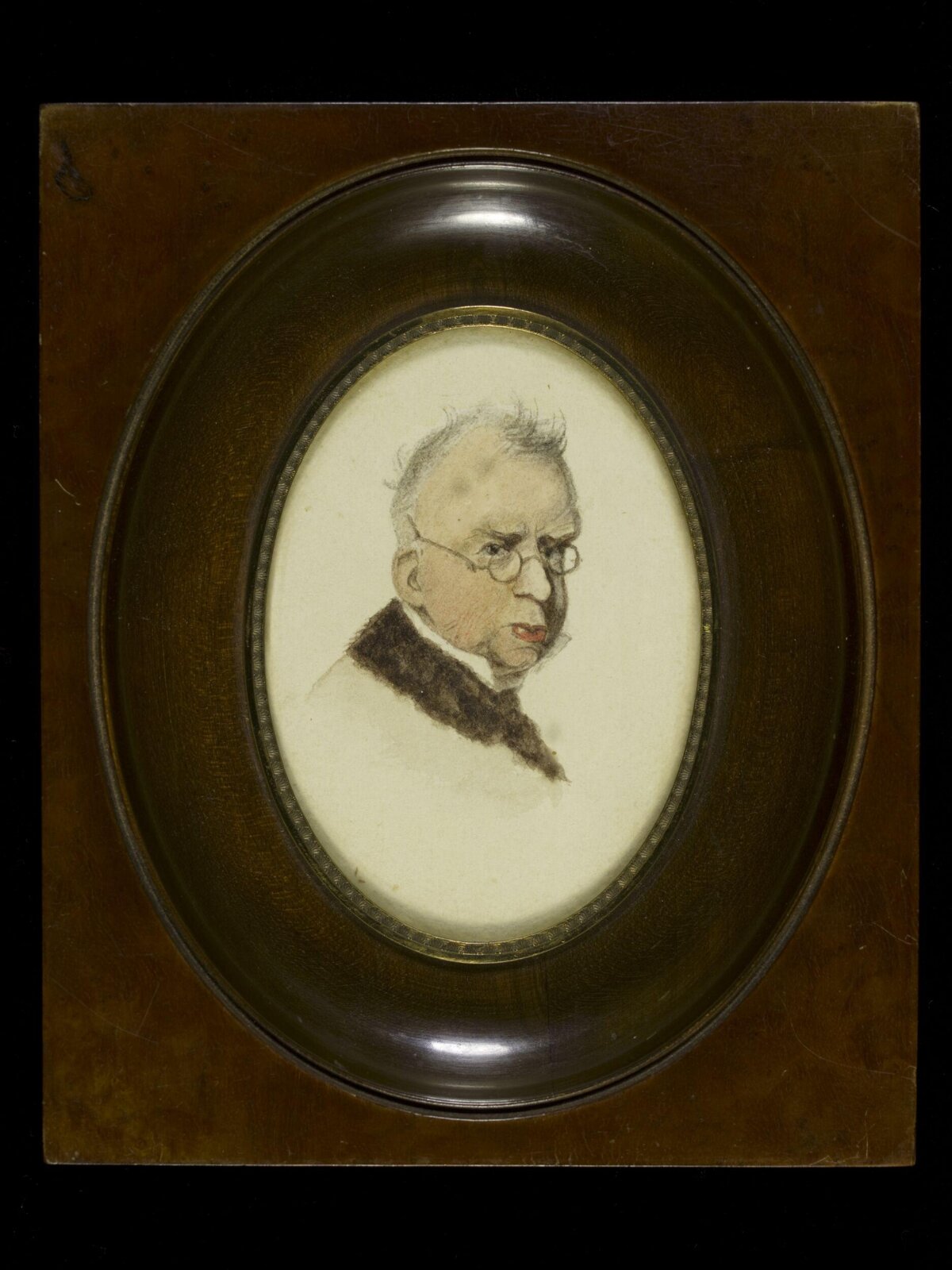
 George ChinneryEnglish, 1774–1852
Self-portrait
May one see it?
Not receiving at present

Victoria and Albert Museum
London, United Kingdom
It belongs to the collection, but is not on display at present.
- Checked
- 9 days ago
- In this state since
- Sep 25, 2026
- Source
- The museum's own collection data
About the work
George Chinnery (1774-1852) was born in London, the son of a writing master with artistic ambition, who exhibited portraits at the Free Society of Artists in 1764 and 1766. Chinnery established himself as a miniature painter (small portraits in watercolour on ivory), exhibiting miniature portraits at the Royal Academy from 1791 to 1795. In 1796 he moved to Dublin, where he had some relations, marrying there in 1799. He began to paint landscapes and large portraits in oil. The abolition of the Irish parliament in 1800 led many of Dublin's wealthier inhabitants to leave the city, and perhaps for this reason, fearing the loss of potential patrons, Chinnery also left. In 1802 he received permission from the East India company to travel from England to India, where he worked as a painter, leaving his wife and children behind in Britain.
Read on
He was initially based in Madras with his elder brother, a merchant and employee of the East India Company. Gradually he received more prestigious portrait commissions, and by 1812 he was established in Calcutta as the principal Western artist in the capital of British India. His wife joined him there in 1818. While in India he made many sketches in pencil of local life, people engaged in their everyday activities, and painted scenes of local architecture in watercolour. Although he was successful and well paid, he was often in debt. In 1825 he abandoned his wife and creditors and sailed for China. He was based in the Portuguese enclave of Macau, which was to be his home for the rest of his life, apart from visits to Canton (modern Guangzhou), Whampoa and Hong Kong.
Trade between China and the West was centred on Canton, but Western merchants were only allowed to stay there briefly, and their families were based in Macau. As in India, Chinnery sketched local scenes in pencil, painting finished topographical scenes in watercolour and in oil back in his studio. He received commissions however for portraits of British merchants, especially those associated with the firm of Jardine, Matheson, and also painted Chinese, Portuguese, American, Swedish and Parsi sitters. Chinnery's Chinese sitters included many Cantonese "hong merchants" who were responsible for all dealings with Western traders. As Hong Kong developed in the 1840s the Western traders and their families began to move from Macau to the new settlement. But Chinnery chose to stay in his home in Macau and died there in 1852 from a stroke.
Victoria and Albert Museum
Particulars
- Accession number
- E.241-2013
In the catalog
Sources
- Victoria and Albert Museum: the museum's own open data · fetched 9 days ago
- Image: Victoria and Albert Museum — © Victoria and Albert Museum, London


![A Village Scene in India [verso], George Chinnery, 1814/1824](https://api.nga.gov/iiif/8d906758-e2f9-4795-a830-446e3e4882fb/full/!2400,2400/0/default.jpg)
![A Village Hut in India [recto], George Chinnery, 1814/1824](https://api.nga.gov/iiif/24134450-f3a2-494a-9837-cc97f2f761da/full/!2400,2400/0/default.jpg)