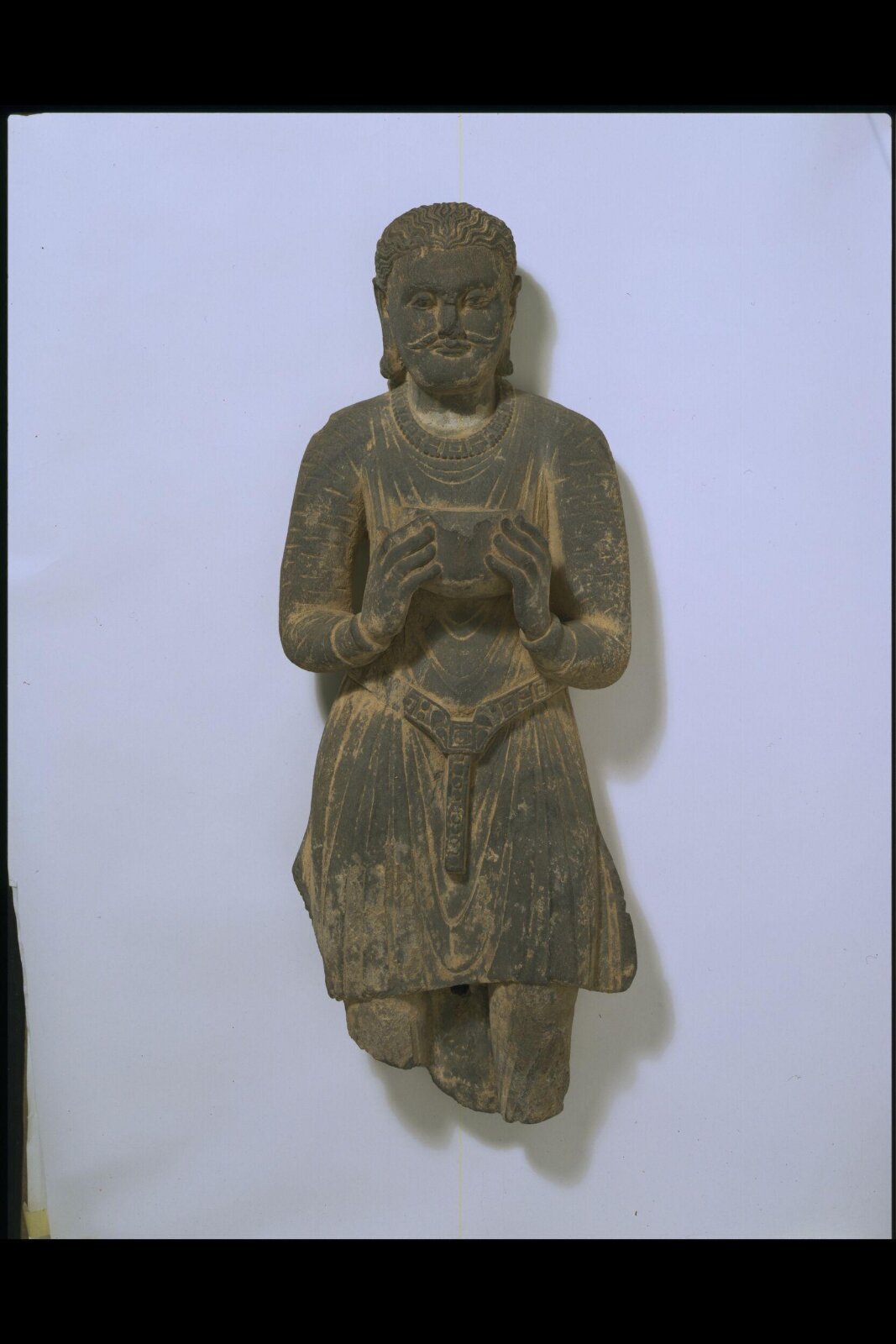
Sculpture
May one see it?
Yes, receiving visitors

Victoria and Albert Museum
RoomSouth-East Asia, Room 47cLondon, United Kingdom
On public display.
- Checked
- 8 days ago
- In this state since
- Sep 25, 2026
- Source
- The museum's own collection data
About the sculpture
Standing figure of male donor, holding a bowl, presumably as an offering to a Buddha represented in a larger composition of which this figure once formed a part. The man is moustached, and dressed in a tunic secured at the waist with a long belt. He wears ear and neck ornaments, establishing his status as a wealthy lay devotee. This is Central Asian style of dress was introduced to India by the Kushans, who formed a powerful kingdom in the second century CE which extended across northern and north-west India. The rulers of the Kushan dynasty (2nd – 4th century CE) were converted to Buddhism early in the history of the dynasty, and they proved to be active patrons of Buddhist monuments and monasteries. Their “northern” capital was in Gandhara, and this region of modern-day Pakistan is rich in a Buddhist legacy from this period.
Read on
This figure once formed part of a larger composition, most probably decorating the base of a stupa platform. He holds in his two raised hands a deep bowl reminiscent of the Buddhist monk’s begging bowl. Presumably it was intended to represent a gift or offering of significant value to warrant depiction in a sculpture of this scale and importance.
Victoria and Albert Museum
Particulars
- Accession number
- 339-1907
In the catalog
Sources
- Victoria and Albert Museum: the museum's own open data · fetched 8 days ago
- Image: Victoria and Albert Museum — © Victoria and Albert Museum, London