Sculpture
May one see it?
Not receiving at present

Victoria and Albert Museum
London, United Kingdom
It belongs to the collection, but is not on display at present.
- Checked
- 8 days ago
- In this state since
- Sep 25, 2026
- Source
- The museum's own collection data
About the sculpture
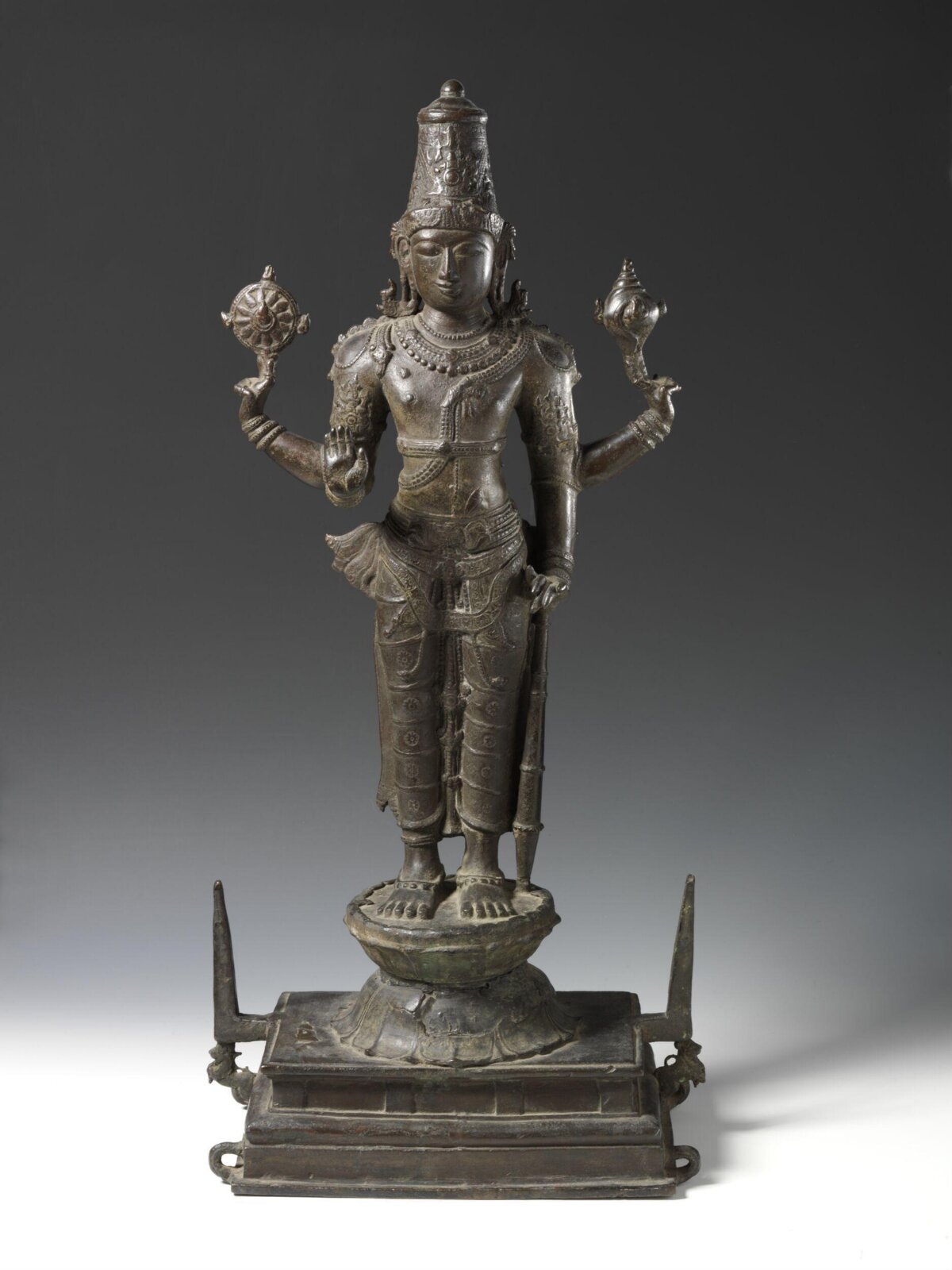
A four-armed standing figure of the god Vishnu in the upright or samabhanga pose. The god stands erect and symmetrical, embodying in his person his cosmic role as the restorer of order and preserver of the universe. His four-armed form allows the display of his principal attributes: the upper right hand holds the flaming wheel (cakra) poised on the tips of the first two fingers; the upper left hand holds the flaming conch (sankha) similarly poised; the lower left, resting on the mace (gada). These are weapons of war – the cakra is a throwing discus, and the conch shell is used as a trumpet of battle, as witnessed in the battle scenes described in the epic Mahabharata. Visnu’s fourth hand, the lower right, is in abhaya-mudra, gesturing protection. These all serve to evoke Visnu’s role as guardian of the universe. The srivatsa, a triangular mark (now much abraded) is visible above the right breast, symbolising the source of the natural world as embodied in Visnu. This mark is also said to invoke Visnu’s consort Laksmi.
Read on
The figure is richly dressed in patterned cloth and jewellery. He wears a tapering conical crown (kirita-mukuta), characteristic of Visnu and particularly elaborate ear pendants (kundala) in the form of rearing makara. The waist-cloth is worn with girdle and sash, the former with long beaded ties extending between the legs, and the latter with projecting bows at the hips. A sacred cord, of beaded design suggestive of pearls, is tied in a bow on the chest. He is adorned with elaborate jewellery, most notably a large torque, armlets (keyura) and a pearl belt with kirttimukha-face buckle.
The figure stands on a circular lotus pedestal, cast in one piece with a rectangular base, the latter with upright tenons for the support of an arched-surround (prabha, now missing) and projecting rings for securing with cord during processional use. The tenons are supported by small rampant lions.
The patination of the bronze confirms that this is an excavated icon. It formed part of a cache of bronze images discovered at Coimbatore and presented to Lord Curzon of Kedleston during his term as Viceroy of India, between 1898 and 1905.
Victoria and Albert Museum
Particulars
- Accession number
- IM.128-1927
What it shows
In the catalog
Sources
- Victoria and Albert Museum: the museum's own open data · fetched 8 days ago
- Image: Victoria and Albert Museum — © Victoria and Albert Museum, London







