 Konstantin Korovin1861–1939
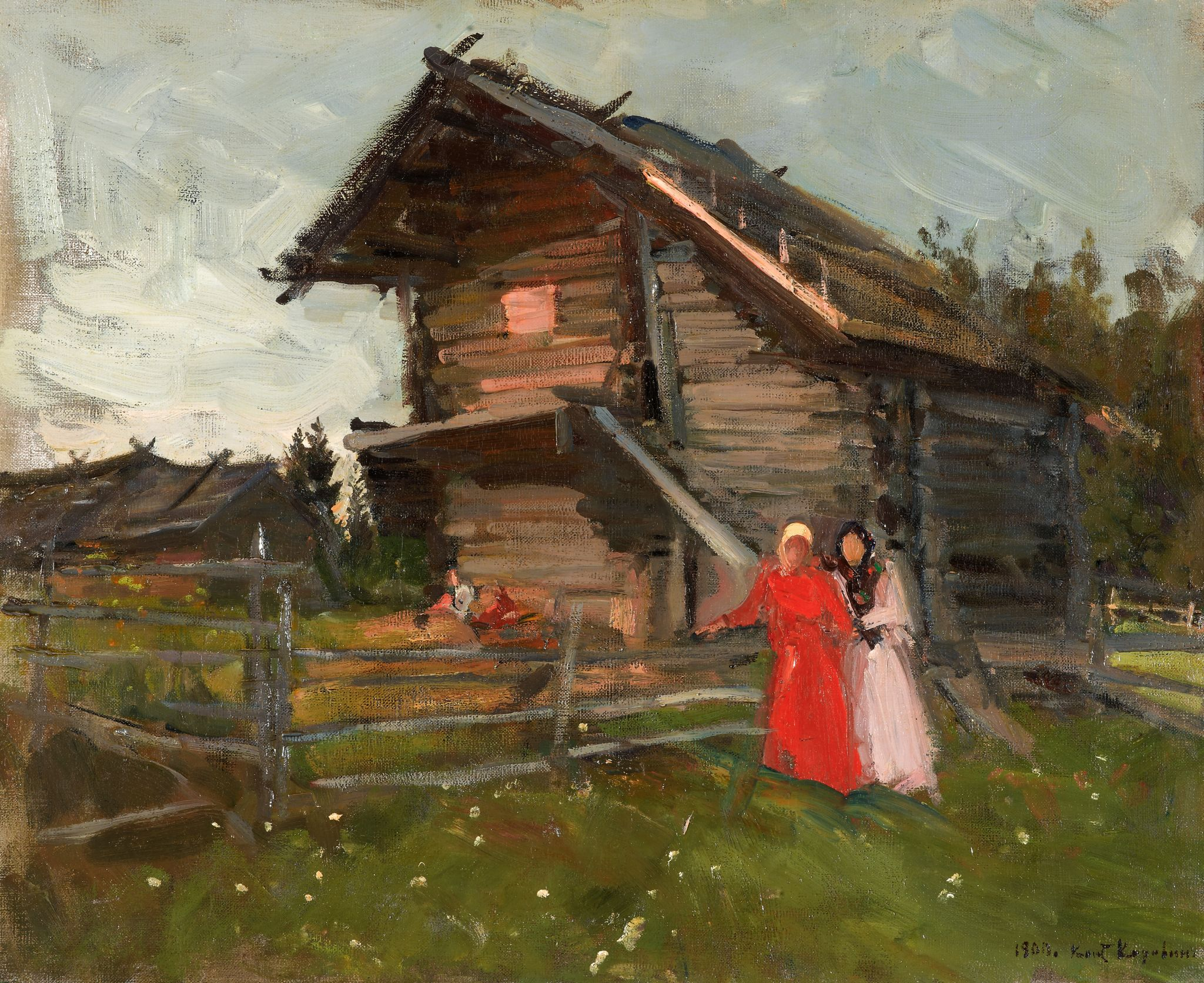
Сарай
May one see it?
Unknown

Tretyakov Gallery
Moscow, Russia
The owner is known; whether it is on view today is not.
- Source
- The museum
About the painting
In the museum's own words — in Russian
Работа «Сарай» – одно из наиболее выразительных зрелых произведений Константина Алексеевича Коровина. Она принадлежит к тому периоду его творчества, когда художественная система мастера уже полностью сложилась, и иллюстрирует основные особенности его живописного языка. В ней реализуется созданный им тип этюда-картины, соединяющий этюдную непосредственность восприятия натуры, случайность момента с построенностью и законченностью картины.
Read on
Коровин не проделал характерный для его современника В. Серова путь от импрессионизма к модерну, оставаясь до конца жизни в пределах импрессионистической системы. Если в ранний период творчества художника пленэр и декоративизм, тенденции импрессионизма и модерна существовали в его искусстве параллельно, то теперь декоративность и экспрессия обогатили коровинский импрессионизм, соединились с ним. Длинный свободный мазок вырастает до размеров бревен, из которых сложен сарай, широкими мазками трактовано небо. Всего несколькими красочными пятнами изображены две женщины, стоящие около плетня, их лица смазаны, а сидящие на лавочке около сарая человеческие фигурки при близком рассмотрении вообще не различимы, и только при взгляде на картину с нескольких шагов из разноцветных мазков складываются изображения людей.
Работа строится на сочетании ярких, насыщенных цветов. Цвет не растворяется в свете, а сохраняет свою интенсивность. При этом художник не выходит за пределы импрессионизма, передавая закатное вечернее освещение и светоцветовые рефлексы на стенах сарая и на земле.
Контрасты зеленого, красного и белого в колорите картины, а также изображение травы с белыми цветами вызывают в памяти написанную ранее в стилистике модерна и близкую к декоративному панно «Северную идиллию» (1892). Однако открытая экспрессия и артистизм, дополненные светоносностью цвета придают этой работе необычайную эмоциональность.
Tretyakov Gallery
Particulars
- Accession number
- 1510
In the catalog
Sources
- Tretyakov Gallery
- Image: Tretyakov Gallery — © State Tretyakov Gallery
Meanwhile, in the life of Konstantin Korovin
The whole life1881–1923 · Workplace
Moscow
1900
The Russian display at the World’s Fair in Paris
Korovin takes part in designing the Russian section: as an architect he designs the building of the Handicraft department, and as author of the exposition he paints 31 decorative panels (now in the Russian Museum). The fair awards him two gold and seven silver medals; other accounts say he designed the Central Asia section of the Russian Empire pavilion.
1900s
The chief designer of the production and tunics instead of corsets
Together with Alexander Golovin, Korovin introduces at the Bolshoi the figure of a chief designer of the production, working as co-author with the director or choreographer (his creative partner is Alexander Gorsky), and proposes replacing ballerinas’ corsets with looser tunics. The set turns from a mere background into a full object of the performance; Korovin regards work on it as just as much “pure art” as painting shown in exhibitions.
1900
Korovin’s name appears for the first time on a state theatre poster
Korovin’s name appears for the first time on the poster of a state theatre: he produces the sets for Alexander Dargomyzhsky’s opera Rusalka.
early 1900s
Moves to the Mariinsky and creates “mood” sets
At the beginning of the 20th century Korovin moves from Mamontov’s opera to the Mariinsky Theatre in St. Petersburg. Departing from traditional decor that only indicated the place of action, he creates mood decor conveying the general emotions of the performance, and also designs sets for Stanislavsky’s dramatic productions.
1901
Begins teaching at the Moscow School
From 1901 Korovin teaches, together with Valentin Serov, at the Moscow School of Painting, Sculpture and Architecture; his pupils include Saryan, Mashkov, Falk, Krymov and Gerasimov. Other accounts say he was a professor at the school in 1909–1913.


![Пруд. Осень, Konstantin Korovin, [Конец 19 в.]](/api/img?u=https%3A%2F%2Fgoskatalog.ru%2Fmuzfo-imaginator%2Frest%2Fimages%2Fpublic%2F1600%2F29700169%2F29700169.jpg)


