Viktor Vasnetsov1848–1926
Русский витязь
Can I see it?
Unknown
Where is “Русский витязь” now? Collection: Ivanovo Regional Art Museum, Ivanovo. Unknown.
Ivanovo, Russia
The owner is known; whether it is on view today is not.
- In this state since
- Source
- The museum
About the painting
Museum text in Russian
На серо-зеленом фоне поколенноеизображение мужчины в черных шароварах и серой рубахе, отделанной красной каймой. Правая рука - на бедре.На серо-зеленом фоне поколенноеизображение мужчины в черных шароварах и серой рубахе, отделанной красной каймой. Правая рука - на бедре.
Ivanovo Regional Art Museum
Details
- Accession number
- ЖР-44
In the catalog
Sources
- The State Catalogue of the Museum Fund of Russia
- Image: Ivanovo Regional Art Museum — © Ивановский областной художественный музей · Госкаталог музейного фонда РФ
In the life of Viktor Vasnetsov
The whole life1878–1880
Mamontov’s commission for the Donetsk Railway
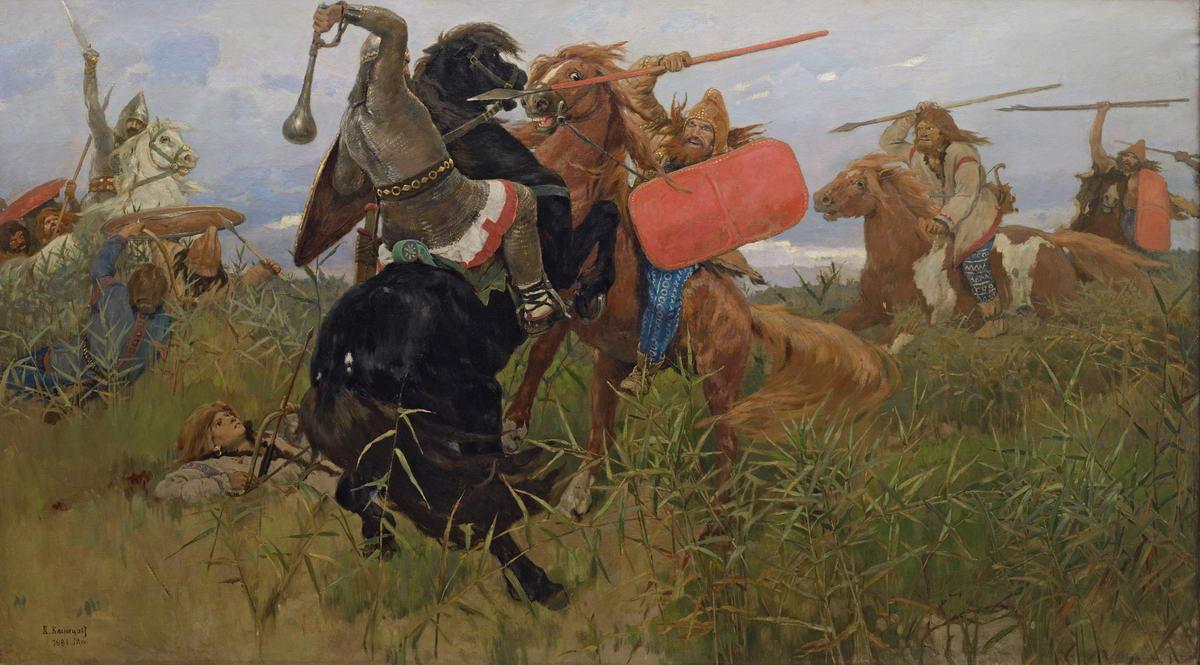
Repin brought him to the house of Savva Mamontov, who commissioned three fairy-tale pictures for the boardroom of the Donetsk Railway — “The Battle of the Russians with the Scythians”, “The Flying Carpet” and “The Three Princesses of the Underground Kingdom” (the princesses of gold, precious stones and coal); the princess Coal, a modest dark-haired girl in a black dress, was especially successful.
1878–1890 · Career
the Peredvizhniki
From 1878 he belonged to the Society of Travelling Art Exhibitions (the Peredvizhniki): he took part in its activity in 1878–1890 and exhibited with it until 1897; he was admitted for the realism and sharp social subjects of his genre paintings.
1879
His daughter Tatyana, the first of five children, is born
In 1879 his daughter Tatyana was born, later an artist and keeper of her father’s legacy; sons followed — Boris (1880), Alexei (1882), Mikhail (1884) and Vladimir (1889).
June 1880
His first visit to Mamontov’s Abramtsevo
In June 1880, with his brother Apollinary, he first came to Abramtsevo at Savva Mamontov’s invitation and joined the circle of Repin, Polenov, Serov and other artists, where he became one of the leaders of the national-romantic current.