Ivan Shishkin1832–1898
Rye Fields
May one see it?
Unknown: the museum keeps its counsel

Tretyakov Gallery
Moscow, Russia
The owner is known. Whether it is on view today, the museum does not say, and we were not trained to guess.
- Source
- The museum's own collection data
About the painting
Rye (Russian: Рожь), sometimes A Rye Field, is an oil painting finished in 1878 by the Russian painter Ivan Shishkin. It depicts a field of rye near the village of Lekarevo, west of Yelabuga in Tatarstan. It measures 107 cm × 187 cm (42 in × 74 in) and is held by the Tretyakov Gallery.
Shishkin was born in 1832 into a Russian merchant family in Yelabuga, then in Vyatka Governorate (today the Republic of Tatarstan), beside the Kama River some 200 km (120 mi) east of Kazan. As with many of his works, this painting draws from the countryside near his early home. It includes two common elements from Shishkin's work: pine trees, and a road leading away from the viewer. Two earlier works in the collection of the Tretyakov, made by Shishkin in the 1860s, show travellers among fields of rye.
Read on
The work is based on a pencil sketch of a field of rye near Lekarevo, which the artist made during a trip with his daughter in 1877, on which he wrote "Эта" (Russian for 'this one'). Notes on another sketch reveal his thoughts: "Раздолье, простор, угодье. Рожь. Божья благодать. Русское богатство" ('Expanse, space, land. Rye. God's grace. Russian wealth')
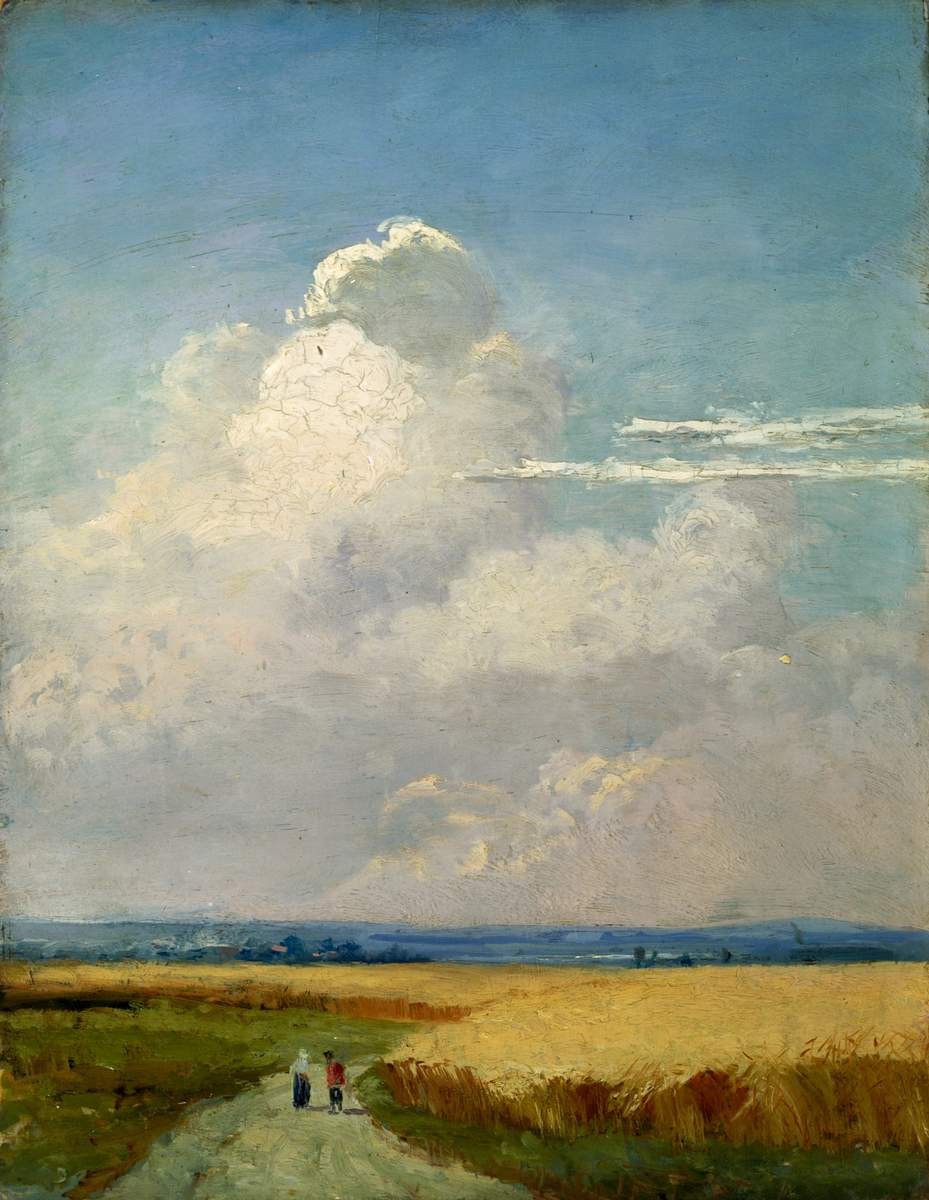
The painting depicts a field of ripening yellow rye among scattered pine trees, ripening under a hazy blue summer sky, but with threatening clouds in the distance. A country track leads off into the field, with the tiny heads of two people barely visible amid the rye. A swallow swoops past the wildflowers beside the track. The large trees amid the crops are survivors of the forest cleared to make the field. The painting is signed and dated in the lower right corner, "И. Шишкинъ. 1878" ('I. Shishkin. 1878').
The completed work was exhibited at the sixth exhibition of the Peredvizhniki (Russian for 'the Wanderers') in 1878. It was bought that year by Pavel Tretyakov, whose collection has grown into the Tretyakov Gallery.
In the museum's own words — the original
Тема стихийной мощи русской природы в картинах Шишкина раскрывалась в суровом величии ее лесов с колоннадами могучих стволов. Его пейзажи дают зрительные аналогии словам-метафорам, существующим в русском языке для описания национального пейзажа – «раздолье», «просторы», «чащобы». В некоторых пейзажах Шишкина звучат «великодержавные» ноты.
Главная тема творчества Шишкина – лес, причем лес, как правило, хвойных, вечнозеленых пород. Любимое время года – лето, любимое время дня – полдень. В отличие от Саврасова и Васильева Шишкин был равнодушен к изменчивым, переходным состояниям природы. И в этом тяготении к устойчивым, неизменным, зрелым формам проявляется своеобразный «классицизм» Шишкина.
Read on
Шишкин не лиричен, он эпичен, монументален, репрезентативен, его мир основан на фундаментальных ценностях – земля, страна, народ, благодать жизни и неба. Монументальная картина требует четкой архитектоники композиции. Так, в знаменитом пейзаже «Рожь» торжественная колоннада сосен уравновешена горизонталью простертого под бледно-голубым небом поля спелой ржи. Сосны четкими силуэтами выделяются на фоне неба. Три основных цвета – желтый, голубой, зеленый – соответствуют трем основным первоэлементам картины – хлеб, небо, деревья. Мир природы связан с жизнью и деятельностью человека. Поспевший урожай – итог его труда и награда за труд и терпение, символ благополучия, божий дар и божья милость. Деревья, обладающие своим индивидуальным характером, статью в пейзажах Шишкина – одушевлены, неслучайно в литературе о Шишкине прижилось их сравнение с васнецовскими богатырями.
Tretyakov Gallery
Particulars
- Accession number
- 837
Sources
- Tretyakov Gallery: the museum's own open data · fetched 5 days ago
- Image: Tretyakov Gallery — Museum open access
Meanwhile, in the life of Ivan Shishkin
The whole life1873, 1878
World's Fairs in Vienna and Paris
He took part in the world's fairs in Vienna (1873) and Paris (1878).
1878
The Album "25 Engravings on Copper"
He published a second album, "25 Engravings on Copper by I. I. Shishkin," prepared for print with the help of his friend, the landscape painter I. V. Volkovsky.
May – October 1879
His Only Trip to the Crimea
Accompanied by the landscape painter Efim Volkov and his pupil Andrei Shilder, he toured the entire southern coast of the Crimea (Gurzuf, Alupka, Alushta, with an ascent of Ai-Petri); he brought back studies, drawings, and pastels, on the basis of which he painted pictures for the 8th Peredvizhniki exhibition of 1880.