ART WIKI32,979 on view
MapCollectionArtistsMuseumsExhibitionsJournal
Sign in

ART WIKI

Where the masterpiece hangs, and when they let you in.

Collections: Art Institute of Chicago, Getty Villa, Harvard Art Museums, Hirshhorn Museum and Sculpture Garden, J. Paul Getty Museum, Minneapolis Institute of Art, Musée du Louvre, National Gallery of Art, National Museum of Asian Art, National Portrait Gallery (Smithsonian), Pushkin State Museum of Fine Arts, Rijksmuseum, Smithsonian American Art Museum, SMK — National Gallery of Denmark, State Hermitage Museum, State Russian Museum, The Cleveland Museum of Art, The Metropolitan Museum of Art, The Museum of Modern Art, Tretyakov Gallery, Victoria and Albert Museum, Whitney Museum of American Art, State Catalogue of the Museum Fund of Russia (274 museums), Europeana (19 museums), Wikidata (6 museums), Paris Musées (12 museums), and Joconde, the French Ministry of Culture's museum database (495 museums). Images belong to their rights holders.

Sections

  • Map
  • Search
  • Collection
  • Masterpieces
  • On view now
  • Artists

More

  • Museums & galleries
  • Exhibitions
  • Journal
  • Where the data comes from
  • Privacy & cookies
HomeMapBrowse
  1. Collection/
  2. Art Institute of Chicago/
  3. Rock-Cut Temple
Rock-Cut Temple, Paul Klee, December 30, 1925
Paul Klee, portraitPaul KleeGerman, 1879–1940

Rock-Cut Temple

December 30, 1925 · Drawing and Watercolor

May one see it?

Not receiving at present

Art Institute of Chicago

Chicago, United States

It belongs to the collection, but is not on display at present.

Checked
3 days ago
In this state since
Aug 19, 2026
Source
The museum
On the mapMuseum page

About the work

A professor at the Bauhaus from 1920 to 1933, Klee often experimented with the systemic use of line. One of Klee’s favored theories, that of the distinction between form and formation through the use of line, is demonstrated here. In this drawing, parallel lines create new architectural structures, highlighting the formative power of the artist and his line. For Klee, the end result, the form, was not important; the act of creation and the limitless possibilities of line were what mattered.

Art Institute of Chicago · CC BY 4.0

Particulars

December 30, 1925 · aged 46
18791940
Accession number
2013.960

In the catalog

Drawings & watercolorsPen and inkModernism20th centuryGermany

Sources

  • Art Institute of Chicago
  • Image: Art Institute of Chicago — © the artist or rights holder

Meanwhile, in the life of Paul Klee

The whole life
  1. 1921–1931

    The preliminary course on the “theory of form”

    Klee developed a preliminary course in the “theory of form” that began with the “point as the beginning of all beginnings”, moving through space, and the “cosmic egg” from which line, spiral, square, circle and cube are born. Students listened to lectures illustrated with Klee’s own abstract watercolours and then painted their own, trying to express movement, balance, flight and tension.

  2. 1923

    Galka Scheyer and the “Blue Four”

    At the instigation of Galka Scheyer the “Blue Four” was formed — Klee, Kandinsky, Lyonel Feininger and Alexej von Jawlensky. Scheyer subsequently organised exhibitions of their work in the United States.

  3. 26 January 1924

    The lecture “On Modern Art” in Jena

    At his exhibition at the Kunstverein in Jena Klee delivered the lecture “On Modern Art” (Über moderne Kunst).

  4. 1924–1925

    Success with the Paris Surrealists

    In 1924 Klee exhibited in Paris for the first time and became a hit with the French Surrealists, who were drawn to his partly morbid motifs. At the Paris Surrealist exhibition of 1925 Max Ernst was impressed by his work.

  5. 1925

    Moving to Dessau with the Bauhaus

    In 1925 the Bauhaus moved to Dessau, and Klee moved with the school.

  6. 1925

    “Pedagogical Sketchbook” is published

    Klee’s theoretical book “Pedagogical Sketchbook” (Pädagogisches Skizzenbuch) is published; five years earlier, in 1920, his essay “Schöpferische Konfession” had appeared.

More by Paul Klee

All works
New House in the Suburbs, Paul Klee, 1924

New House in the Suburbs

1924 · National Gallery of Art

May Picture, Paul Klee, 1925

May Picture

1925 · The Metropolitan Museum of Art

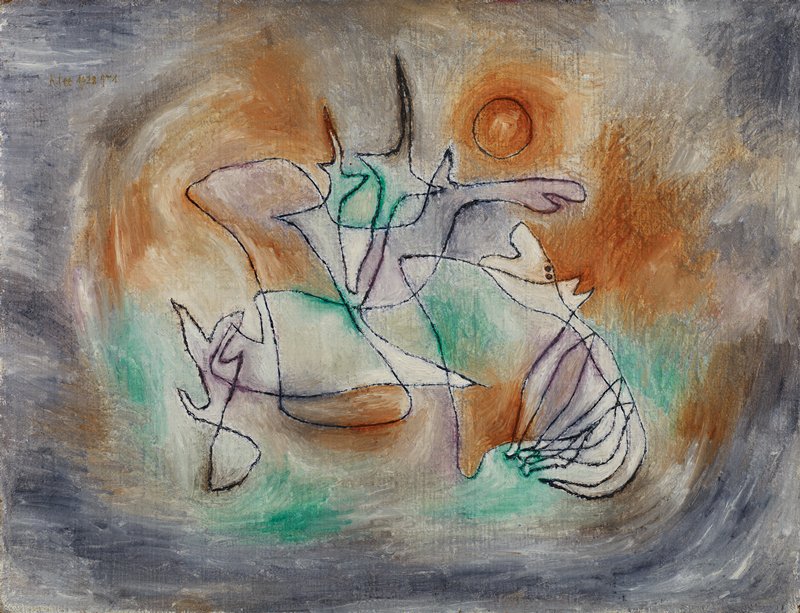
Howling Dog, Paul Klee, 1928

Howling Dog

1928 · Minneapolis Institute of Art

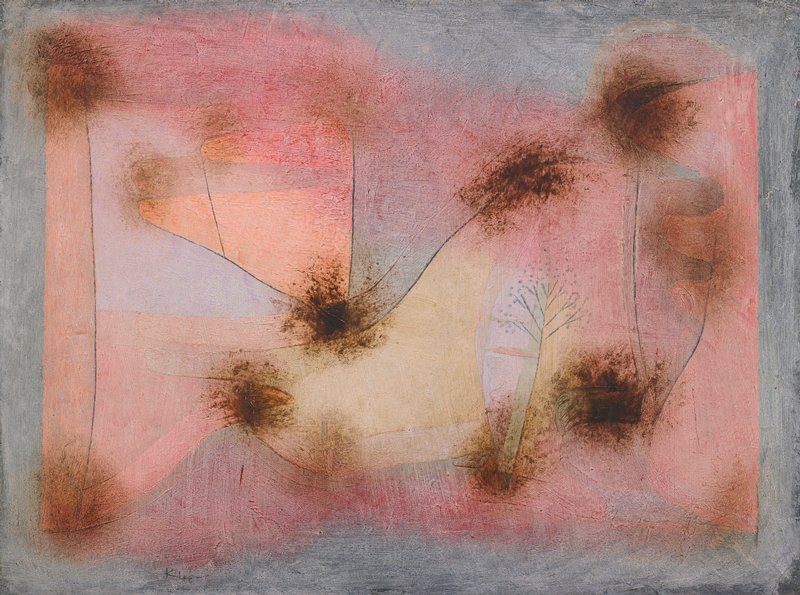
Hardy Plants, Paul Klee, 1934

Hardy Plants

1934 · Minneapolis Institute of Art

Stakim, Paul Klee, c. 1928

Stakim

c. 1928 · Art Institute of Chicago

Fleeing Ghost, Paul Klee, 1929

Fleeing Ghost

1929 · Art Institute of Chicago

In the Magic Mirror, Paul Klee, 1934

In the Magic Mirror

1934 · Art Institute of Chicago

Auslöschendes Licht, Paul Klee

Auslöschendes Licht

Albertina

Neighbors at Art Institute of Chicago

Museum page
The Bedroom, Vincent van Gogh, 1889

Vincent van Gogh

The Bedroom, 1889

A Sunday on La Grande Jatte — 1884, Georges Seurat, 1884–86, border added 1888–89

Georges Seurat

A Sunday Afternoon on the Island of La Grande Jatte, 1884–86, border added 1888–89

Paris Street; Rainy Day, Gustave Caillebotte, 1877

Gustave Caillebotte

Paris Street; Rainy Day, 1877

Two Sisters (On the Terrace), Pierre-Auguste Renoir, 1881

Pierre-Auguste Renoir

Two Sisters (On the Terrace), 1881

The Basket of Apples, Paul Cézanne, c. 1893

Paul Cézanne

The Basket of Apples, c. 1893

Stacks of Wheat (End of Summer), Claude Monet, 1890–91

Claude Monet

Stacks of Wheat (End of Summer), 1890–91

American Gothic, Grant Wood, 1930

Grant Wood

American Gothic, 1930

Nighthawks, Edward Hopper, 1942

Edward Hopper

Nighthawks, 1942