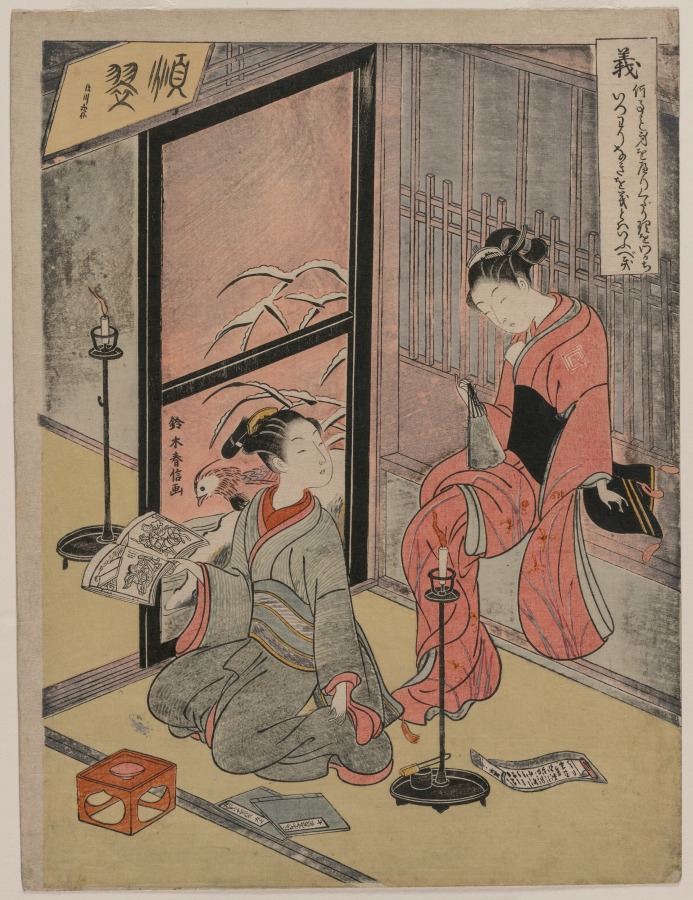
Righteousness, from The Five Virtues
Can I see it?
Not on view at present
Where is “Righteousness, from The Five Virtues” now? Collection: The Cleveland Museum of Art, Cleveland. Not on view at present. Checked September 29, 2026.

Cleveland, United States
It belongs to the collection, but is not on display at present.
- Checked
- In this state since
- Source
- The museum
About the work
Two young male courtesans enjoy reading in their quarters by candlelight. One holds an illustrated book recognizable as the drawing manual Illustrated Book of the Treasure-Bag of Sketches (絵本写宝袋), published in 1720 by Tachibana Morikuni (1679–1748). The poem at the top translates as follows:
In all things to be humble,
discern the path of reason,
and abstain from falsehood.
This is what we call righteousness.
The Cleveland Museum of Art
Details
- Accession number
- 1985.307
In the catalog
Sources
- The Cleveland Museum of Art
- Image: The Cleveland Museum of Art — Museum open access
In the life of Suzuki Harunobu
The whole life1765
The first full-colour nishiki-e prints
The calendar prints became the first nishiki-e (“brocade prints”), and their origin is traced to 1765: Harunobu printed a single image from several separate blocks, up to ten colours on a sheet, and was the first ukiyo-e artist to use more than three colours consistently; notches and wedges held the paper in place so that the successive printings stayed in register. Paid for by wealthy patrons, he used the best materials — cherry wood instead of catalpa and more expensive colours applied more thickly for a more opaque effect.
1765–1770
Five years at his peak: 20 books and a thousand prints
Between 1765 and 1770 Harunobu created over twenty illustrated books, over one thousand colour prints (other accounts give more than eight hundred works) and a number of paintings.
1765–1770
Recognised as the master of ukiyo-e and widely imitated
In the last years of his life Harunobu came to be regarded as the master of ukiyo-e and was widely imitated: many artists copied his style during his lifetime.
late 1760s
Master of bijin-ga and scenes of Edo life
Harunobu became one of the primary producers of pictures of beautiful women (bijin-ga) and scenes of urban life for the Edo print connoisseur market: his prints include not only geisha, courtesans and sumo wrestlers but also street vendors and errand boys. Accounts differ on portraits of kabuki actors: by some he was among the first to paint them, by others he scornfully refused the subject.