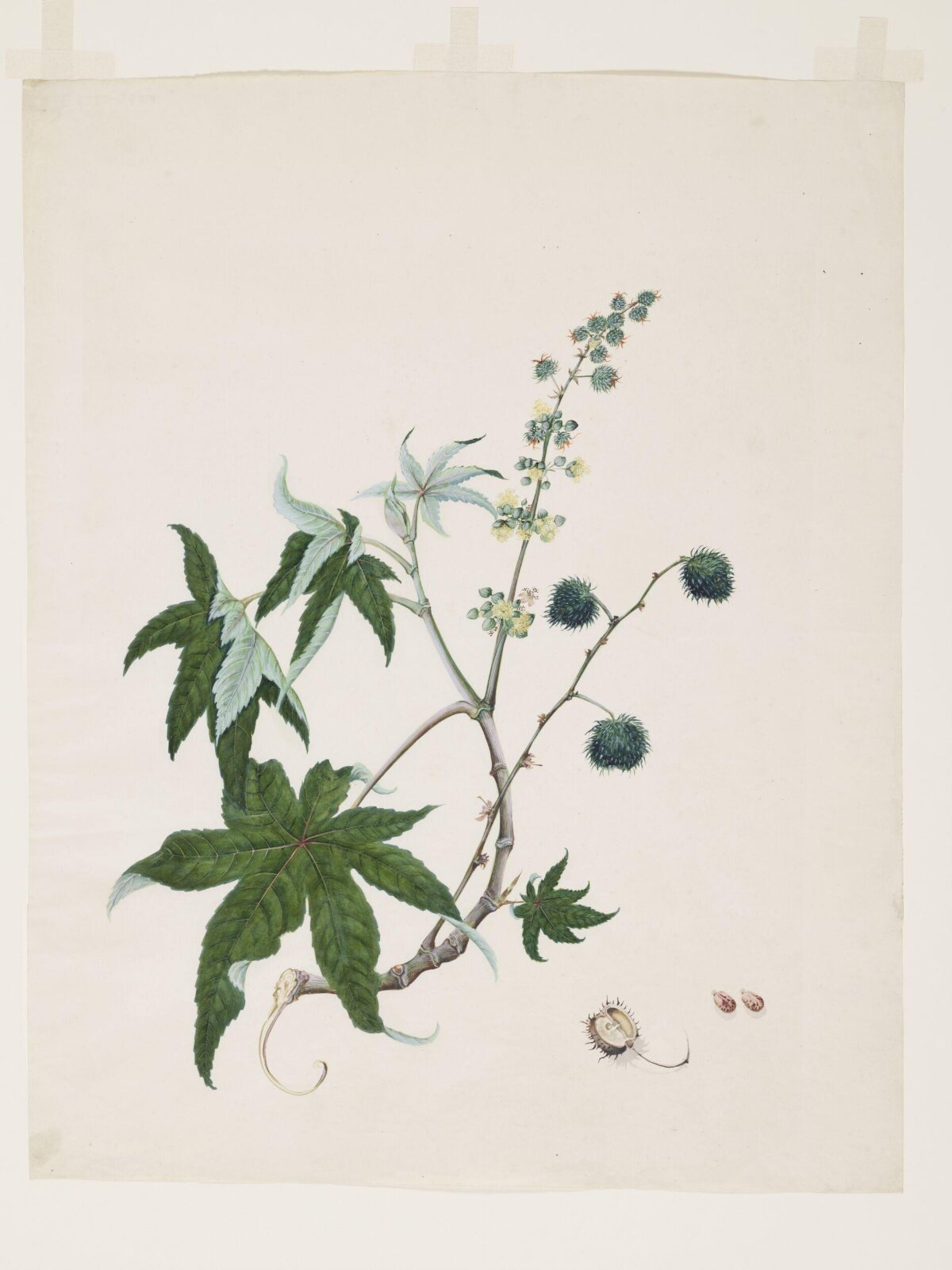
Ricinus communis L.
May one see it?
Not receiving at present

Victoria and Albert Museum
London, United Kingdom
It belongs to the collection, but is not on display at present.
- Checked
- 9 days ago
- In this state since
- Sep 25, 2026
- Source
- The museum's own collection data
About the work
In the late 18th century European gardeners and plantsmen and women became more and more interested in plants from China. Many of our most familiar garden plants such as tree paeonies, magnolias and camellias were introduced from China during this period as a consequence of trading contacts and plant hunting expeditions.
Read on
In China, foreigners were confined to the island of Macao and allowed into Canton only when their ships were in port. Consequently collectors and botanists commissioned paintings of Chinese plants from native artists in the trading ports. Although China had a long tradition of naturalistic flower painting the Chinese artists were given examples of European illustration to copy and were trained in the western conventions of botanical drawing. They were adept copyists, but the Chinese drawings always retain a distinctive character that makes them unmistakable. The modelling of the forms is always rather solid, and done in two contrasting flat tones. The native Chinese style of painting involved abstraction and idealization of natural forms; when following Western instruction to give precise details in order that the plant might be identified and classified, the Chinese artist gave a literal transcripton of the individual specimen with all its unique features.
Victoria and Albert Museum
Particulars
- Accession number
- E.1737-1924
What it shows
In the catalog
Sources
- Victoria and Albert Museum: the museum's own open data · fetched 9 days ago
- Image: Victoria and Albert Museum — © Victoria and Albert Museum, London