Viktor Vasnetsov1848–1926
Река Вятка
Can I see it?
Unknown
Where is “Река Вятка” now? Collection: Ryazan Oblast State Art Museum named after I.P. Pojalostin, Ryazan. Unknown.
The owner is known; whether it is on view today is not.
- In this state since
- Source
- The museum
About the painting
Museum text in Russian
Изображение реки среди лугов. На втором плане пашня, далее луг со стадом и лес.
Ryazan Oblast State Art Museum named after I.P. Pojalostin
Details
- Accession number
- Ж-751
In the catalog
Sources
- The State Catalogue of the Museum Fund of Russia
- Image: Ryazan Oblast State Art Museum named after I.P. Pojalostin — © Рязанский государственный областной художественный музей им. И. П. Пожалостина · Госкаталог музейного фонда РФ
In the life of Viktor Vasnetsov
The whole life1873–1875
He leaves the Academy before graduating
In 1873, a year before the end of the course, he almost stopped attending the Academy and went only to Chistyakov’s studio: Chistyakov told him he had already got from the Academy all it could give, and Kramskoi advised the same; on 4 (16) February 1875 he was formally discharged, receiving a certificate that listed two small silver medals and one large one.
1876–1877
Mamontov’s letter, homesickness and the first sketch for the “Bogatyrs”
In Polenov’s Paris studio he and Repin re-read a letter from Savva Mamontov calling the artists to Moscow; the letter sharpened his homesickness (“Alone, alone and alone!”), and it was there that the first painted sketch of the “Bogatyrs” was made.
November 1877
Wedding to Alexandra Ryazantseva
Before leaving for Paris he had proposed to Ryazantseva; the wedding took place in November 1877 in the Church of Saints Peter and Paul of the Semyonovsky-Alexandrovsky military hospital in St Petersburg.
1878
He moves to Moscow, the city of his life’s work
In 1878, his resolve strengthened by Mamontov’s letter, he moved to Moscow, the city to which most of his creative life would be tied: he settled in a small flat in 3rd Ushakovsky Lane near Ostozhenka, walked the city for hours admiring the Kremlin and St Basil’s, and until 1885 the family changed rented flats in Moscow six times.
1878–1880
Mamontov’s commission for the Donetsk Railway
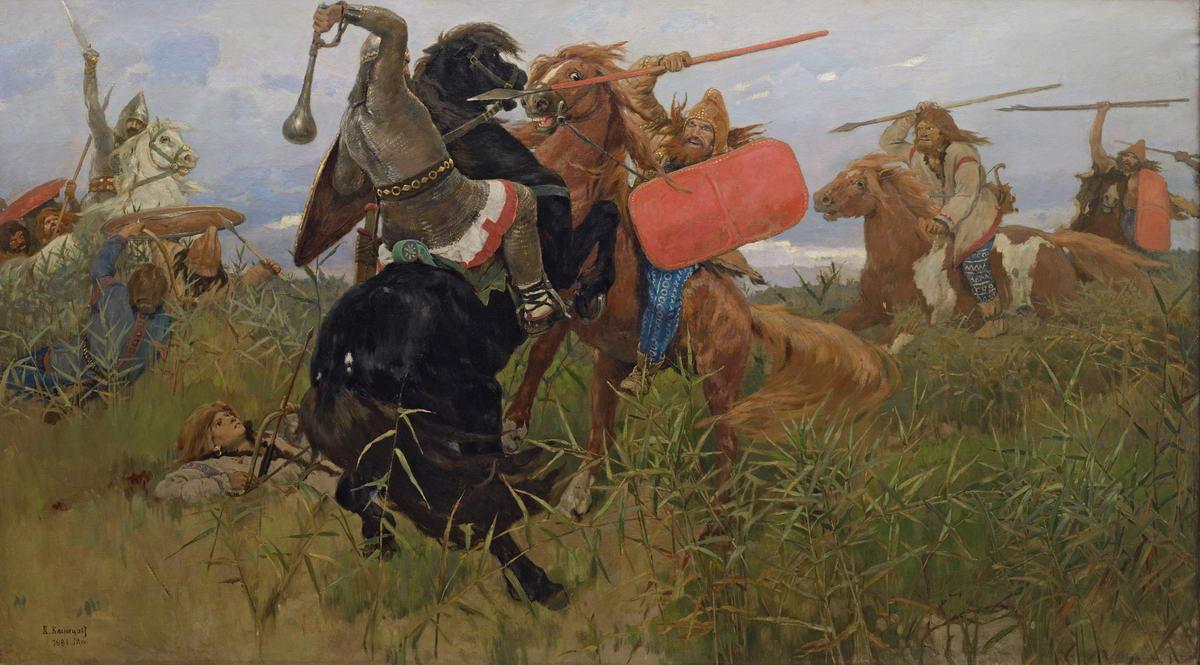
Repin brought him to the house of Savva Mamontov, who commissioned three fairy-tale pictures for the boardroom of the Donetsk Railway — “The Battle of the Russians with the Scythians”, “The Flying Carpet” and “The Three Princesses of the Underground Kingdom” (the princesses of gold, precious stones and coal); the princess Coal, a modest dark-haired girl in a black dress, was especially successful.
June 1880
His first visit to Mamontov’s Abramtsevo
In June 1880, with his brother Apollinary, he first came to Abramtsevo at Savva Mamontov’s invitation and joined the circle of Repin, Polenov, Serov and other artists, where he became one of the leaders of the national-romantic current.