Red Plank
Can I see it?
Not on view at present
Where is “Red Plank” now? Collection: Art Institute of Chicago, Chicago. Not on view at present. Checked November 23, 2026.

Chicago, United States
It belongs to the collection, but is not on display at present.
- Checked
- In this state since
- Source
- The museum
About the sculpture
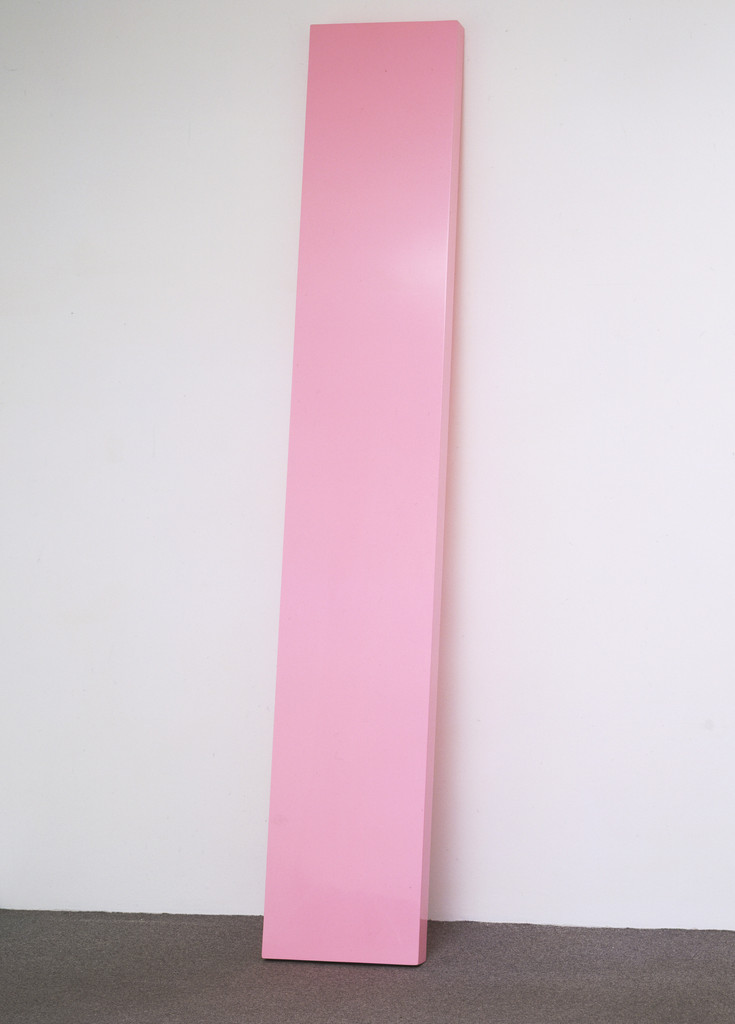
John McCracken was a pioneering figure of West Coast Minimalism in the 1960s, when many California artists were concerned with issues of light and color. Having begun his career as a painter, he moved toward a more object-based aesthetic, making abstract works in the form of basic geometric shapes such as cubes or quadratic volumes. In 1966 he developed what became his signature sculptural forms: tall, leaning planks made of wood, coated in fiberglass, and then painted with a highly finished lacquer. Striking in their monolithic simplicity and characterized by pure, monochromatic surfaces, McCracken’s handcrafted “planks,” which rest on the floor and lean against the wall, successfully blur the boundary between painting and sculpture.
Read on
John McCracken is considered a Minimalist sculptor with a singularly spiritual bent. He lacquered basic geometric volumes to lustrous effect, and California car culture often motivated his color choices (cars were “mobile color chips,” he once said), but he strove to make objects that were also “hallucinatory” or “other-wordly.” From 1966 forward McCracken’s signature form was the vividly monochrome “plank,” of which Red Plank is a prime example—stately, monolithic, yet leaning casually against the gallery wall.These sleek sculptures exist “between two worlds,” the artist explained, “the floor representing the physical world of standing objects, trees, cars, buildings, human bodies . . . and the wall representing the world of the imagination, illusionist painting space, [and] human mental space.”
Art Institute of ChicagoCC BY 4.0
Details
- Accession number
- 1970.294
What it shows
In the catalog
Sources
- Art Institute of Chicago
- Image: Art Institute of Chicago — © the artist or rights holder