 Isaac Levitan1860–1900
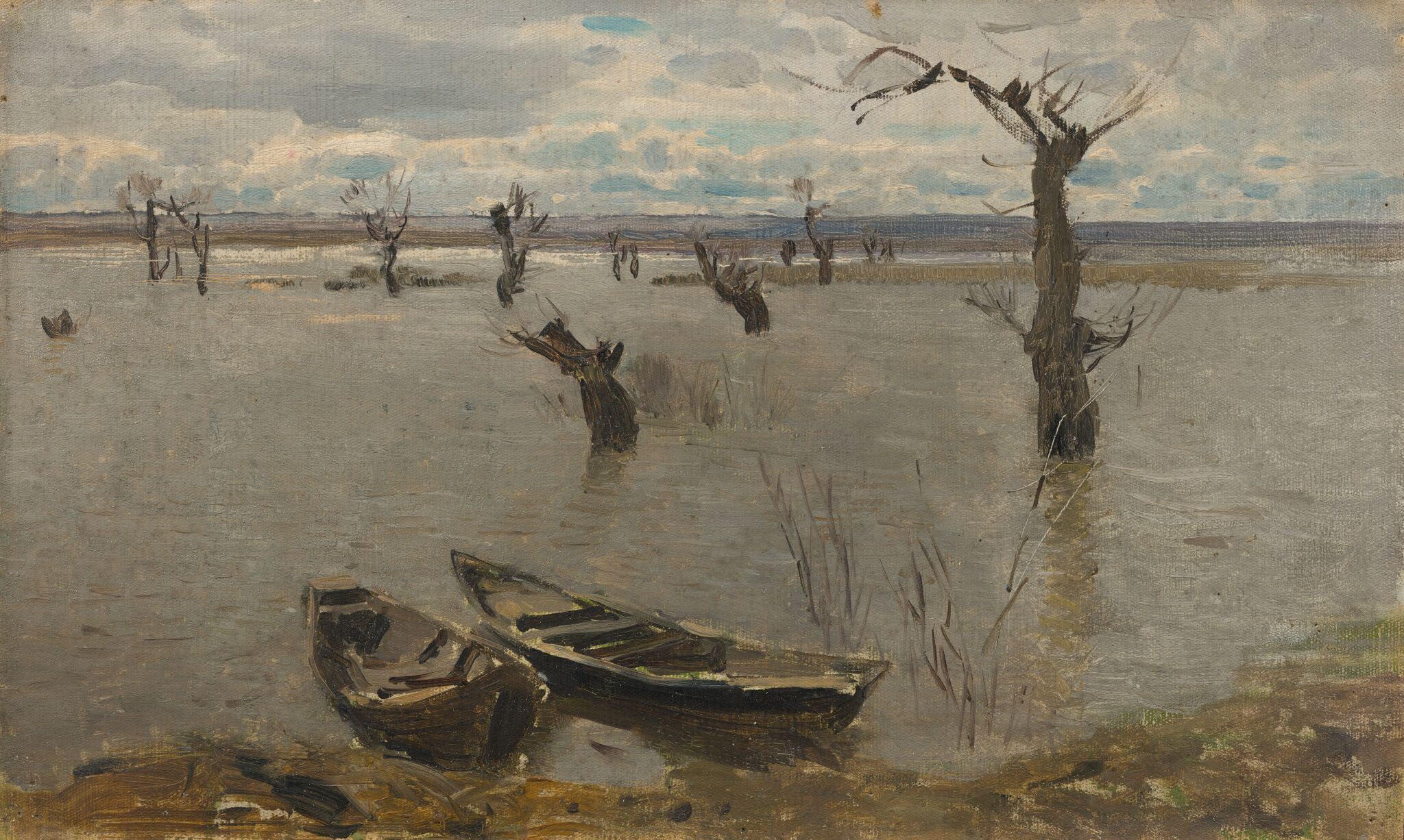
Разлив. Этюд
Can I see it?
Unknown
Where is “Разлив. Этюд” now? Collection: Tretyakov Gallery, Moscow. Unknown.

Moscow, Russia
The owner is known; whether it is on view today is not.
- Source
- The museum
About the painting
Museum text in Russian
Впервые Левитан побывал на Волге в 1887 году. Это были весенние месяцы – апрель, май. Художник уехал из Москвы один и выбрал местом для работы и жизни маленький городок в Нижегородской губернии Васильсурск, расположенный при впадении реки Суры в Волгу. Высокий берег, на котором теснились дома, церкви, избы, очень привлекателен: эти места за их живописность называли волжской Швейцарией. Но весна того года была поздней, с затяжными холодными дождями, серым низким небом и долго не спадающим половодьем. В холодной воде печально стояли деревья с корявыми стволами и распростертыми в стороны обнаженными ветвями. Пронизывающие ветры и дожди не давали художнику возможности работать, ради чего он и поехал на встречу с великой рекой.
Read on
Левитан был разочарован «чрезвычайно»; он ждал от Волги «сильных художественных впечатлений, а взамен этого она показалась мне настолько тоскливой и мертвой, что у меня заныло сердце...» Именно такое настроение отразилось в натурном этюде «Разлив», который стал одним из подготовительных для картины «Разлив на Суре» (1887, частное собрание). Этюд с разлившейся до горизонта рекой, низким небом с бегущими тучами и брошенными у берега лодками полон такой печали и тоски, что и зрителю передается состояние, которое переживал когда-то Левитан. Человек чуткой души, сложной, очень подвижной нервной организации, он в каждой работе был предельно искренним и стремился выразить всю сложную гамму чувств, что наполняли его душу.
В Москву он привез десятки этюдов с видами Волги, Васильсурска, окрестностей городка, уютных пасек. Тогда же он начал картину «Вечер на Волге» (1887–1888, Третьяковская галерея), в которой обобщил свои впечатления от могучей реки. Левитан завершил работу на следующий год, но уже в других волжских местах.
Tretyakov Gallery
Details
- Accession number
- Ж-239
In the catalog
Sources
- Tretyakov Gallery
- Image: Tretyakov Gallery — © State Tretyakov Gallery
In the life of Isaac Levitan
The whole lifemid-1880s
His heart disease sharply worsens
Levitan's material situation improves in the mid-1880s, but a hungry childhood, an unsettled life and hard work tell on his health: his heart disease sharply worsens.
spring 1885
He graduates without the title of artist
In spring 1885, at twenty-four, he graduates from the school but does not receive the title of artist: he is given a diploma as a teacher of penmanship. He has no money.
April 1885
He settles at Maximovka and meets Chekhov
In April 1885 he settles in the remote village of Maximovka near Babkino, where the Chekhovs are staying at the Kiselyov estate; his acquaintance with Anton Pavlovich Chekhov begins a friendship and rivalry that will last all his life.
1886
The Crimea and an exhibition of fifty landscapes
A trip to the Crimea in 1886 restores his strength; on his return Levitan organises an exhibition of fifty of his landscapes.
spring 1888
He discovers Plyos on the Volga
In spring 1888 he sails by steamer along the Oka to Nizhny Novgorod and on up the Volga with the artist Alexei Stepanov and Sofia Kuvshinnikova; to their own surprise they discover the small, quiet town of Plyos and decide to stay on for a while. The three summer seasons there (1888–1890) prove extremely productive: some two hundred works bring Levitan wide fame.
late 1889 – early 1890
His first trip to Western Europe
He visits France and Italy, wanting to get to know modern painting better as shown at the World Exhibition in Paris — probably above all the Barbizon school and the Impressionists. According to Nesterov, in the West he became convinced that the path he had chosen was the right one.