Qadam Khan
May one see it?
Not receiving at present

Victoria and Albert Museum
London, United Kingdom
It belongs to the collection, but is not on display at present.
- Checked
- 8 days ago
- In this state since
- Sep 25, 2026
- Source
- The museum's own collection data
About the painting
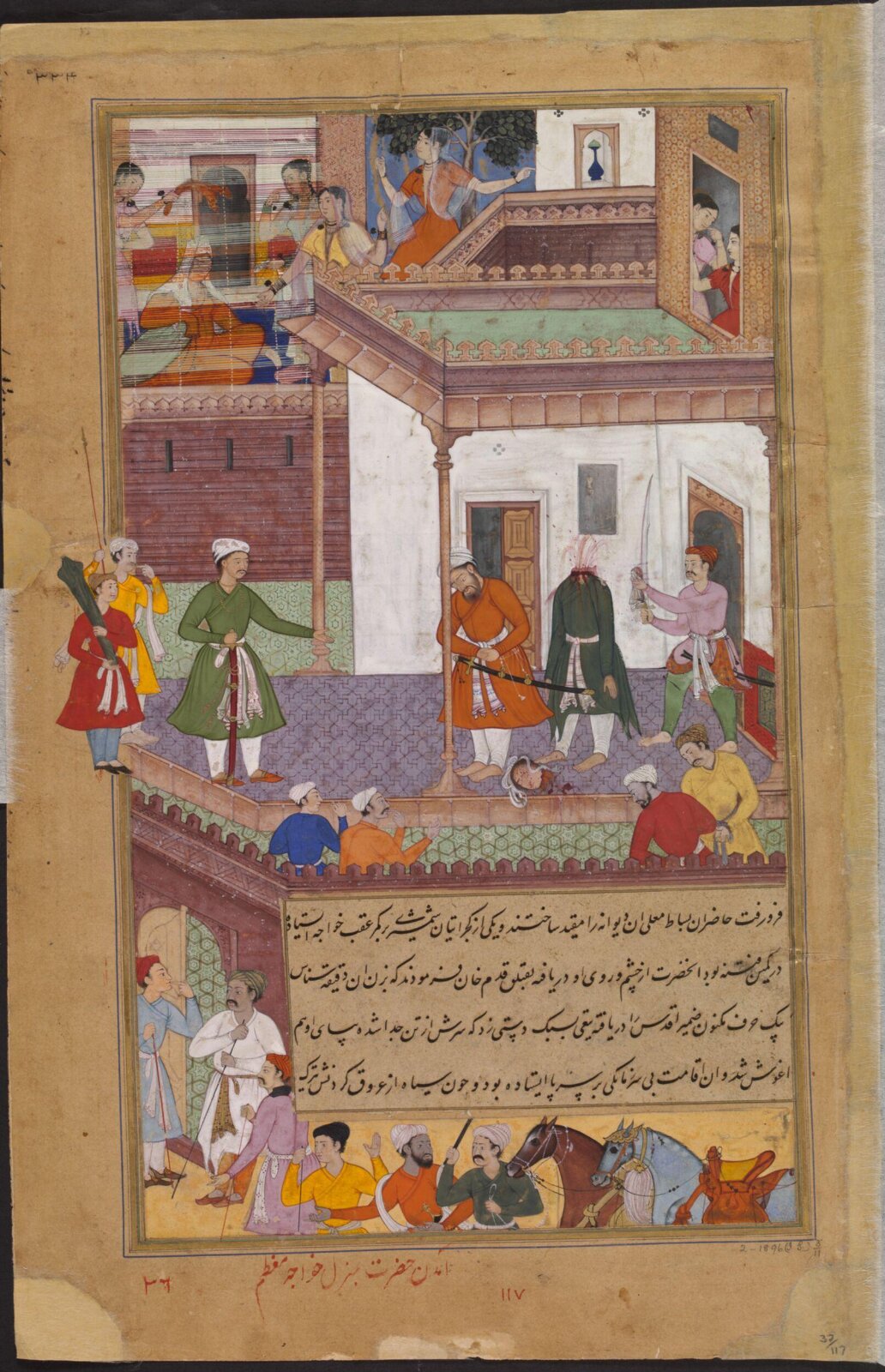
In 1564, the Mughal emperor Akbar visited the house of his uncle, Khwaja Mu’azzam, to order him not to remove his wife from the capital, Agra. Zuhra Agha had already received death threats from her husband, and her mother feared that if she was taken away Khwaja Mu'azzam would carry out his threat. On hearing that the emperor's arrival was imminent, Khwaja Mu'azzam became frenzied and stabbed Zuhra Agha, killing her. When Akbar entered the house, his companions tied up the murderer, but the emperor sensed that one of the domestic servants was about to kill him. He swiftly ordered one of his own men, Qutlaq Qadam Khan, to strike first. The unnamed artists who designed the composition and applied the colours vividly depict the incident described in the Persian text.
Read on
The would-be attacker was instantly decapitated and, in the words of Henry Beveridge's English translation, ‘for a moment the trunk remained standing and the black blood spouted from the arteries of the neck’. The event was illustrated in this partial copy of the text written by Abu'l Fazl between about 1590 and 1595. On the reverse is another painting (IS.2:38-1896) thought to be by the same, unidentified artist.
The Akbarnama (Book of Akbar) was commissioned by the emperor Akbar in 1589 as the official chronicle of his reign. It was written by Abu'l Fazl and substantially complete by 1596. The illustrations were being prepared as the historian drafted and rewrote the textby at least 49 different artists from Akbar's Ketabkhana, or "House of Books", where manuscripts were stored as well as created.. After Akbar's death in 1605, this incomplete manuscript remained in the library of his son, Jahangir (r. 1605-1627), who recorded his ownership on the flylife. The Museum purchased it in 1896 from Mrs Frances Clarke, the widow of Major-General John Clarke who bought it in India while serving as Commissioner of Oudh between 1858 and 1862.
Victoria and Albert Museum
Particulars
- Accession number
- IS.2:37-1896
What it shows
In the catalog
Sources
- Victoria and Albert Museum: the museum's own open data · fetched 8 days ago
- Image: Victoria and Albert Museum — © Victoria and Albert Museum, London