 El LissitzkyRussian, 1890–1941
Проун
May one see it?
Unknown

Tretyakov Gallery
Moscow, Russia
The owner is known; whether it is on view today is not.
- In this state since
- Source
- The museum
About the work
In the museum's own words — in Russian
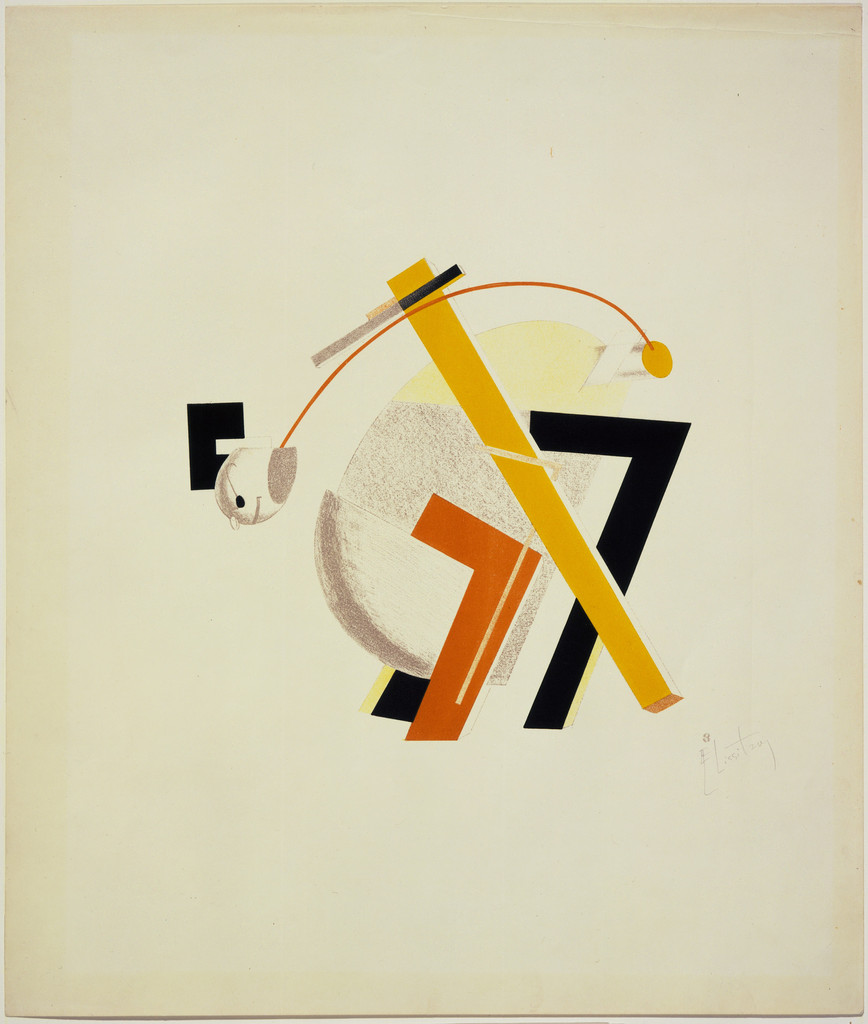
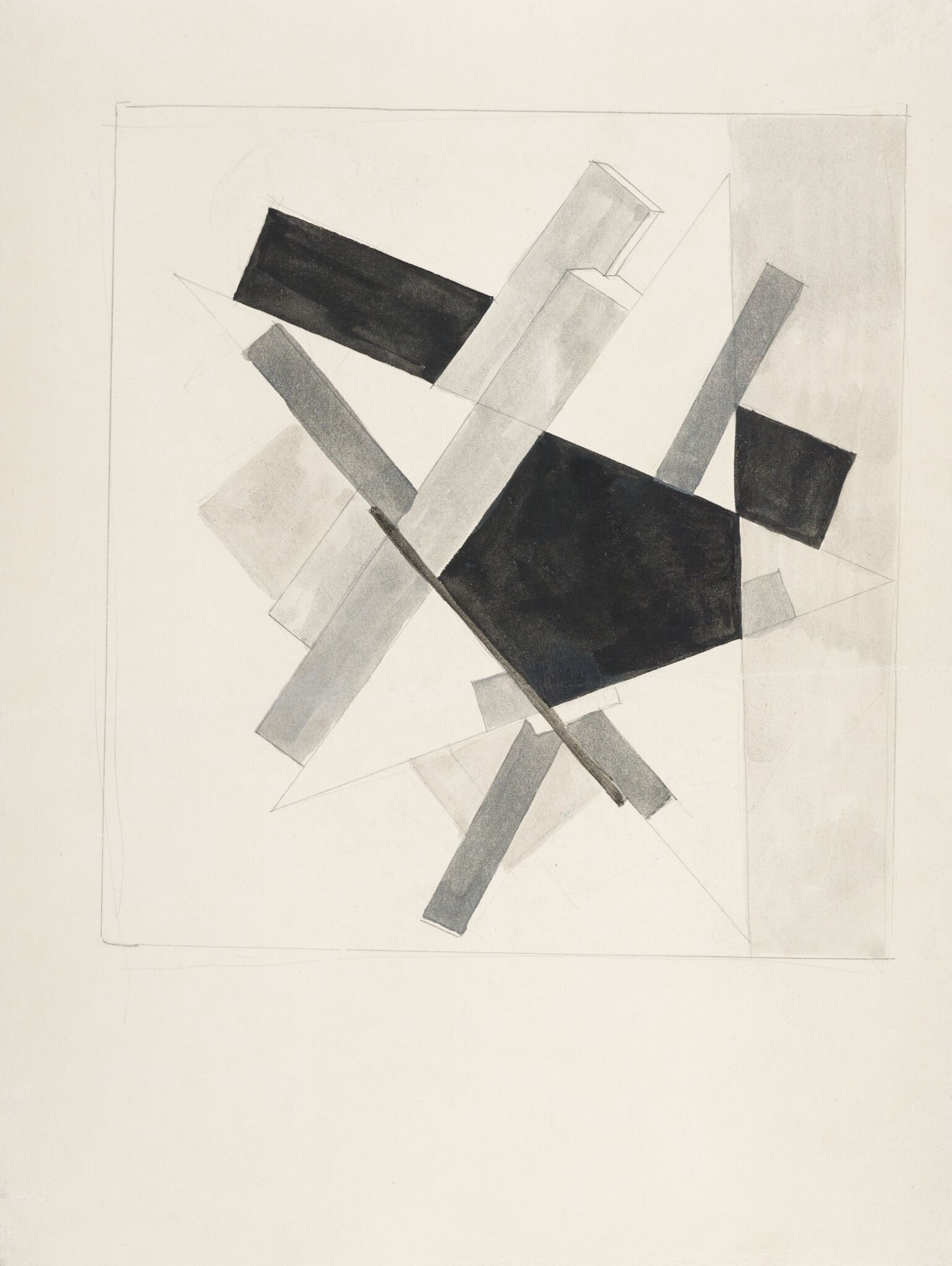
Среди проунов Лисицкого существовало не так много работ с конкретными названиями, уточняющими характер композиции, чаще всего они имели буквенно-числовое обозначение (1 С, 2 D, 5 А, и т.д.). Название «Звезда» имеет документальное подтверждение: существовала живописная работа 1922 года с таким названием (ее местонахождение неизвестно), принятая на временное хранение в музей Асконы. Неизвестно, имеет ли рисунок из коллекции Третьяковской галереи отношение к этому живописному проуну. Однако в рисунке обнаруживается явное композиционное сходство с одним из вариантов обложки каталога Первой выставки русского искусства в 1922 году.
Read on
Лисицкий часто использовал одну и ту же композицию с некоторыми вариациями в разных областях своего творчества. Геометрическая конструкция некоторых проунов могла служить основой для ряда полиграфических работ, или ‒ наоборот ‒ решение, найденное для оформления обложки, могло получить дальнейшее развитие в станковом произведении.
Tretyakov Gallery
Particulars
- Accession number
- АРХ ГР-3612
In the catalog
Sources
- Tretyakov Gallery
- Image: Tretyakov Gallery — © State Tretyakov Gallery
Meanwhile, in the life of El Lissitzky
The whole life1919–1920
Choosing Malevich and breaking with Chagall
Malevich replaces the school's classical teaching programme with his own and spreads suprematist theory school-wide; Lissitzky, still loyal to Chagall, is torn between two opposing paths but ultimately favours suprematism and breaks away from traditional Jewish art, and Chagall leaves the school shortly afterwards — he later recalled that his most zealous disciple, the moment he was appointed professor, went over to his opponents' camp. Lissitzky designs Malevich's book “On the New System in Art”, printed in 1,000 copies — an enormous number for an art book.
17 January – February 1920
Malevich and Lissitzky found Molposnovis, which becomes UNOVIS
On 17 January 1920 Malevich and Lissitzky co-found the short-lived group Molposnovis (“Young Followers of a New Art”); after a brief and stormy dispute and two rounds of renaming, it re-emerges in February as UNOVIS, the “Exponents of the New Art”. The group, disbanded in 1922, was pivotal in spreading suprematist ideology and launched Lissitzky's status as a leading figure of the avant-garde; its members signed works with a black square, while Lissitzky used a red one.
1921
Leaving for Germany as a “cultural emissary”
In 1921, as UNOVIS declines and suprematism begins to fracture into a utopian, spiritual half and a utilitarian one, Lissitzky aligns with neither and leaves Vitebsk: he takes a job as a “cultural emissary” of Soviet Russia and moves to Weimar Berlin to establish contacts between Russian and German artists — what exactly he did in this role remains unclear. In 1921–1925 he lives in Germany and Switzerland.
1922
First solo exhibition in Hanover
The year after the publication of his first Proun series in 1921, Kurt Schwitters introduces Lissitzky to the Hanover gallery Kestnergesellschaft, where he holds his first solo exhibition. The second Proun series, printed in Hanover in 1923, is a success.
1923
The Proun Room at the Great Berlin Art Exhibition
In 1923, for the Great Berlin Art Exhibition, Lissitzky transforms a small room (about 3 by 3 by 2.5 m) into a single work of art, the Proun Room, which lets viewers “walk into an image” and become active participants. He violates the unwritten rule of rejecting the commercialization of art by putting price tags on three elements of the room; the price tags, together with his “half-dance” during the demonstration of the room, alienate his friend Theo van Doesburg.
1923–1924
Tuberculosis and a Swiss hospital
In 1923–1924 Lissitzky is severely ill with tuberculosis and stays in a Swiss hospital; at this time he is reported even to have considered suicide. He will die of tuberculosis in 1941.