 El LissitzkyRussian, 1890–1941
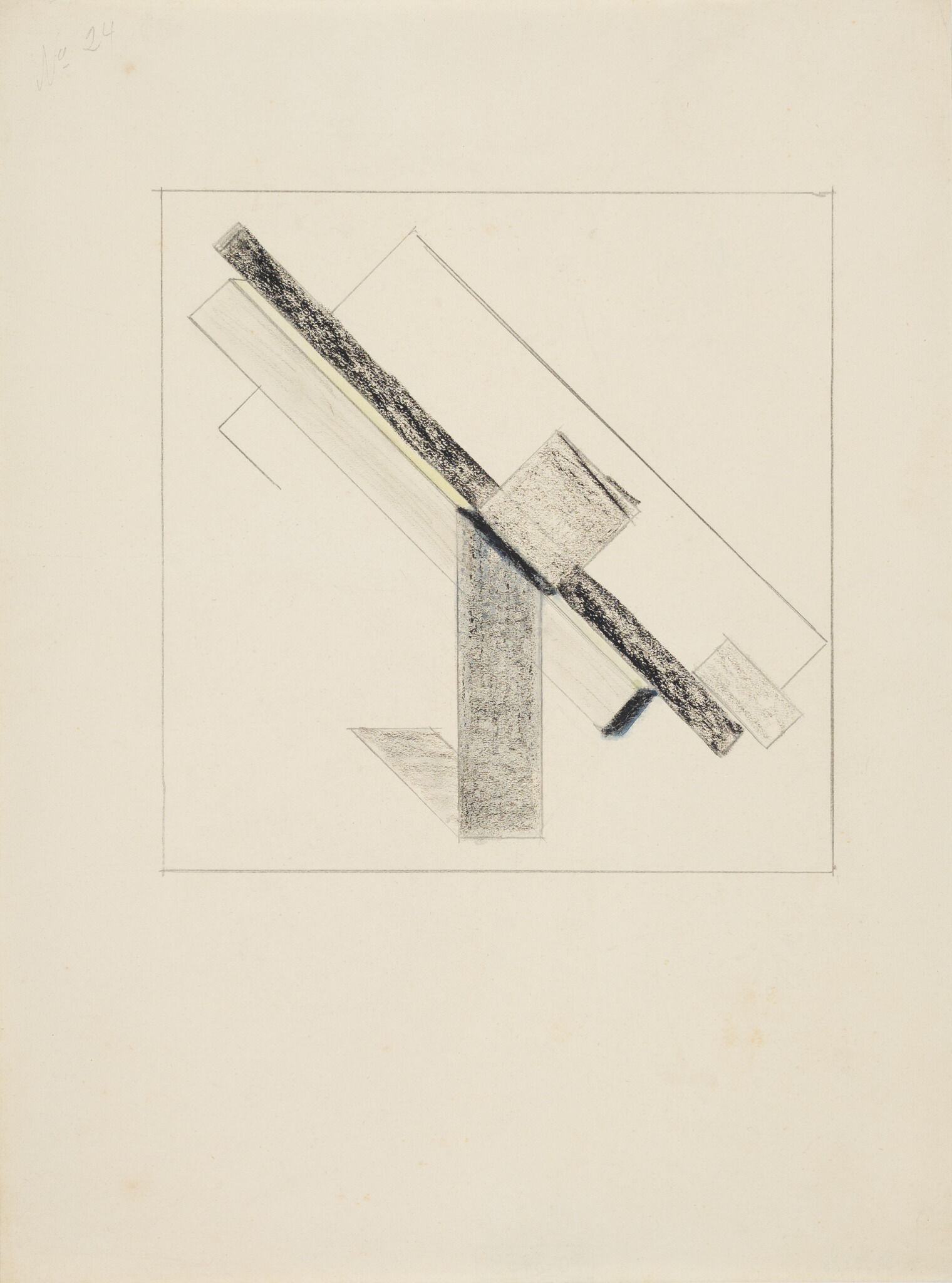
Проун 55
May one see it?
Unknown

Moscow, Russia
The owner is known; whether it is on view today is not.
- In this state since
- Source
- The museum
About the work
In the museum's own words — in Russian
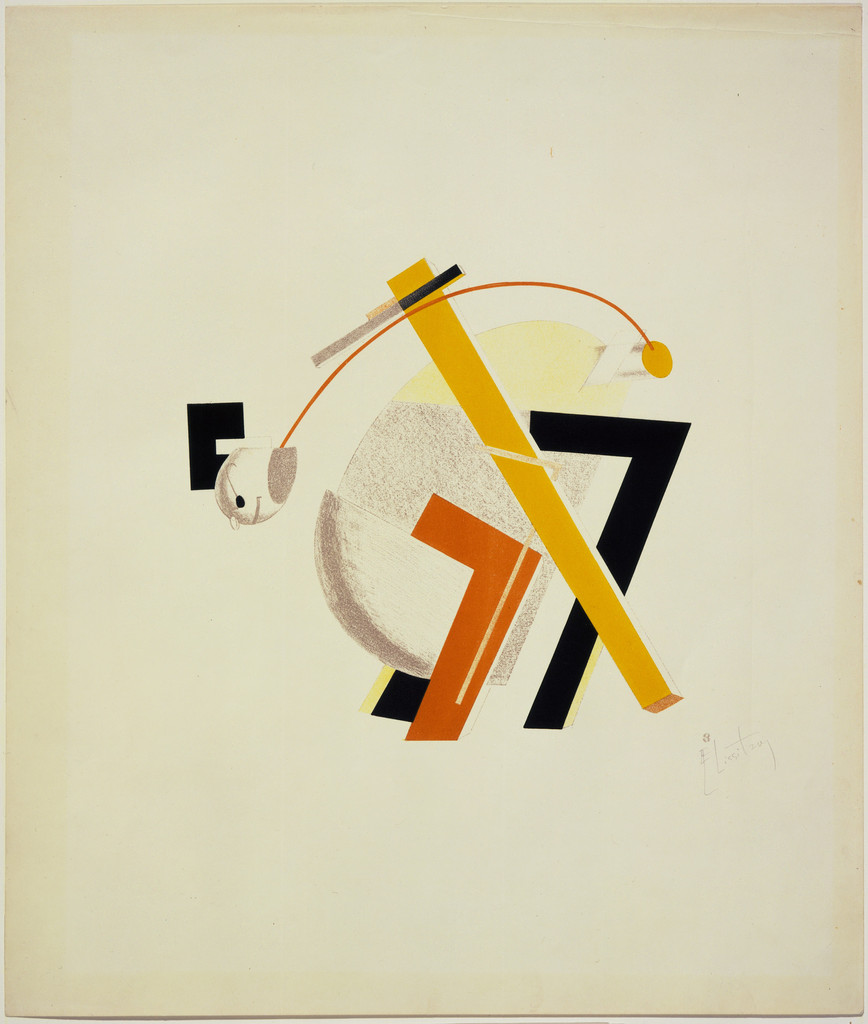
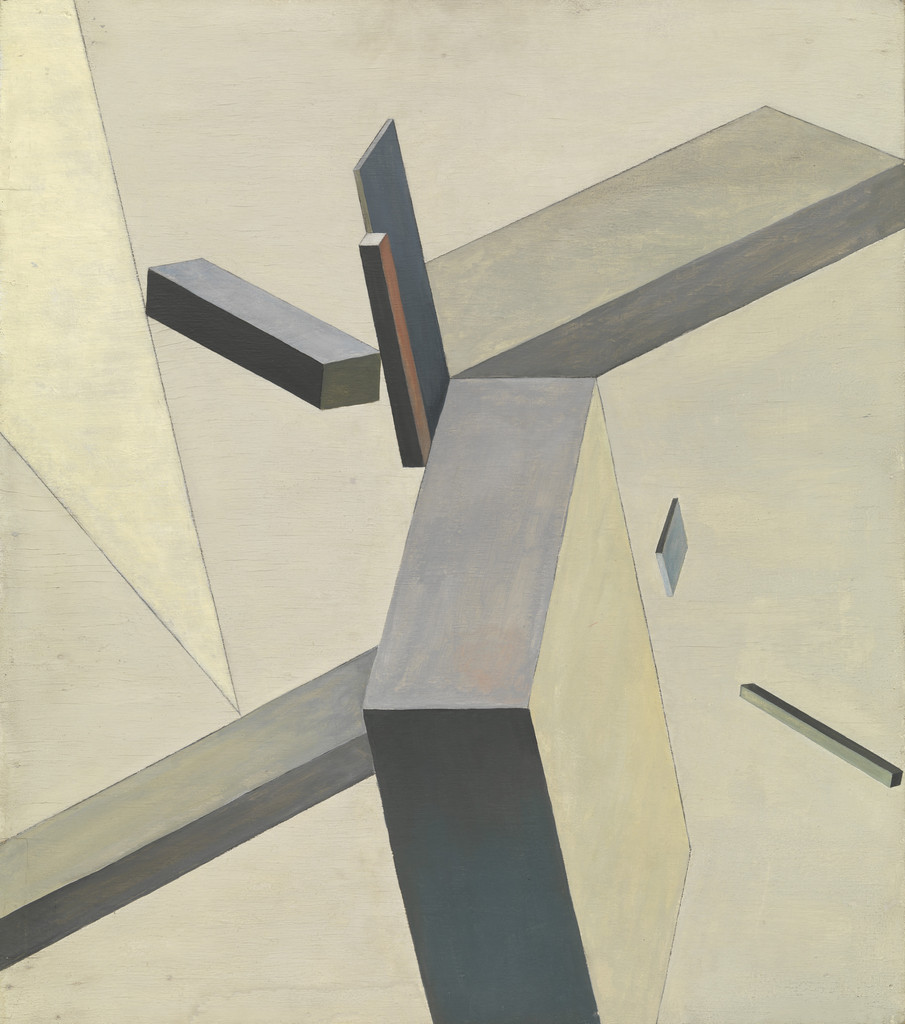
Три рисунка проунов из коллекции Третьяковской галереи являются эскизами к живописному проуну, находящемуся в собрании Художественного музея Морицбург (Халле). Эскизы демонстрируют, как последовательно Лисицкий прорабатывает композицию, постепенно продвигаясь к окончательному решению: меняет угол наклона конструкции, добавляет и убирает ее отдельные детали, меняет соотношение оттенков цвета и насыщенность колорита.
Read on
Его пластический замысел ‒ соединение на плоскости листа и холста имитации рельефа с двухмерными элементами реализуется при помощи совмещения перспектив с разными точками схода, виртуозного превращения плоскости в объем и обратно, взаимопроникновения объемных и плоских фигур. Комбинируя геометрические плоскости с трехмерными объектами, Лисицкий выстраивает идеальную динамичную конструкцию, парящую в пространстве белого фона. Цветом и тональной насыщенностью он передает фактуру материала, его «вес», плотность или прозрачность.
Tretyakov Gallery
Particulars
- Accession number
- РС-3759
In the catalog
Sources
- Tretyakov Gallery
- Image: Tretyakov Gallery — © State Tretyakov Gallery
Meanwhile, in the life of El Lissitzky
The whole life1920–1921
Moscow: INKhUK, a lecture on the Prouns, VKhUTEMAS
In 1920 Lissitzky leaves Vitebsk for Moscow and becomes a member of INKhUK (the Institute of Artistic Culture, also referred to as GINKhUK); on 23 September 1921 he gives a lecture there about his Prouns. In 1921 he also starts to teach at VKhUTEMAS but soon leaves Moscow for Germany.
1921
Leaving for Germany as a “cultural emissary”
In 1921, as UNOVIS declines and suprematism begins to fracture into a utopian, spiritual half and a utilitarian one, Lissitzky aligns with neither and leaves Vitebsk: he takes a job as a “cultural emissary” of Soviet Russia and moves to Weimar Berlin to establish contacts between Russian and German artists — what exactly he did in this role remains unclear. In 1921–1925 he lives in Germany and Switzerland.
1922
First solo exhibition in Hanover
The year after the publication of his first Proun series in 1921, Kurt Schwitters introduces Lissitzky to the Hanover gallery Kestnergesellschaft, where he holds his first solo exhibition. The second Proun series, printed in Hanover in 1923, is a success.
1923
The Proun Room at the Great Berlin Art Exhibition
In 1923, for the Great Berlin Art Exhibition, Lissitzky transforms a small room (about 3 by 3 by 2.5 m) into a single work of art, the Proun Room, which lets viewers “walk into an image” and become active participants. He violates the unwritten rule of rejecting the commercialization of art by putting price tags on three elements of the room; the price tags, together with his “half-dance” during the demonstration of the room, alienate his friend Theo van Doesburg.
1923–1924
Tuberculosis and a Swiss hospital
In 1923–1924 Lissitzky is severely ill with tuberculosis and stays in a Swiss hospital; at this time he is reported even to have considered suicide. He will die of tuberculosis in 1941.
1925
Return to the USSR
Lissitzky's years in Germany and Switzerland run from 1921 to 1925; it appears that in 1925 he returns to the Soviet Union.