 El LissitzkyRussian, 1890–1941
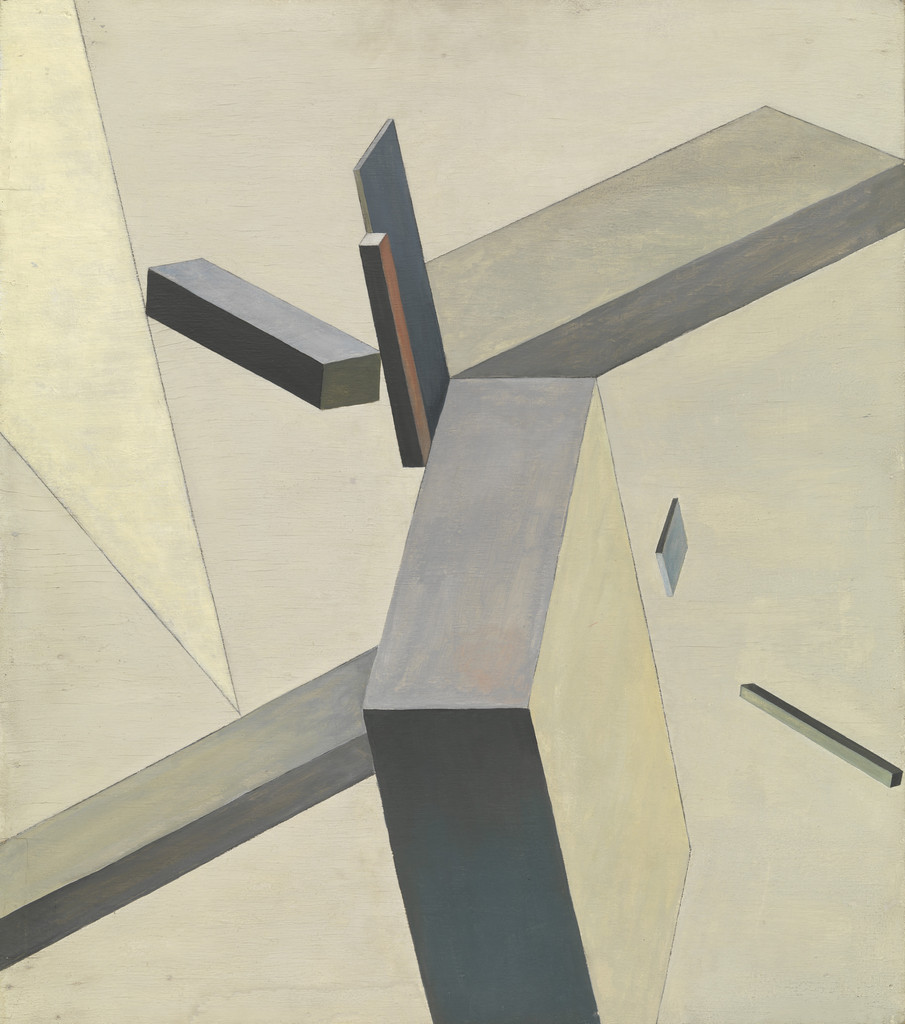
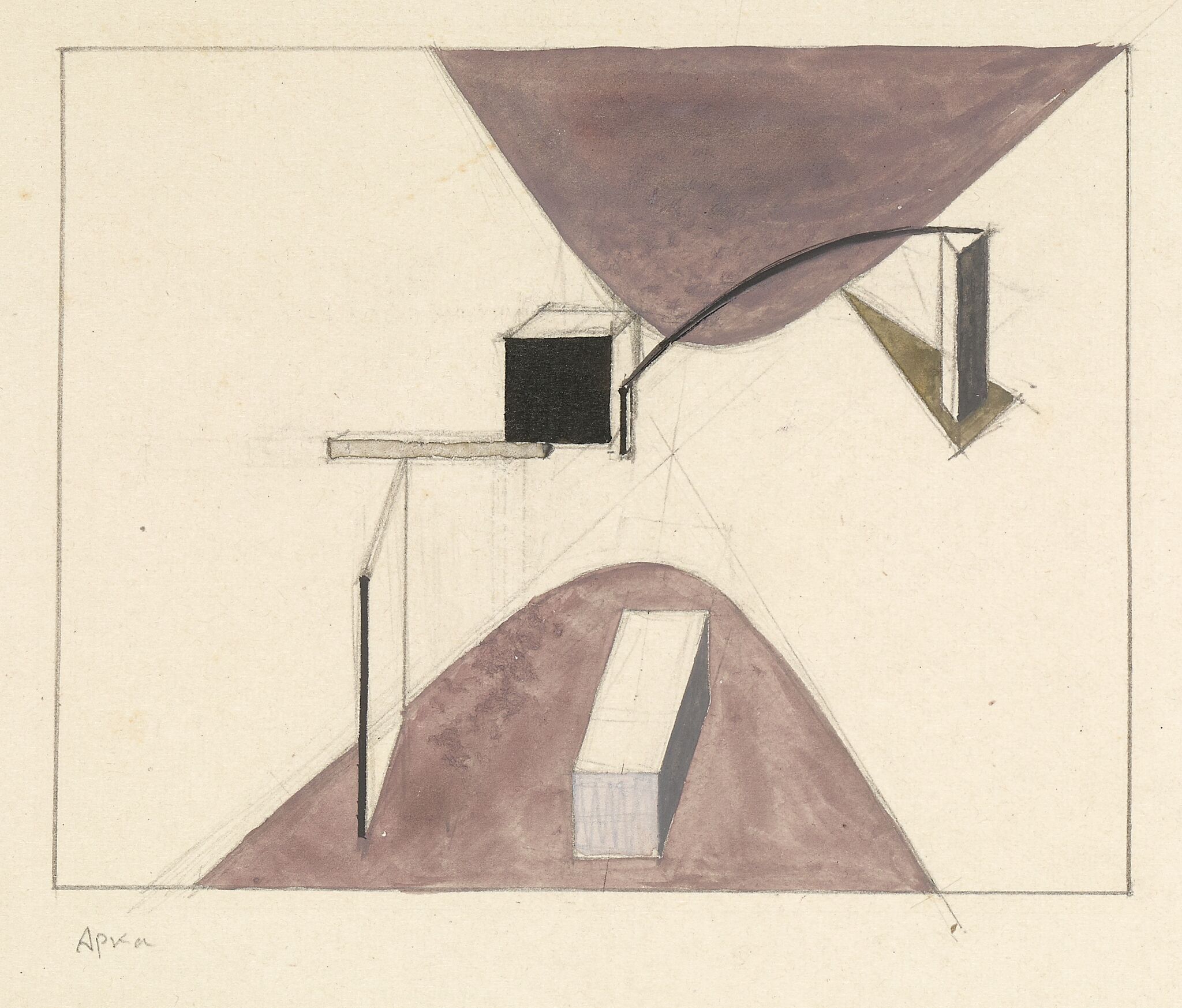
Проун 23. Арка
May one see it?
Unknown

Moscow, Russia
The owner is known; whether it is on view today is not.
- In this state since
- Source
- The museum
About the work
In the museum's own words — in Russian
В конце 1919 года Лисицкий изобрел новую художественную систему, которая по его замыслу могла бы служить основой архитектуры будущего; в ней соединялись законы конструктивного построения объемной формы с идеей геометрической плоскости. В конце лета ‒ начале осени 1920 года направление получило название Проун (Проект утверждения нового). До этого момента произведениям, созданным в рамках этой художественной системы, Лисицкий давал названия, как бы раскрывающие их пластический замысел. Используя хорошо знакомые ему приемы архитектуры, Лисицкий оперировал ее базовыми понятиями − массой, весом, пространством, ритмом, эстетизируя их, но не лишая утилитарной функции, присущей архитектурному проекту: многие работы имели уточняющие названия, фиксирующие архитектурно-инженерную доминанту художественного образа – «Город», «Арка», «Мост», «Дом над землей», «Балка», «Москва».
Read on
В проуне «Арка» Лисицкий экспериментирует со сферической перспективой (на подготовительном рисунке обозначена линии глубины и их точка схода). Судя по всему, эта композиция была одной из наиболее ценимых автором; в таких проунах кристаллизовались их основные принципы, позже развитые и используемые уже в разнообразных комбинациях. Именно этот проун Лисицкий поместил в качестве иллюстрации к статье «Супрематизм миростроительства» в альманахе «Уновис №1», а затем как пример проуна в выпущенной им совместно с Хансом Арпом книге «Die Kunstismen 1914-1924».
Живописный проун, эскизом к которому является данная работа, зафиксирован на фотографии витебской мастерской Лисицкого 1919−1920 гг. Более поздний вариант картины находится в Музее Ван Аббе (Эйндховен).
Tretyakov Gallery
Particulars
- Accession number
- РС-3763
In the catalog
Sources
- Tretyakov Gallery
- Image: Tretyakov Gallery — © State Tretyakov Gallery
Meanwhile, in the life of El Lissitzky
The whole life1918
Founding the art section of the Kultur-Lige
In 1918 in Kiev Lissitzky, together with Joseph Chaikov, Issachar Ber Ryback, Mark Epstein and others, founds the art section of the Kultur-Lige, an avant-garde artistic and literary association whose aim was to create a new Jewish national art.
May 1919
Chagall's invitation and the move to Vitebsk
In May 1919, at Marc Chagall's invitation, Lissitzky returns to Vitebsk to teach graphic arts, printing and architecture at the newly formed People's Art School, which Chagall created after being appointed Commissioner of Artistic Affairs for Vitebsk. Lissitzky designs and prints propaganda posters and illustrations for a local newspaper; he later never mentioned them, probably because he portrayed Leon Trotsky and other early revolutionaries who later became enemies of the Soviet state.
October 1919
Persuading Malevich to move to Vitebsk
In October 1919, on an errand in Moscow, Lissitzky persuades Kazimir Malevich to relocate to Vitebsk. Malevich brings a wealth of new ideas, which inspire Lissitzky but clash with the local public and professionals who favoured figurative art, and with Chagall himself.
1919–1920
Choosing Malevich and breaking with Chagall
Malevich replaces the school's classical teaching programme with his own and spreads suprematist theory school-wide; Lissitzky, still loyal to Chagall, is torn between two opposing paths but ultimately favours suprematism and breaks away from traditional Jewish art, and Chagall leaves the school shortly afterwards — he later recalled that his most zealous disciple, the moment he was appointed professor, went over to his opponents' camp. Lissitzky designs Malevich's book “On the New System in Art”, printed in 1,000 copies — an enormous number for an art book.
17 January – February 1920
Malevich and Lissitzky found Molposnovis, which becomes UNOVIS
On 17 January 1920 Malevich and Lissitzky co-found the short-lived group Molposnovis (“Young Followers of a New Art”); after a brief and stormy dispute and two rounds of renaming, it re-emerges in February as UNOVIS, the “Exponents of the New Art”. The group, disbanded in 1922, was pivotal in spreading suprematist ideology and launched Lissitzky's status as a leading figure of the avant-garde; its members signed works with a black square, while Lissitzky used a red one.
1921
Leaving for Germany as a “cultural emissary”
In 1921, as UNOVIS declines and suprematism begins to fracture into a utopian, spiritual half and a utilitarian one, Lissitzky aligns with neither and leaves Vitebsk: he takes a job as a “cultural emissary” of Soviet Russia and moves to Weimar Berlin to establish contacts between Russian and German artists — what exactly he did in this role remains unclear. In 1921–1925 he lives in Germany and Switzerland.