 Mikhail Vrubel1856–1910
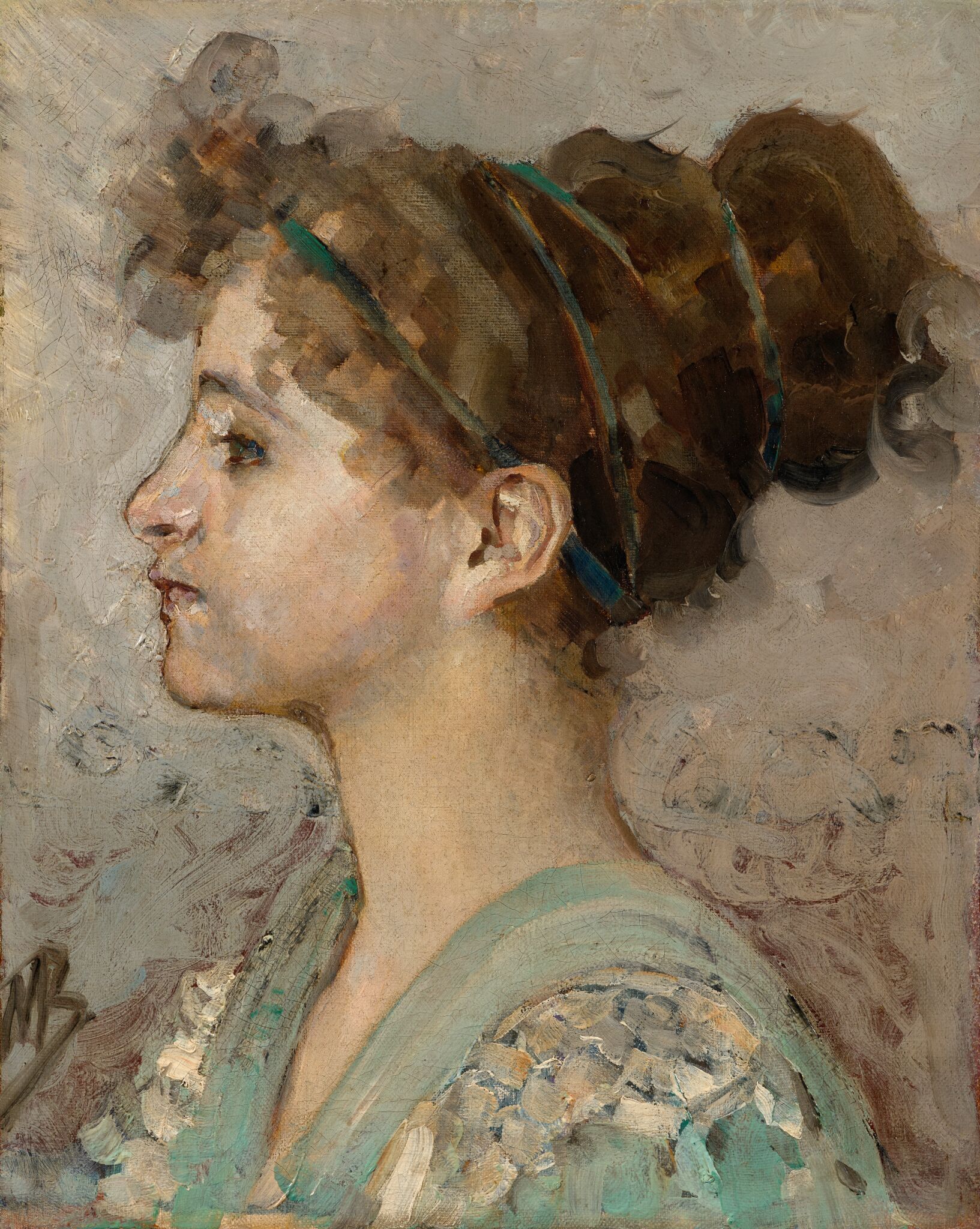
Портрет Насти
Can I see it?
Unknown
Where is “Портрет Насти” now? Collection: Tretyakov Gallery, Moscow. Unknown.

Moscow, Russia
The owner is known; whether it is on view today is not.
- Source
- The museum
About the painting
Museum text in Russian
Портрет Анастасии Врубель (1877–1932), в замужестве Нёмитц, сестры художника, был написан им в 1894 году. Весной этого года Врубель сопровождал Сергея, старшего сына Саввы Мамонтова, в Италию на лечение. Путешественники жили неподалеку от Генуи. Возвращались они в Россию пароходом по морю через Неаполь, Бриндизи, Пирей, Афины и Константинополь. Прибыв в Одессу, Врубель задержался здесь, чтобы навестить семью отца и пробыл в городе до середины мая. 19 апреля 1894 года Александр Михайлович, отец художника, писал его сестре Анне: «Миша … гостит у нас со среды … Приехал он сюда на пароходе «Лазарев», вместе с молодым Сергеем Мамонтовым в 7 часов утра… Время проводим больше дома, и в своей компании… Миша привез с собой около 20 разных видов, им самим написанных во время последнего путешествия. Некоторые из них очень хороши. Кроме того, Миша написал у нас портрет-фантазию Насти».
Read on
Самая младшая, сводная сестра Врубеля, Настя, посещала занятия в Одесской рисовальной школе и очень любила лепить. Художник с большой симпатией создает образ семнадцатилетней девушки, обладавшей живым умом и решительным, волевым характером. За год до этого он написал декоративные панно «Суд Париса» (1893) на сюжет античного мифа. Его воображение было наполнено античными мифами и связанными с ними сюжетами, которые и нашли отражение в портрете. Фантазию Врубеля подпитывало и недавнее путешествие, запечатленное им в этюдах, на которых изображены старинные итальянские порты, греческие “Пропилеи” в Афинах. Колористически портрет выдержан в той же коричневато-оливковой гамме, что и “Суд Париса”. У потомков Анастасии существует семейная легенда, что поначалу Врубель написал портрет сестры с обнаженными плечами, как в фигуре Венеры в средней части триптиха. Родители запротестовали и художник вынужден был “сменить” внешний вид модели.
Портретируемая позирует в легком платье с накинутой воздушной шелковой шалью, украшенной геометрическим орнаментом. На голове – высокая прическа по греческой моде, перехваченная лентами. Графически точно очерчен профиль лица, линия тонкой длинной шеи на фоне стены. В целом, в произведении предстает нежный, изящный и одновременно трогательный образ юной особы, возникший волею фантазии гениального художника. Портрет долго хранился в семье потомков Анастасии и в 2004 году был приобретен Третьяковской галереей при финансовой поддержке Анатолия Новикова
Tretyakov Gallery
Details
- Accession number
- Ж-1930
In the catalog
Sources
- Tretyakov Gallery
- Image: Tretyakov Gallery — © State Tretyakov Gallery
In the life of Mikhail Vrubel
The whole life1891–1892
A second journey to Italy
Vrubel accompanied the Mamontovs to Italy as an adviser to the Abramtsevo pottery, but quarrelled with Elizaveta Mamontova and left with Savva Mamontov for Milan, where his half-sister Lilya was studying singing. He spent the winter in Rome, where he was to carry out Mamontov’s commissions — sets for “The Merry Wives of Windsor” and a new curtain for the Private Opera: he lodged with the Svedomsky brothers and later worked in the studio of Alexander Rizzoni.
mid-1890s
With Schechtel on the Morozov mansions
His work for Mamontov secured Vrubel’s reputation in Moscow, and together with Fyodor Schechtel he decorated S. T. Morozov’s mansion on Spiridonovka Street and A. V. Morozov’s house in Podsosensky Lane. His most important sculpture is held to be the “Gothic” group “Robert and the Nuns”, which adorns the staircase lantern of the Morozov mansion.
early 1896
Meeting Nadezhda Zabela
In St Petersburg Vrubel stepped in for the ailing Korovin as designer of Humperdinck’s opera “Hansel and Gretel”, which Mamontov was financing, and at a rehearsal he first heard, then saw, the singer of Gretel — Nadezhda Zabela. Rushing up to her in the interval with the cry “What a lovely voice!”, he proposed almost on the day they met, and later told his sister that had she refused, he would have killed himself on the spot.
22 May 1896
The Academy rejects his Nizhny Novgorod panels
Mamontov secured Vrubel a commission for two huge panels for the art section of the All-Russian Exhibition — “Mikula Selyaninovich” and “The Princess of the Dream”, a hundred square metres in three months. But the academician Albert Benois, in charge of the pavilion, demanded sketches, a telegram went to St Petersburg — “Vrubel’s panels are monstrous, they must be removed” — the Academy’s commission ruled them unfit to show, and on 22 May the works were carried out of the pavilion.
July 1896
Mamontov’s pavilion for the “rejected” panels
Mamontov bought both panels for 5,000 roubles: Polenov and Korovin finished “Mikula”, Vrubel completed “The Princess of the Dream” in a shed at the Abramtsevo pottery, and in time for the imperial couple’s visit on 15–17 July the canvases were shown in a specially built pavilion signposted “Exhibition of decorative panels by the artist M. A. Vrubel, rejected by the jury of the Imperial Academy of Arts” — the words naming the Academy’s jury soon had to be painted over. A newspaper battle followed: Nikolai Garin-Mikhailovsky offered the first balanced analysis of Vrubel’s art, while Maxim Gorky mocked his panels in five articles.
28 July 1896
Marries Nadezhda Zabela in Geneva
Meeting Zabela’s family went badly — the age gap troubled them (he was 40, she 28), and the bride herself knew that Vrubel drank and squandered money — but on 28 July the couple were married in the Cathedral of the Exaltation of the Holy Cross in Geneva. They spent their honeymoon in a guesthouse in Lucerne, where Vrubel went on working on panels for A. V. Morozov’s Gothic study: by the wedding he was literally penniless and had walked from the station to his bride’s.