 Mikhail Vrubel1856–1910
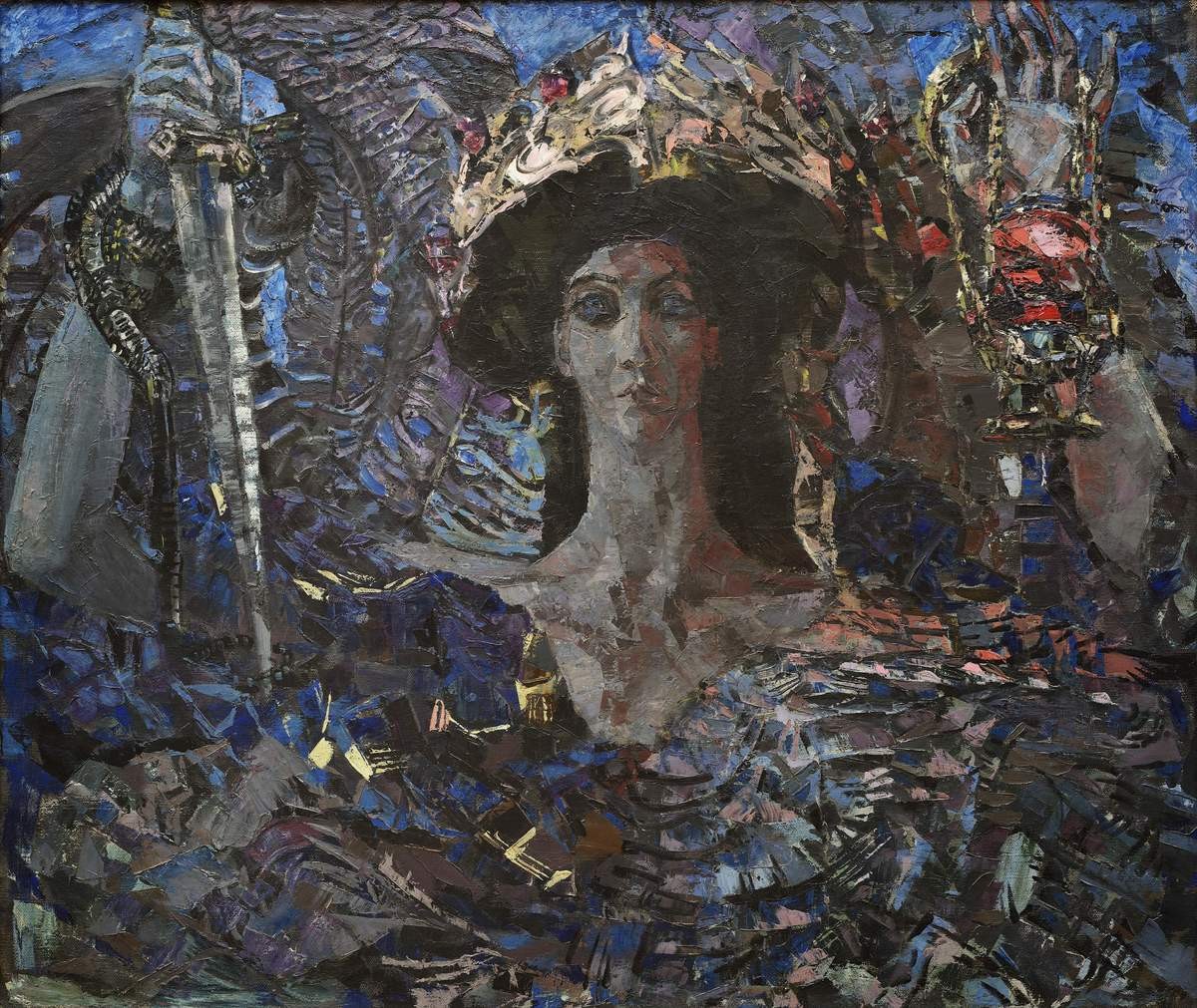
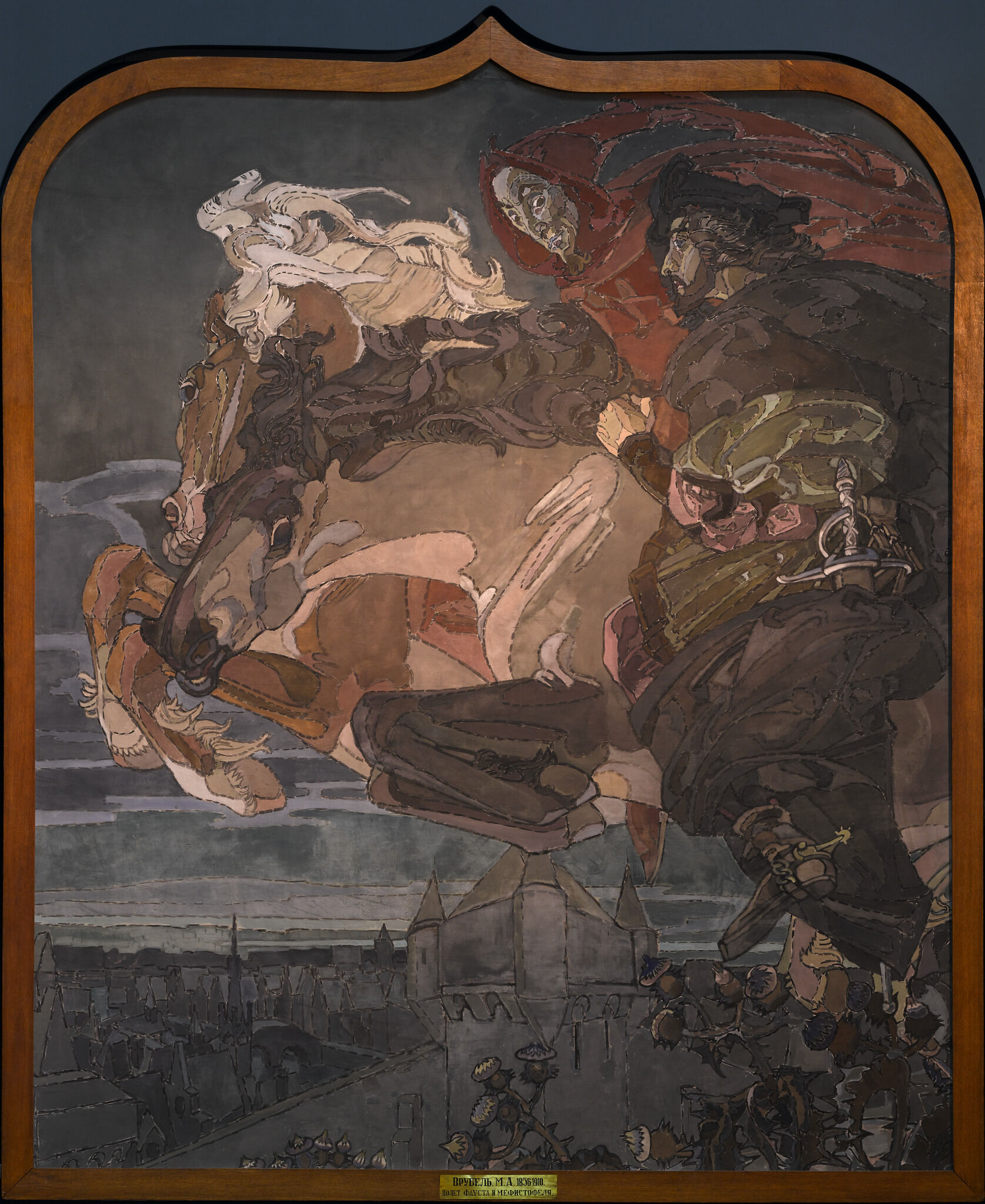
Полет Фауста и Мефистофеля
Can I see it?
Unknown
Where is “Полет Фауста и Мефистофеля” now? Collection: Tretyakov Gallery, Moscow. Unknown.

Moscow, Russia
The owner is known; whether it is on view today is not.
- Source
- The museum
About the painting
Museum text in Russian
Панно «Полет Фауста и Мефистофеля» стало живописной частью оформления интерьеров особняка купца Алексея Викуловича Морозова.
А.В. Морозов – московский меценат, рафинированный эстет, происходил из известной купеческой семьи. Отойдя от дел, обладая колоссальным состоянием, Морозов увлекся собирательской деятельностью. Коллекция изобразительного искусства размещалась в особняке, полученном Морозовым по наследству в 1895 году. М.К. Морозова писала: «Дом, который после смерти отца перешел к нему (на Покровке во Введенском переулке, ныне Подсосенский пер., 21) как старшему, был огромный с бесконечным числом комнат. Все комнаты второго этажа наполнялись витринами с фарфором его собрания и иконами. Сам же он жил внизу, где у него было две столовые, гостиная и кабинет. Кабинет его был двухсветный, очень высокий, весь отделанный деревом, с пятью панно работы М.А. Врубеля».
Read on
Внутренняя отделка особняка была осуществлена архитектором Ф.О. Шехтелем. Кабинет хозяина был решен в готическом стиле. Его украшали три вертикально вытянутых хоста, своей формой напоминающих средневековые окна. Триптих включал в себя образы Мефистофеля, Маргариты и Фауста.
Отличался по формату, почти квадратный холст, изображающий «Полет Фауста и Мефистофеля». Два всадника взмывают в воздух на волшебных конях. Они проносятся в ночной мгле над спящим городом. Кони, образы Фауста и его темного двойника, цветы чертополоха на первом плане и острые кровли башен – все превращается в причудливо сплетающийся узор. Безупречный рисунок Врубеля, передающий жизненную выразительность форм, соединяется с декоративной плоскостностью. Цвета живописи сложно разработаны. Художник использует излюбленное им изысканное сочетание многочисленных оттенков коричневого, лилового и серебристо-серого. Колорит вызывает в памяти цвета старинных гобеленов и средневековых витражей, сквозь которые еще не прорвался солнечный свет.
Врубель принимал участие в создании декоративного ансамбля дома А.В. Морозова в период творческого расцвета, наивысшего подъема своего таланта.
Tretyakov Gallery
Details
- Accession number
- 10992
In the catalog
Sources
- Tretyakov Gallery
- Image: Tretyakov Gallery — © State Tretyakov Gallery
In the life of Mikhail Vrubel
The whole lifeearly 1896
Meeting Nadezhda Zabela
In St Petersburg Vrubel stepped in for the ailing Korovin as designer of Humperdinck’s opera “Hansel and Gretel”, which Mamontov was financing, and at a rehearsal he first heard, then saw, the singer of Gretel — Nadezhda Zabela. Rushing up to her in the interval with the cry “What a lovely voice!”, he proposed almost on the day they met, and later told his sister that had she refused, he would have killed himself on the spot.
22 May 1896
The Academy rejects his Nizhny Novgorod panels
Mamontov secured Vrubel a commission for two huge panels for the art section of the All-Russian Exhibition — “Mikula Selyaninovich” and “The Princess of the Dream”, a hundred square metres in three months. But the academician Albert Benois, in charge of the pavilion, demanded sketches, a telegram went to St Petersburg — “Vrubel’s panels are monstrous, they must be removed” — the Academy’s commission ruled them unfit to show, and on 22 May the works were carried out of the pavilion.
July 1896
Mamontov’s pavilion for the “rejected” panels
Mamontov bought both panels for 5,000 roubles: Polenov and Korovin finished “Mikula”, Vrubel completed “The Princess of the Dream” in a shed at the Abramtsevo pottery, and in time for the imperial couple’s visit on 15–17 July the canvases were shown in a specially built pavilion signposted “Exhibition of decorative panels by the artist M. A. Vrubel, rejected by the jury of the Imperial Academy of Arts” — the words naming the Academy’s jury soon had to be painted over. A newspaper battle followed: Nikolai Garin-Mikhailovsky offered the first balanced analysis of Vrubel’s art, while Maxim Gorky mocked his panels in five articles.
28 July 1896
Marries Nadezhda Zabela in Geneva
Meeting Zabela’s family went badly — the age gap troubled them (he was 40, she 28), and the bride herself knew that Vrubel drank and squandered money — but on 28 July the couple were married in the Cathedral of the Exaltation of the Holy Cross in Geneva. They spent their honeymoon in a guesthouse in Lucerne, where Vrubel went on working on panels for A. V. Morozov’s Gothic study: by the wedding he was literally penniless and had walked from the station to his bride’s.
summer 1898
First symptoms of illness
During a summer stay in Ukraine the first symptoms of his future illness appeared: his migraines grew so severe that he took phenacetin in huge quantities — up to 25 grains or more, according to his sister-in-law. A previously unknown irritability set in too, especially when someone disagreed with his opinion of a work of art.
January 1898
“Morning” at Diaghilev’s exhibition
In St Petersburg Ilya Repin advised Vrubel not to destroy his panel “Morning”, which a client had turned down, but to show it at an exhibition. So the canvas went into Sergei Diaghilev’s exhibition of Russian and Finnish artists at the museum of the Stieglitz School.