 Félix Edouard VallottonFrench, 1865–1925
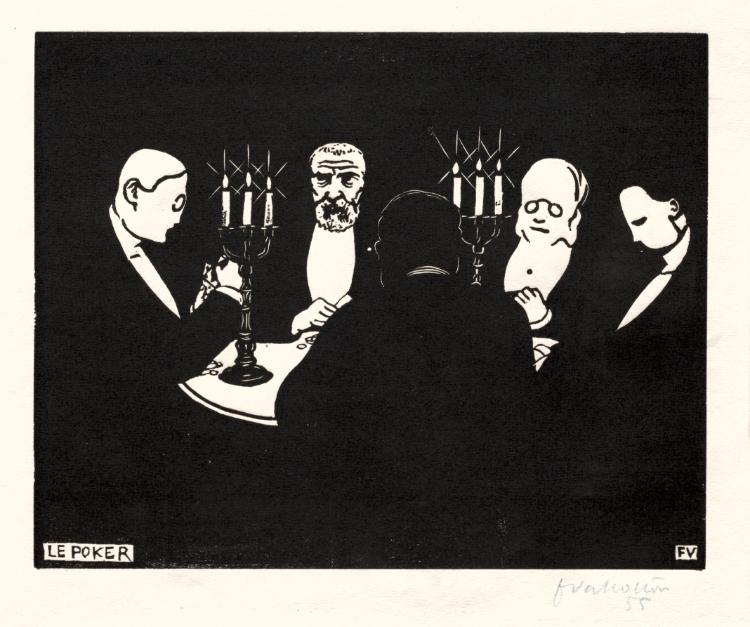
Poker
Can I see it?
Not on view at present
Where is “Poker” now? Collection: The Cleveland Museum of Art, Cleveland. Not on view at present. Checked September 29, 2026.

Cleveland, United States
It belongs to the collection, but is not on display at present.
- Checked
- In this state since
- Source
- The museum
About the work
The bold, simplified style of Vallotton's more than 200 woodcuts made him a central figure in the late 19th-century revival of the medium. With stylized forms and striking contrasts of black and white, Vallotton effectively depicted the personality of each poker player and the brightly lit candelabra in the otherwise darkened room.
The Cleveland Museum of Art
Details
- Accession number
- 1959.303
In the catalog
Sources
- The Cleveland Museum of Art
- Image: The Cleveland Museum of Art — Museum open access
In the life of Félix Edouard Vallotton
The whole life1889–1903 · Membership
Les Nabis
1890–1897
Art critic for the Gazette de Lausanne
To earn a living Vallotton restored paintings for the dealer Henri Haro, and from 1890 he wrote for the Swiss Gazette de Lausanne — some thirty articles on the Paris art world up to 1897.
1893–1897
Woodcuts for La Revue Blanche; the Natansons' patronage
His woodcuts brought Vallotton clients and financial security: he illustrated leading French periodicals, including La Revue Blanche, and foreign ones such as The Chap-Book of Chicago, and cut covers for theatre programmes and book illustrations. Thadée Natanson, publisher of La Revue Blanche, and his wife Misia became his patrons and introduced him to the Paris avant-garde elite — Mallarmé, Proust, Satie and Debussy.
1896
His album “Studies of Women” is published
A Paris publisher issued Vallotton's album “Studies of Women”.
1898
Buys a Kodak camera
Vallotton bought a Kodak No. 2 “Bullet” and based at least five interior paintings on his photographs; his first pictures were taken at the Château d'Étretat, the Château de la Naz, the Natansons' summer house above Cannes and the Villa Beaulieu in Honfleur.
23 January 1898
On Dreyfus's side
At the height of the Dreyfus affair Vallotton passionately defended the falsely accused officer; his series of satirical woodcuts, including “The Age of the Newspaper”, appeared on the front page of Le Cri de Paris. The affair divided the Nabis and was one reason the group had drifted apart by 1900.