Claude MonetFrench, 1840–1926
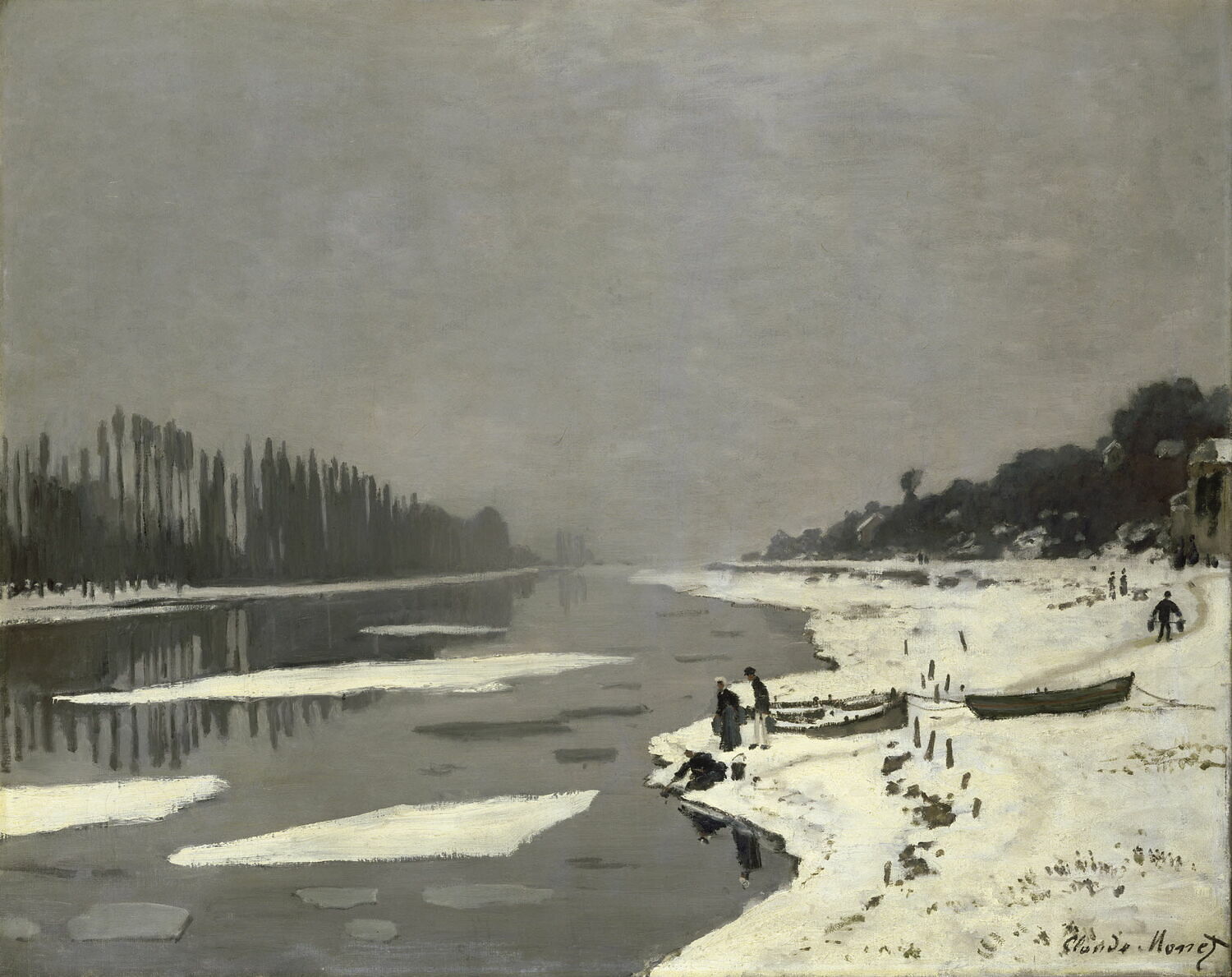
Landscape. Seine at Asnieres
May one see it?
Yes, receiving visitors

State Hermitage Museum
Room403Saint Petersburg, Russia
On public display.
- Checked
- 29 Aug 2026
- In this state since
- Aug 30, 2026
- Source
- The museum's own collection data
About the painting
The Seine at Asnières is an 1873 oil on canvas painting by Claude Monet, now in the Hermitage Museum in St Petersburg. It was previously in the collection of Alice Meyer (née Sieveking; 1866–1949), widow of the extremely rich Hamburg businessman Eduard Lorenz Lorenz-Meyer (1856–1926) before being looted by the USSR after World War II and retained as war reparations. It has been on public display since an exhibition in 1995.
Read on
Painted a few months after producing Impression, Sunrise, it shows a late afternoon scene with péniches moored at Asnières on the Seine to the north-west of Paris. The small town had recently been linked by rail to Paris via gare Saint-Lazare and was starting to industrialise, with a population of workers and lower-middle-class inhabitants building themselves houses in gritstone or brick, some of which are shown with tree gardens on the opposite bank in the painting. Living at Argenteuil, another town on the Seine slightly to the north, Monet came to paint the subject with his friends.
Particulars
- Accession number
- ГЭ-10613
In the catalog
Sources
- State Hermitage Museum: the museum's own open data · fetched 29 Aug 2026
- Image: State Hermitage Museum — Museum open access
Meanwhile, in the life of Claude Monet
The whole life1870–1871
London exile
Evading conscription during the Franco-Prussian War, Monet lived in London, where he studied Constable and Turner, met Pissarro and Whistler, and became acquainted with his first and principal dealer, Paul Durand-Ruel — an encounter decisive for his career.
May 1871
Zaandam: 25 paintings
Leaving London, Monet settled in Zaandam in the Netherlands, where he painted twenty-five pictures (the police suspected him of revolutionary activity). During this period he also made his first visit to Amsterdam.
1874
First Impressionist exhibition
At the exhibition, organized on the initiative of Monet and his associates as an alternative to the Salon, "Impression, Sunrise" was shown. The critic Leroy mockingly dubbed the participants "impressionists" — and so the term Impressionism was born.