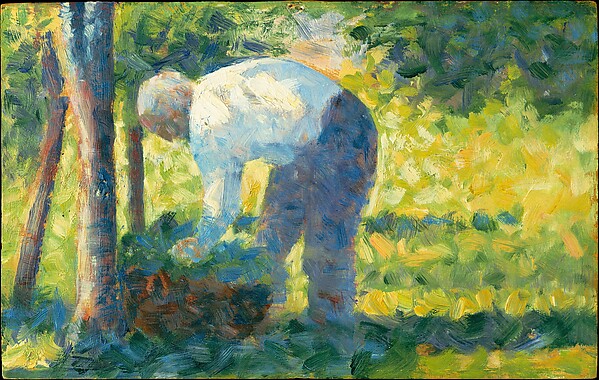
Georges SeuratFrench, 1859–1891
Paysage rose
May one see it?
Unknown

Musée d'Orsay
Paris, France
The owner is known; whether it is on view today is not.
- In this state since
- Source
- The museum
Particulars
- Accession number
- RF 1965 18
In the catalog
Sources
- Wikidata
- Image: Musée d'Orsay — Georges Seurat · Public domain · Wikimedia Commons
Meanwhile, in the life of Georges Seurat
The whole life1880s
Charles Henry's lectures at the Sorbonne
In the 1880s Seurat hears lectures by the mathematician Charles Henry at the Sorbonne on the emotional properties and symbolic meaning of lines and colour; there remains controversy over how far he adopted Henry's ideas.
1884
Meeting Paul Signac
At the first exhibition of the Groupe des Artistes Indépendants Seurat meets Paul Signac, a future follower of pointillism; Signac later wrote that “Bathers” is painted in broad flat strokes and looks less bright than the Impressionists' canvases, but that the systematic separation of light, shade and local colour gives it harmony.
15 May – 30 June 1884
The Salon rejects “Bathers”: a debut at the Indépendants
The official Salon rejects “Bathers at Asnières”, and Seurat shows the painting instead at the Groupe des Artistes Indépendants, which runs from 15 May to 30 June 1884 — his debut as a painter.
1886
Nine works, the public's mockery and the critics' defence
At the last Impressionist exhibition Seurat presents nine works; the critics R. Marx and Félix Fénéon write favourable reviews, but the public ridicules the “pictures painted in dots”, and the Swiss critic Émile Hennequin finds them grey and poor in light. The Impressionists are sceptical: when Pissarro says that “La Grande Jatte” is very interesting, Degas replies that he would have noticed, but it is so large; Seurat himself blames the hall for being too dark and cramped to give the picture the necessary distance.
15 May – 15 June 1886
“La Grande Jatte” is first shown at the eighth Impressionist exhibition
“A Sunday Afternoon on the Island of La Grande Jatte” is shown to the public for the first time at the eighth Impressionist exhibition, held from 15 May to 15 June 1886. The painting will initiate Neo-Impressionism and alter the direction of modern art.
19 September 1886
Fénéon names “Neo-Impressionism” and defends Seurat
Félix Fénéon, who gives the new movement the name “Neo-Impressionism”, defends the artist in an article for the Belgian paper “L'Art Moderne” of 19 September 1886: here, he argues, no virtuosity of brushwork or impasto is needed, but the eye must be quick, sharp and perceptive.