Ram Kumar
Painting
May one see it?
Not receiving at present

Victoria and Albert Museum
London, United Kingdom
It belongs to the collection, but is not on display at present.
- Checked
- 8 days ago
- In this state since
- Sep 25, 2026
- Source
- The museum's own collection data
About the painting
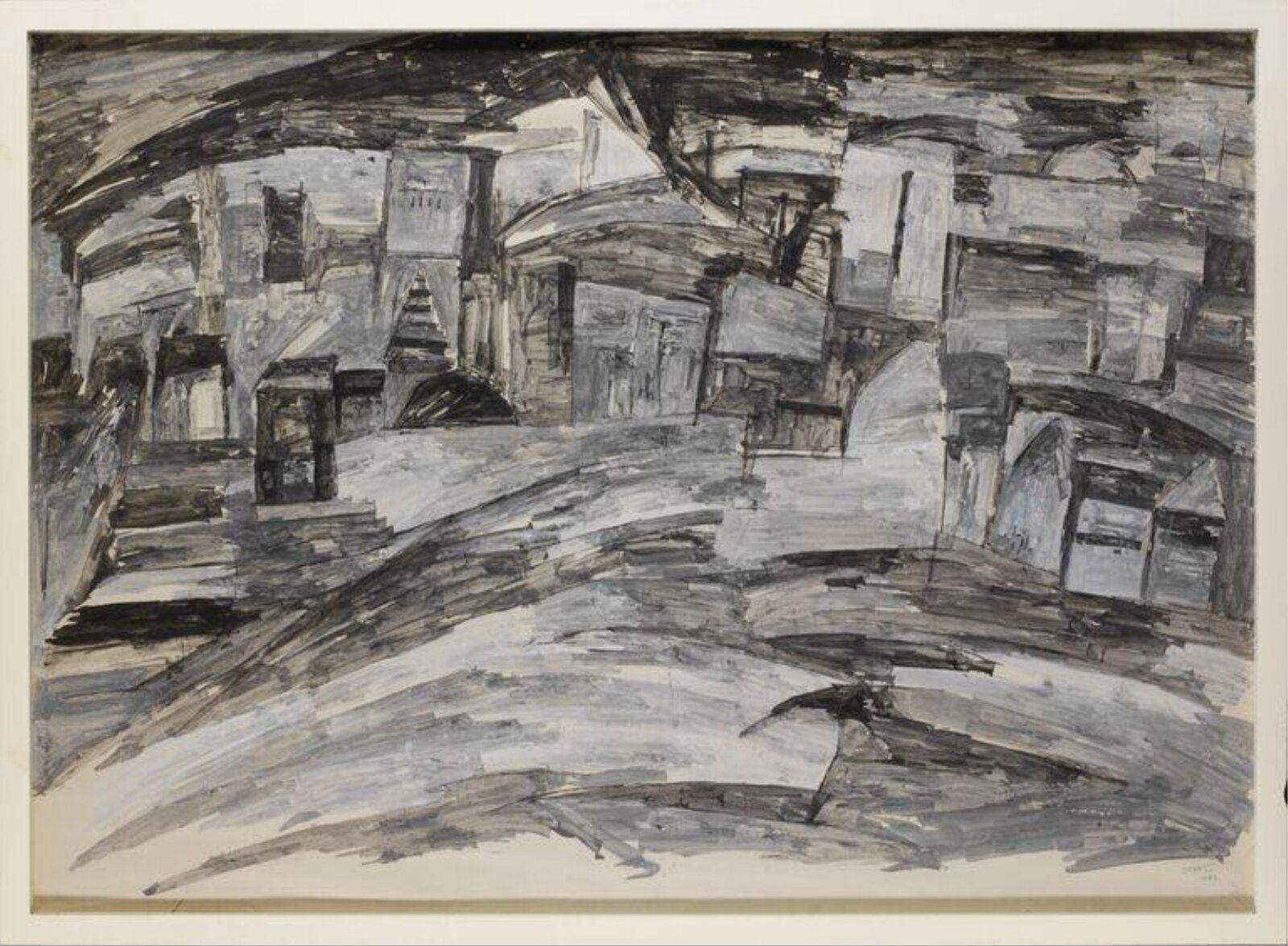
The painting, executed in black ink and white gouache, depicts a string of unpeopled, box-like, and undifferentiated houses seen across an expanse of flat, open ground. One can observe the 'sikhara' of a small temple or shrine among the buildings towards the left. The artist has depicted the little houses adjacent to one another, possibly suggesting the promiscuity and density that one finds in urban conglomerates. Unlike the works of Amrita Sher-Gil and Nandalal Bose, where peasants and tribesmen are inserted in timeless, pastoral settings, often untainted by idustrialization, Kumar's village appears gloomy and dreary. The blue and grey colours could perhaps indicate the materials used to fabricate the small habitations, such as tin sheets and corrugated iron.
Read on
Since 1985, Kumar's work has been predominantly abstract, or hovering on the verge of abstract and figurative rendering of landscape. In the early 1960s particularly, compositions based on the geometry of groups of buildings, and the configurations of light and shadow they generated, became and important concern. The present work, executed with broad and loose brushstrokes, is reminiscent of Western expressionist painting techniques.
Unlike the expressionists however, Kumar adopts a restricted tonality. Although obviously a finished work, it perhaps represents a transitional stage in the compositional development of one of the non-figurative oil paintings on which he tends to concentrate.
Victoria and Albert Museum
Particulars
- Accession number
- IS.109-1985
What it shows
In the catalog
Sources
- Victoria and Albert Museum: the museum's own open data · fetched 8 days ago
- Image: Victoria and Albert Museum — © Victoria and Albert Museum, London