Johann Heinrich FüssliSwiss, 1741–1825
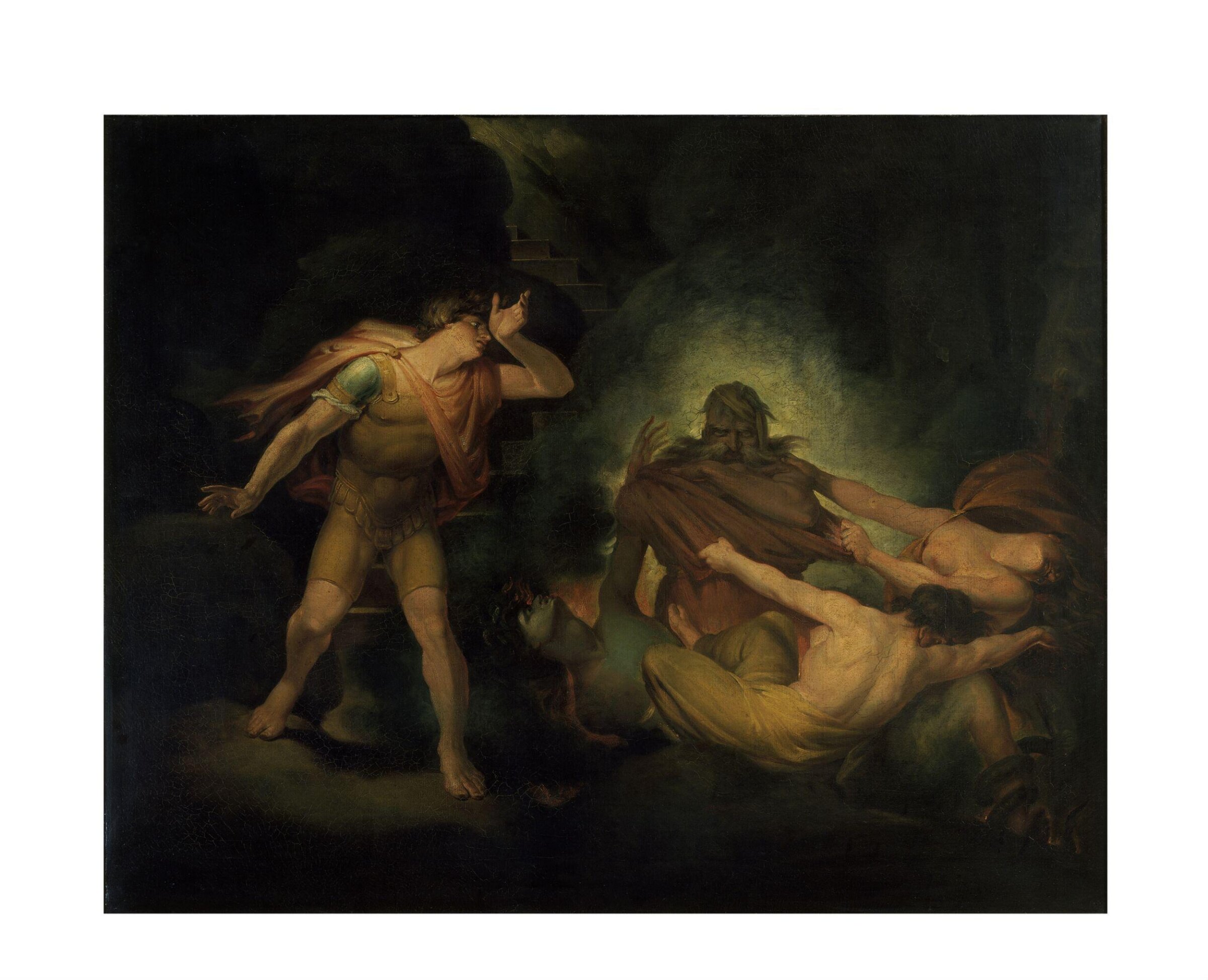
Odin in the Underworld
Can I see it?
Not on view at present
Where is “Odin in the Underworld” now? Collection: Art Institute of Chicago, Chicago. Not on view at present. Checked September 29, 2026.

Chicago, United States
It belongs to the collection, but is not on display at present.
- Checked
- In this state since
- Source
- The museum
About the work
Poet and scholar Thomas Gray’s The Descent of Odin (published 1768), a loose translation of an Old Norse poem, inspired this strange image—an exercise in nearly pure wash devoid of line. Fuseli’s drawing depicts the Norse god Odin descending into the underworld to learn the fate of his beloved son Balder. The arms emerging from the ground belong to the prophetess with whom Odin consults. Above is a vision of the Valkyries mourning at Balder’s tomb.
Fuseli’s image of Odin is a clever adaptation of Michelangelo’s God Dividing the Land and the Water, a fresco on the Sistine Chapel ceiling in Rome.
Art Institute of ChicagoCC BY 4.0
Details
- Accession number
- 1922.2153
In the catalog
Sources
- Art Institute of Chicago
- Image: Art Institute of Chicago — CC0
In the life of Johann Heinrich Füssli
The whole lifebetween 1765 and 1770
Reynolds advises him to become an artist
In England Füssli met Sir Joshua Reynolds and showed him his drawings. Following his advice, he resolved to devote himself entirely to art, and in 1770 he set off for Italy.
1770–1778
Travel: Italy
1770–1778
Rome: Michelangelo and a new name, Fuseli
During his Italian years Füssli changed his name to the more Italian-sounding Fuseli; in Rome he moved in the circle of the Scottish painter Alexander Runciman and the Swedish sculptor Tobias Sergel, and he also met Anton Raphael Mengs. He studied Michelangelo and liked to contemplate the marble statues of Monte Cavallo in the evening, against a murky sky or lit by lightning.