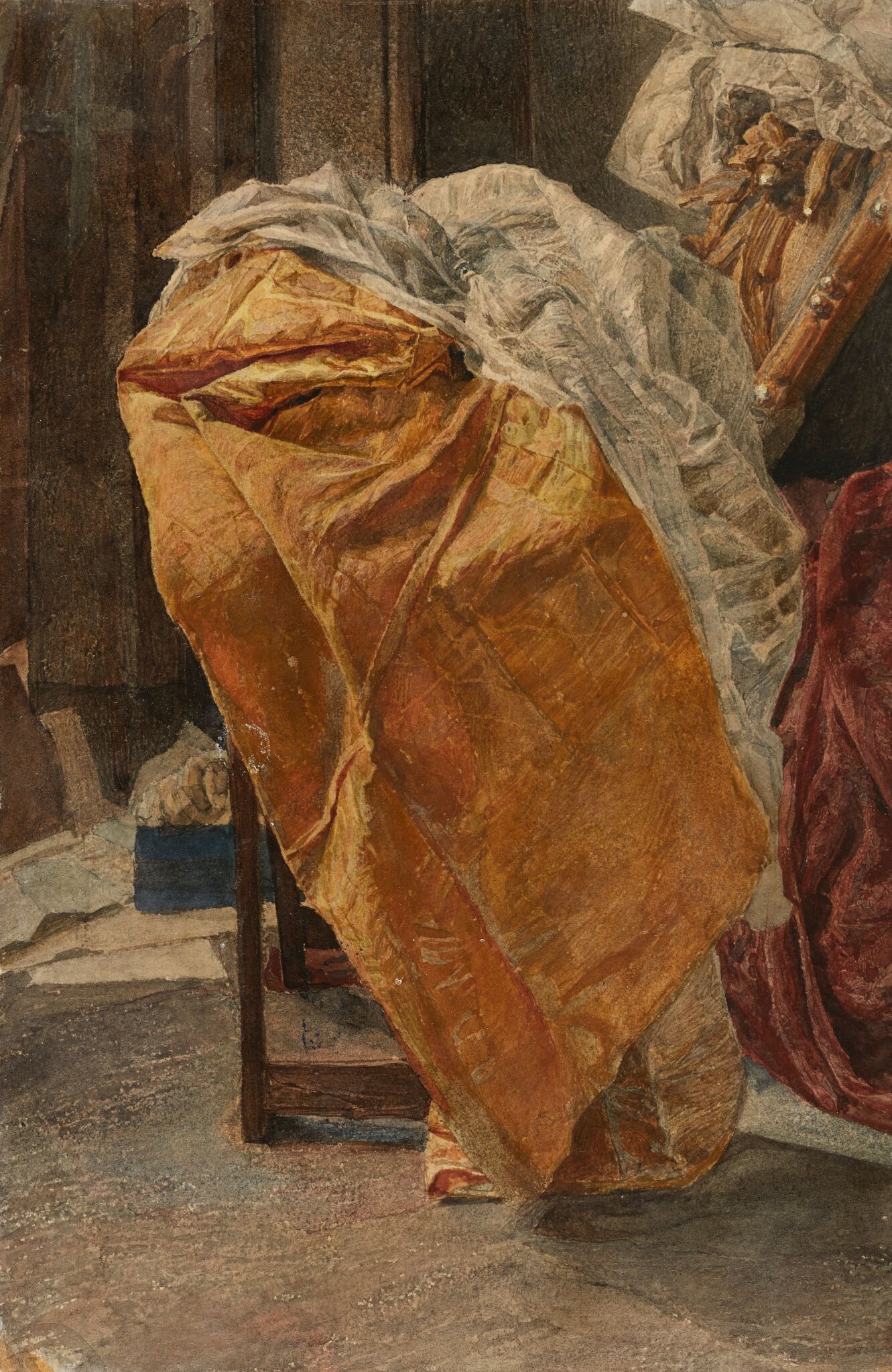
 Mikhail Vrubel1856–1910
Натюрморт. Ткани
May one see it?
Unknown

Moscow, Russia
The owner is known; whether it is on view today is not.
- In this state since
- Source
- The museum
About the work
In the museum's own words — in Russian
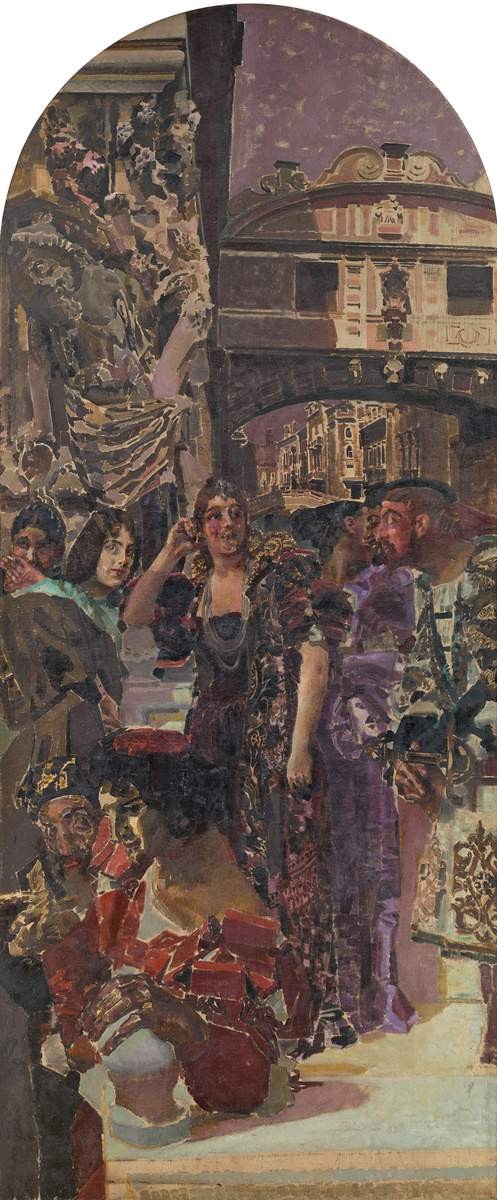
«Натюрморт. Ткани» связан с композицией «Натурщица в обстановке Ренессанса» (1884, Национальный музей «Киевская картинная галерея»). Осенью 1883 года Врубель писал сестре: «Узнав, что я нанимаю мастерскую, двое приятелей Серов и Дервиз пристали присоединиться к ним писать натурщицу в обстановке renessance, понатасканной от Дервиза, племянника знаменитого богача, акварелью. Моя мастерская, а их — натура. Я принял предложение. И вот в промежутках составления эскиза картины и массы соображений и подготовлений… Занялись мы акварелью…
Read on
Подталкиваемый действительно удачно, прелестно скомпонованным мотивом модели, не стесненный во времени и не прерываемый замечаниями: „зачем у нас здесь так растрепан рисунок“, когда в другом уголке только что начал с любовью утопать в созерцании тонкости, разнообразия и гармонии, задетый за живое соревнованием с достойными соперниками (мы трое единственные понимающие серьезную акварель в Академии), — я прильнул, если можно так выразиться, к работе; переделывал по десяти раз одно и то же место, и вот с неделю тому назад вышел первый живой кусок, который меня привел в восторг; рассматриваю его фокус и оказывается — просто наивная передача самых подробных живых впечатлений натуры; а детали, о которых я говорил, облегчают только поиски средств передачи. Я считаю, что переживаю момент сильного шага вперед».
Tretyakov Gallery
Particulars
- Accession number
- 21161
In the catalog
Sources
- Tretyakov Gallery
- Image: Tretyakov Gallery — © State Tretyakov Gallery
Meanwhile, in the life of Mikhail Vrubel
The whole lifeearly 1880s
Friendship with Valentin Serov
At the Academy Vrubel became close to Valentin Serov: despite the ten-year age gap, a great deal bound them together, down to the deepest level. His years with Chistyakov changed Vrubel himself as well: decorative dandyism gave way to asceticism, as he proudly wrote to his sister.
autumn 1883
An invitation to Kiev
In the spring of 1883 “The Betrothal of Mary and Joseph” earned Vrubel the Academy’s second silver medal, and in the autumn Professor Adrian Prakhov, on Chistyakov’s recommendation, invited him to Kiev to restore the twelfth-century St Cyril’s Church. The offer promised good money — four icons in 76 days at 300 roubles for every 24 days of work — and the artist agreed to come once the academic year was over.
1884
Arrival in Kiev
Vrubel staged his arrival in Kiev in his own style: L. Kovalsky, a student at the drawing school, remembered a fair-haired young man in a black velvet suit, stockings and short breeches — “a young Venetian from a painting by Tintoretto or Titian”. Over the summer he earned 650 roubles, including in St Sophia’s Cathedral, where he painted three angels in the drum of the dome, and gave up all thought of finishing the Academy.
1884–1885
Sent to Venice
The way out of an awkward situation was a mission to Ravenna and Venice to study late Roman and Byzantine art; Vrubel’s companion, the painter Samuil Gaiduk, waited two days for him in Venice while he went on a spree in Vienna. In wintry Venice the two shared a studio on Via San Maurizio, and Vrubel was captivated by the mosaics of San Marco and Torcello and by the early Renaissance masters — Carpaccio, Cima da Conegliano, Bellini.
1884–1885
Meeting Mendeleev
In Venice Vrubel met Dmitri Mendeleev by chance — Mendeleev was married to one of Chistyakov’s students — and they discussed preserving paintings in a humid climate and argued over the merits of painting in oil on zinc. But the paint would not hold on the zinc panels sent from Kiev for the icons, and by April all Vrubel wanted was to go back to Russia.
summer 1885
Odessa: first tells Serov about the “Demon”
At the end of June Vrubel left for Odessa to stay with the sculptor Boris Edwards, with whom he had once attended art school: Edwards, together with Kyriak Kostandi, was trying to reform the Odessa Art School, put Vrubel up in his house and urged him to stay for good. When Valentin Serov arrived that summer, Vrubel told him for the first time of his plan to paint the “Demon”, and in letters home he already spoke of a whole tetralogy.