 Konstantin Korovin1861–1939
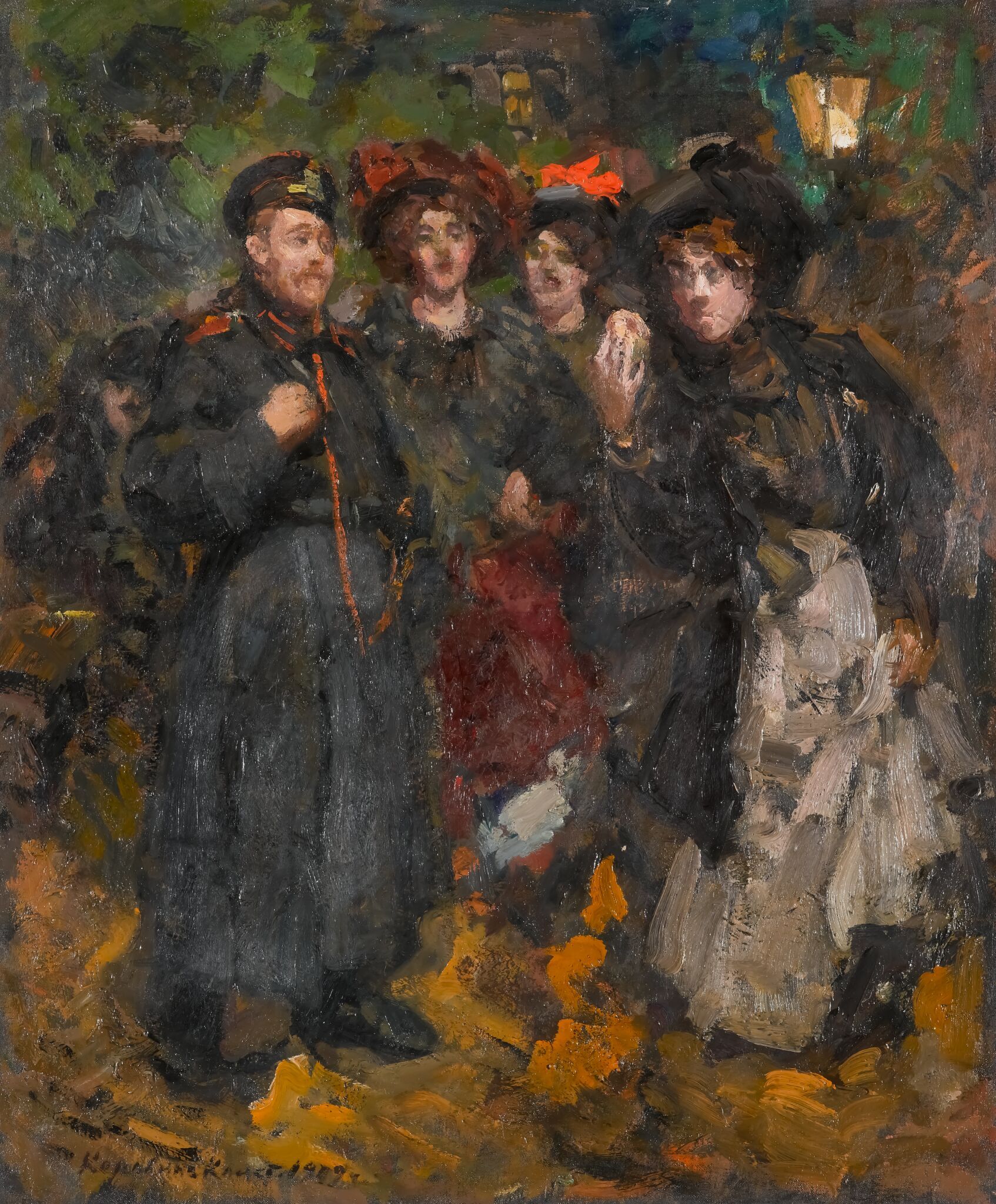
На бульваре
Can I see it?
Unknown
Where is “На бульваре” now? Collection: Tretyakov Gallery, Moscow. Unknown.

Moscow, Russia
The owner is known; whether it is on view today is not.
- Source
- The museum
About the painting
Museum text in Russian
Типичный для Константина Коровина образ шумной улицы, не раз воспетый в произведениях начала 1900-х годов («Париж. Бульвар Капуцинок», «Париж. Кафе де ля Пэ», «Париж ночью. Итальянский бульвар»), в композиции «На бульваре» получает неожиданное прочтение. Отойдя от излюбленной панорамы столичной жизни как калейдоскопа огней, тротуаров, витрин, художник обращается к изображению самих обитателей города, населяющих так часто повторенные им проспекты и переулки.
Компания прохожих – одетый в черную шинель мужчина в окружении трех дам – кажется органическим продолжением окружающего пейзажа. Под желтоватым светом фонаря их фигуры теряют четкие очертания, растворяясь в вечерней мерцающей сероватой воздушной среде. Яркими пятнами горят акценты одежды – красные погоны, окантовка формы, бант на шляпке девушки.
Read on
«Почему все эти страдания, зачем они, когда такое небо, солнце, зелень лугов, цветы, когда бульвары, кафе, куаферы, наряды…» – задает риторический вопрос Константин Коровин в своих воспоминаниях. Эта готовность всматриваться в красоту, улавливать ее совершенные формы в несовершенном мире, отличает живопись мастера, певца «прекрасной эпохи». Коровин, основоположник русского импрессионизма, формулирует суть своего творчества как «выявление красоты и радости жизни», чтобы «не видно было пота и мучений».
Tretyakov Gallery
Details
- Accession number
- 9112
In the catalog
Sources
- Tretyakov Gallery
- Image: Tretyakov Gallery — © State Tretyakov Gallery
In the life of Konstantin Korovin
The whole life1881–1923 · Workplace
Moscow
1900
The Russian display at the World’s Fair in Paris
Korovin takes part in designing the Russian section: as an architect he designs the building of the Handicraft department, and as author of the exposition he paints 31 decorative panels (now in the Russian Museum). The fair awards him two gold and seven silver medals; other accounts say he designed the Central Asia section of the Russian Empire pavilion.
early 1900s
Moves to the Mariinsky and creates “mood” sets
At the beginning of the 20th century Korovin moves from Mamontov’s opera to the Mariinsky Theatre in St. Petersburg. Departing from traditional decor that only indicated the place of action, he creates mood decor conveying the general emotions of the performance, and also designs sets for Stanislavsky’s dramatic productions.
1900
Korovin’s name appears for the first time on a state theatre poster
Korovin’s name appears for the first time on the poster of a state theatre: he produces the sets for Alexander Dargomyzhsky’s opera Rusalka.
1900s
The chief designer of the production and tunics instead of corsets
Together with Alexander Golovin, Korovin introduces at the Bolshoi the figure of a chief designer of the production, working as co-author with the director or choreographer (his creative partner is Alexander Gorsky), and proposes replacing ballerinas’ corsets with looser tunics. The set turns from a mere background into a full object of the performance; Korovin regards work on it as just as much “pure art” as painting shown in exhibitions.
1901
Begins teaching at the Moscow School
From 1901 Korovin teaches, together with Valentin Serov, at the Moscow School of Painting, Sculpture and Architecture; his pupils include Saryan, Mashkov, Falk, Krymov and Gerasimov. Other accounts say he was a professor at the school in 1909–1913.


![Пруд. Осень, Konstantin Korovin, [Конец 19 в.]](/api/img?u=https%3A%2F%2Fgoskatalog.ru%2Fmuzfo-imaginator%2Frest%2Fimages%2Fpublic%2F1600%2F29700169%2F29700169.jpg)


