 Nicholas RoerichRussian, 1874–1947
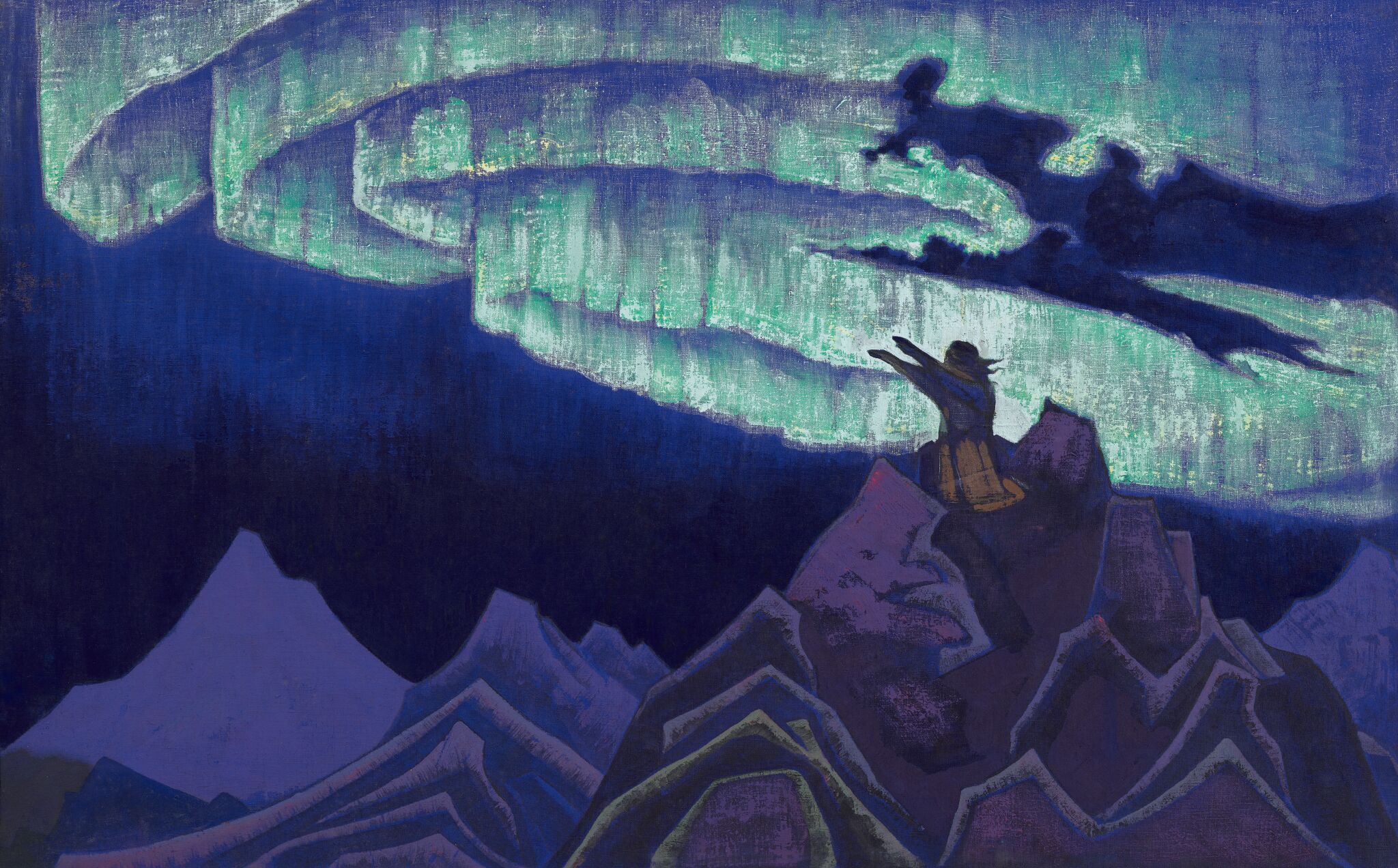
Моисей-Водитель
Can I see it?
Unknown
Where is “Моисей-Водитель” now? Collection: Tretyakov Gallery, Moscow. Unknown.

Moscow, Russia
The owner is known; whether it is on view today is not.
- Source
- The museum
About the painting
Museum text in Russian
Особенным ночным колоритом выделяется картина «Моисей-водитель», написанная в фиолетово-ультрамариновой гамме. Под фосфоресцирующим сиянием на вершине горы на коленях стоит пророк Моисей, протянув руки к небесам с молитвой ко Всевышнему. Картина исполнена Рерихом в Кашмире на пике творческого взлета во время Центрально-Азиатской экспедиции.
В прессе 1920-х годов Рериха называли «художником библейского символизма». В американском журнале The Graphic (March 19, 1927), впервые опубликовавшем репродукцию картины, указано: «Бог поднял Моисея на высокую гору и показал ему Землю Обетованную».
Во Второй книге Моисеевой Ветхого Завета (гл. 19) сказано о божественном явлении: «Были громы и молнии, и густое облако над горой», что в картине Рериха подобно небесному сиянию Aurora Borealis.
Read on
Творчество Рериха наполнено образами подвижников, героев духа, предводителей человечества, благодаря которым получили развитие великие религиозные и философские традиции. В серии «Знамена Востока» (1924–1925) воплотилась мечта художника о единстве религий, точнее, их мирном сосуществовании.
Tretyakov Gallery
Details
- Accession number
- Ж-2597
In the catalog
Sources
- Tretyakov Gallery
- Image: Tretyakov Gallery — © State Tretyakov Gallery
In the life of Nicholas Roerich
The whole life1922–1923
Corona Mundi, Alatas and the Roerich Museum
In 1922 the International Cultural Centre “Corona Mundi” (“Crown of the World”) is founded. In 1923 Roerich sets up the publishing house “Alatas” with Georgy Grebenshchikov and, with the New York businessman Louis Horch, the Roerich Museum and the commercial enterprises World Service. Pancosmos Corporation and Beluha Corporation.
8 May 1923
Leaving America: via Paris to India
Roerich, his wife and their younger son leave America for Paris and then for India, where a large-scale Central Asian expedition is to be organised under his leadership. Later he will visit the United States only three times, briefly, in 1924, 1929 and 1934.
2 December 1923
First months in India: from Bombay to Darjeeling
The Roerichs arrive in India from Paris and travel more than three thousand kilometres — Bombay, Jaipur, Agra, Sarnath, Benares, Calcutta, Darjeeling. In Sikkim they work out the route of the future expedition.
1925–1928
The Central Asian expedition
After Indonesia, Ceylon and Madras in early 1925, the main stage of the expedition begins — through Kashmir, Ladakh, Xinjiang, the USSR (with a visit to Moscow), Siberia, the Altai and Mongolia into Tibet, across unexplored parts of the Trans-Himalaya. Until 1928 archaeological and ethnographic studies are carried out, rare manuscripts are found, about five hundred paintings are made and the “Himalayas” series is begun.
June 1926
In Moscow: gifts for Commissar Chicherin
In June 1926 Roerich personally hands People's Commissar Chicherin a “letter from the Mahatmas” for the Soviet government and a casket of Himalayan earth for the grave of “Mahatma Lenin”; Chicherin passes the gifts on to the Lenin Institute.
autumn 1927
Held near Lhasa: five months in snowbound captivity
The expedition, which has turned into the “Tibetan journey” — a mission of Western Buddhists to Lhasa — is stopped by the Tibetan authorities on the approaches to the city, reportedly under pressure from British intelligence. For five months it is held in snowbound captivity in freezing cold on the Changtang plateau; it is never admitted to Lhasa and fights its way through to India at great cost and with heavy losses.