Gustave CourbetFrench, 1819–1877
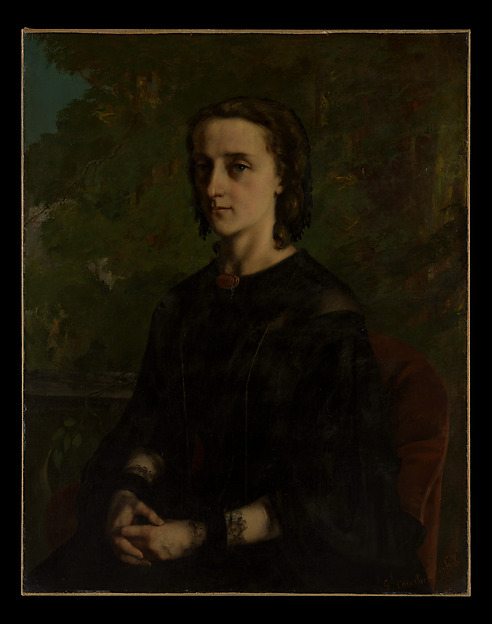
Model Reading in the Studio
Can I see it?
Not on view at present
Where is “Model Reading in the Studio” now? Collection: Art Institute of Chicago, Chicago. Not on view at present. Checked September 29, 2026.

Chicago, United States
It belongs to the collection, but is not on display at present.
- Checked
- In this state since
- Source
- The museum
Details
- Accession number
- 1968.163
In the catalog
Sources
- Art Institute of Chicago
- Image: Art Institute of Chicago — CC0
In the life of Gustave Courbet
The whole lifec. 1844 – 1847
Brasserie Andler: the realists' circle
Around these years Courbet built ties in Paris artistic circles: he frequented the Brasserie Andler next to his studio, where proponents of realism in art and literature gathered, among them Charles Baudelaire and Honoré Daumier.
1844–1847
Ornans, Belgium and the Netherlands
Between 1844 and 1847 Courbet visited Ornans several times and also travelled to Belgium and the Netherlands, where he made contact with picture dealers. His trip to Holland in 1847 further strengthened his admiration for Rembrandt and Hals.
1847
The Salon jury rejects all three paintings
All three of Courbet's paintings submitted to the Salon of 1847 were rejected by the jury. The jury also rejected works by many well-known artists, including Delacroix, Daumier and Théodore Rousseau, who planned to set up their own exhibition gallery, a plan overtaken by the outbreak of revolution.
1848
Salon of 1848: seven paintings accepted, none sold
In 1848 all seven works Courbet submitted to the jury were shown at the Salon, but he did not manage to sell a single painting.
1849
Gold medal at the Salon of 1849
Courbet's first Salon success came with “After Dinner at Ornans”, reminiscent of Chardin and Le Nain; it earned him a gold medal and was purchased by the state. The medal exempted his works from jury approval at the Salon until 1857, when the rule changed.
1850–1851
Salon of 1850–1851: “A Burial at Ornans”
At the Salon of 1850–1851 Courbet showed “The Stone Breakers”, “The Peasants of Flagey” and “A Burial at Ornans”: the canvas, about 3 by 6.7 metres, drew both praise and fierce denunciation, with critics accusing him of a deliberate pursuit of ugliness. Courbet became a celebrity, spoken of as a genius, a “terrible socialist” and a “savage”.