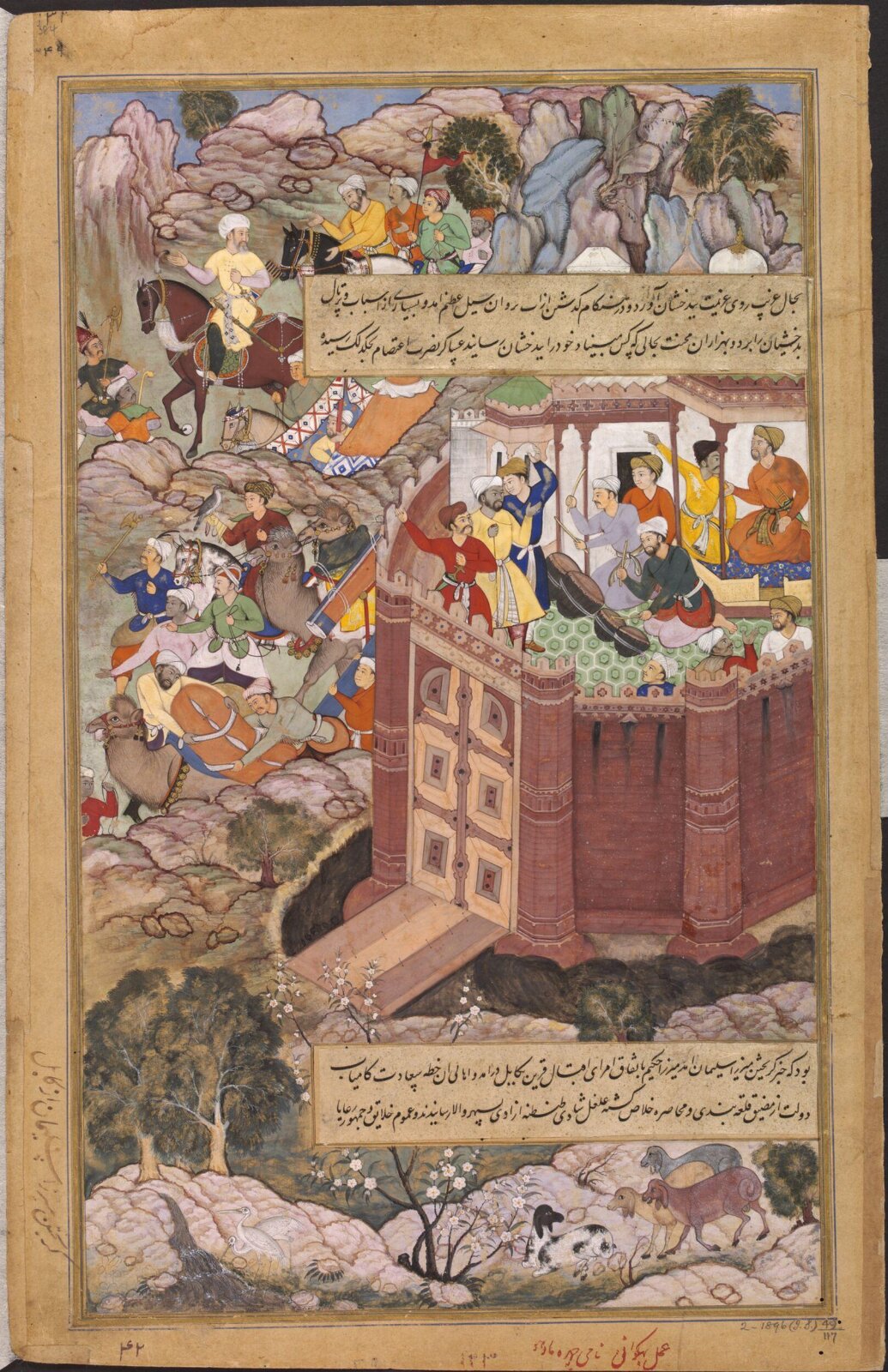
Mirza Sulayman
Can I see it?
Not on view at present
Where is “Mirza Sulayman” now? Collection: Victoria and Albert Museum, London. Not on view at present. Checked September 25, 2026.

London, United Kingdom
It belongs to the collection, but is not on display at present.
- Checked
- In this state since
- Source
- The museum
About the painting
This illustration to the Akbarnama (Book of Akbar) depicts the flight of Mirza Sulayman from the Mughal army in Kabul (present-day Afghanistan). Those bearing the title Mirza were, like the Mughal royal family, descended from Timur, the Central Asian ruler who had briefly conquered Hindustan, as the northern regions of the Indian subcontinent were known, in 1398. As a result, Hindustan was later seen as a legitimate target for conquest by members of the different branches of the family. During the reign of the Mughal emperor Akbar (r.1556–1605) battles between Mughal forces and various Mirzas frequently took place as each tried to seize control of a particular region. The title Mirza is a contraction of the Persian ‘Amirzadeh’, meaning ‘born of the amir’ (that is, Timur). The picture was painted by the Mughal court artist Bhagwan, with the faces done by Madhav.
Read on
The Akbarnama was commissioned by Akbar as the official chronicle of his reign. It was written in Persian by his court historian and biographer, Abu’l Fazl, between 1590 and 1596, and the V&A’s partial copy of the manuscript is thought to have been illustrated between about 1590 and 1595. This is thought to be the earliest illustrated version of the text, and drew upon the expertise of some of the best royal artists of the time.
The V&A purchased the manuscript in 1896 from Frances Clarke, the widow of Major General John Clarke, who bought it in India while serving as Commissioner of Oudh between 1858 and 1862.
Victoria and Albert Museum
Details
- Accession number
- IS.2:49-1896
In the catalog
Sources
- Victoria and Albert Museum
- Image: Victoria and Albert Museum — © Victoria and Albert Museum, London