 Henry MooreEnglish, 1898–1986
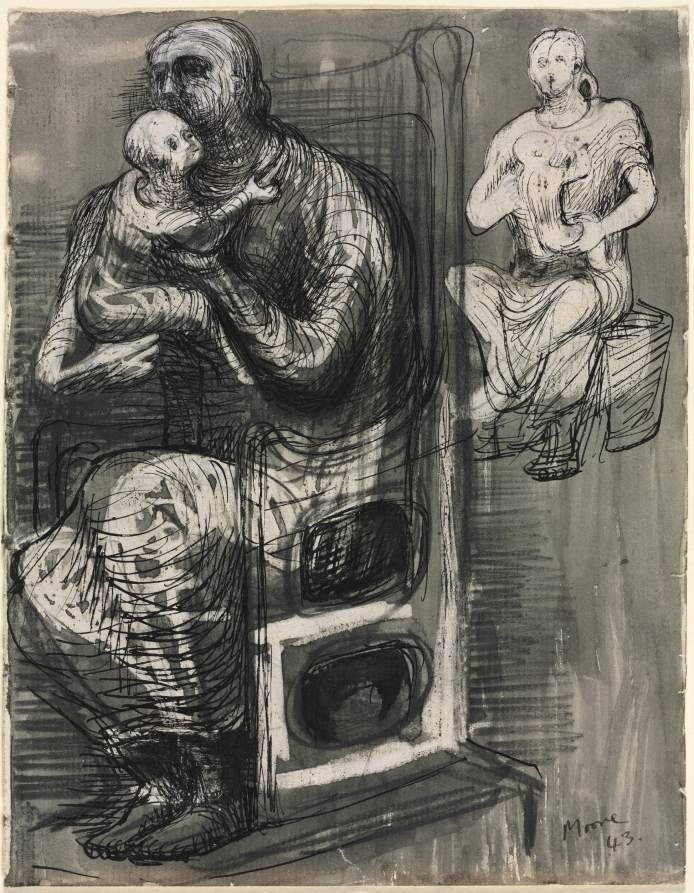
Madonna and Child
Can I see it?
Not on view at present
Where is “Madonna and Child” now? Collection: The Cleveland Museum of Art, Cleveland. Not on view at present. Checked September 29, 2026.

Cleveland, United States
It belongs to the collection, but is not on display at present.
- Checked
- In this state since
- Source
- The museum
About the work
This is a study for a stone sculpture in the Church of St. Matthew, Northampton, England. Moore once commented on the relationship between drawing and sculpure: "Every few months I stop carving for two or three weeks and do life drawing...Drawing and carving are so different that a shape or size or conception which ought to be satisfying in a drawing will be totally wrong realized as stone. Nevertheless there is a connection between my drawings and my sculpture. Drawing keeps one fit, like physical exercises---perhaps acts like water to a plant---and lessens the danger of repeating onself and getting into a formula. It enlarges one's form repertoire, one's form experience. But in my sculpture I do not draw directly upon the memory or observation of a particular object, but rather use whatever comes up from my general fund of knowledge of natural forms."
The Cleveland Museum of Art
Details
- Accession number
- 1947.685
In the catalog
Sources
- The Cleveland Museum of Art
- Image: The Cleveland Museum of Art — © 2010 The Henry Moore Foundation. All Rights Reserved / Artists Rights Society (ARS), New York
In the life of Henry Moore
The whole life1940–1986
A bomb in Hampstead: the move to Hoglands
In September 1940 bomb shrapnel hit the Moores’ Hampstead home and they left London for Hoglands, a farmhouse in the hamlet of Perry Green near Much Hadham in Hertfordshire. It remained Moore’s home and workshop for the rest of his life; though he grew wealthy he never felt the need to move to larger premises.
August 1941
The miners of Wheldale
In August 1941 the War Artists’ Advisory Committee commissioned Moore to draw miners working underground at the Wheldale Colliery in Yorkshire, where his father had worked. He drew the shelterers passively awaiting the all-clear, while the miners aggressively worked the coal-faces.
1944
The death of Moore’s mother
Moore’s mother, Mary (née Baker), died in 1944; two years later his daughter was named after her.