 James Jacques Joseph TissotFrench, 1836–1902
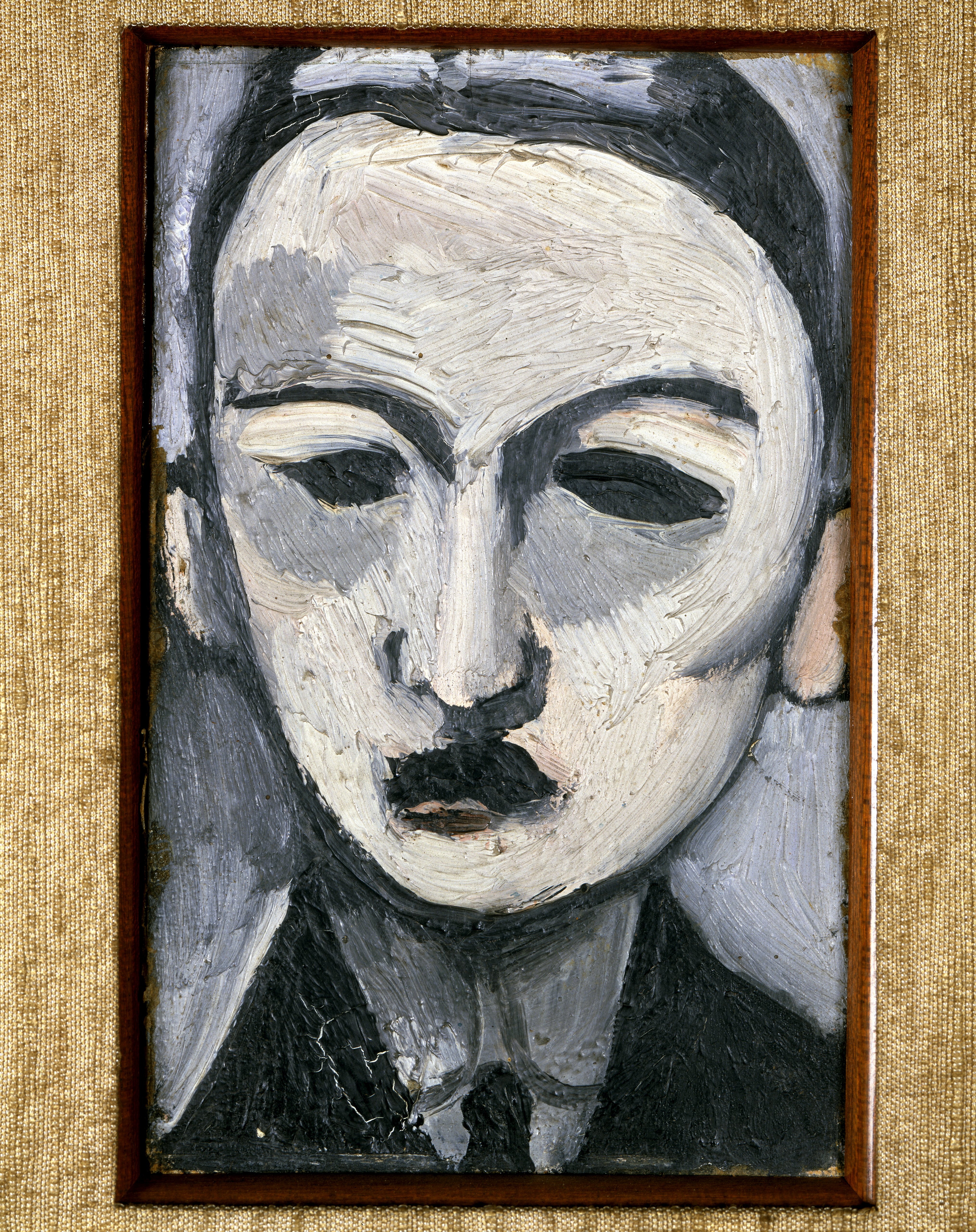
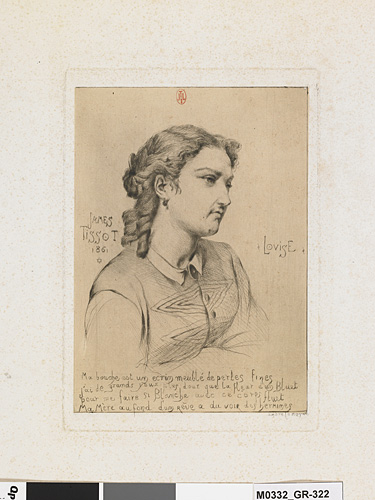
Louise
May one see it?
Unknown
Besançon, France
The owner is known; whether it is on view today is not.
- In this state since
- Source
- The museum
About the work
In the museum's own words — in French
eau-forte et pointe sèche sur papier vélin ocre
Musée des Beaux-Arts et d'Archéologie de Besançon
Particulars
- Accession number
- Gr.322
What it shows
In the catalog
Sources
- Musée des Beaux-Arts et d'Archéologie de Besançon
- Image: Musée des Beaux-Arts et d'Archéologie de Besançon — © Pierre Guenat; Ministère de la Culture (France), base Joconde
Meanwhile, in the life of James Jacques Joseph Tissot
The whole life1859
Salon debut: scenes from “Faust”
In 1859 Tissot exhibited at the Paris Salon for the first time, showing five paintings of medieval scenes, many of them from Goethe's “Faust” (he made his debut at 23).
1859
With Henri Leys in Antwerp
In 1859, before his first Salon, Tissot met the Belgian painter Henri Leys in Antwerp; his influence, along with that of the Germans Peter von Cornelius and Moritz Retzsch, shows in Tissot's medieval scenes.
1860
The State buys “The Meeting of Faust and Marguerite”
Before he had won any Salon medal, the French government paid 5,000 francs for his “Meeting of Faust and Marguerite”; in 1861 the painting was shown at the Salon together with a portrait and other works. It was acquired for the Luxembourg Gallery.
1862
First showings in London
In 1862 Émile Péreire lent his painting “Walk in the Snow” to the International Exhibition in London, and in 1863 three of Tissot's works were shown at the gallery of the dealer Ernest Gambart. After 1862 he began to move from medieval subjects to narrative scenes of Victorian life suited to English taste.