
 Paul CézanneFrench, 1839–1906
Louis Guillaume
May one see it?
Yes, receiving visitors

National Gallery of Art
Room84 · West Building, Main FloorWashington, D.C., United States
On public display.
- Checked
- 5 hours ago
- In this state since
- Aug 19, 2026
- Source
- The museum's own collection data
About the painting
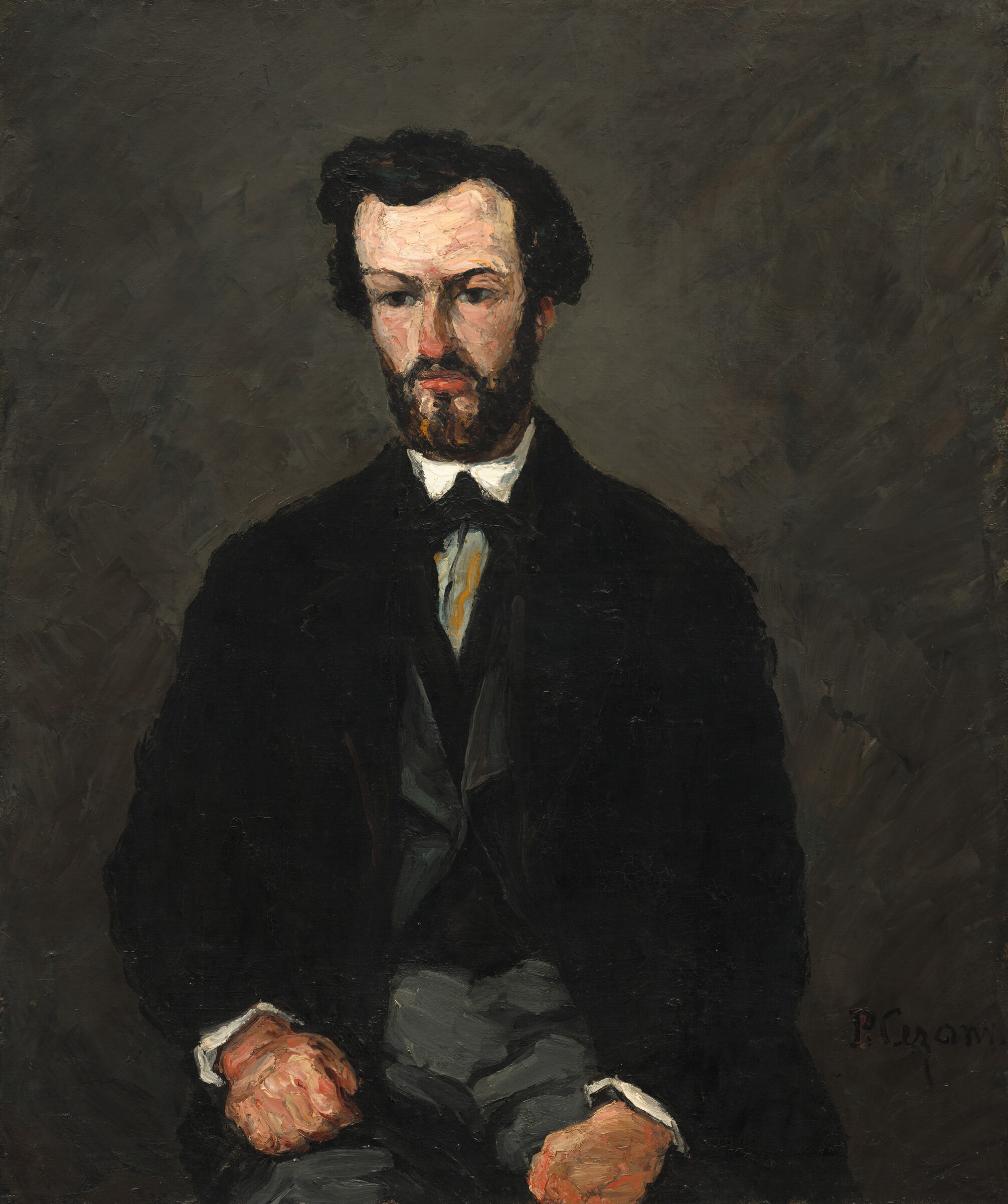
Portrait of Louis Guillaume is an oil-on-canvas portrait painted c. 1882 by the French Post-Impressionist artist Paul Cézanne. Guillaume was the son of friends of the artist and a friend of Cézanne's son, Paul. He is portrayed in a highly sculpted manner with a near-expressionless, uncommunicative face and an immobile, lifeless body. In form and complexity, the painting is ahead of its time. It contains many abstractions, mostly in its presentation of the head and body as simple, solid shapes, a technique later taken up and developed by Henri Matisse.
Read on
The work's low-key colours, mostly greys, whites and dark greens, achieve a sombre tone, echoed by the shy reserve on the boy's face. While his skin is rendered with pearly white paint, giving the surface a lively sheen or glow, this contrasts with his black, severely cropped hair and dark clothes, while his eyes are only black hollows. Heavy-lidded, they are, according to art critic Meyer Schapiro, "without spiritual light... they belong to a world of shadow."
One critic famously wrote that Cézanne painted the heads of friends as if they were apples, and that sense of cool detachment is evident in this work. Its formal qualities are reminiscent of a still-life or landscape, however while at first look there is evidence of the artist's awareness of the "abyss between human beings", there are signs of hope and connection in the delicately rendered tones of the cheeks, the ornament of the wall, the folds of the dress, and the cravat which echoes the verticals of the folds of the face and wall.
The painting was purchased by Ambroise Vollard by 1906. It was sold to a Florentine collector c. 1907 before it was sold in 1927 to Chester Dale in New York. In 1963 Dale donated the work to the National Gallery of Art in Washington, D.C.
Particulars
- Accession number
- 1963.10.101
What it shows
In the catalog
Sources
- National Gallery of Art: the museum's own open data · fetched 4 days ago
- Image: National Gallery of Art — Museum open access
Meanwhile, in the life of Paul Cézanne
The whole life1877
Sixteen Works at the Third Impressionist Exhibition
He presented 16 works at the third Impressionist exhibition, once again met with harsh criticism. It was the last time he exhibited with the Impressionists.
March 1886
Zola's Novel "The Masterpiece" and the Crisis of a Friendship
Zola published "The Masterpiece" (L'Œuvre), a novel about a failed painter, Claude Lantier, in whom Cézanne recognized himself. It was long believed that the friendship ended forever, but a rediscovered letter of 1887 shows that relations continued for some time.
28 April 1886
Married: Marie-Hortense Fiquet
28 April 1886
Marriage to Hortense Fiquet
He married Hortense Fiquet in Aix in the presence of his parents. The marriage was concluded not out of love but to secure the rights of their fourteen-year-old son Paul as a legitimate heir.
October 1886
Death of His Father and Inheritance
After the death of Louis-Auguste, Cézanne, together with his mother and sisters, inherited his fortune, including the Jas de Bouffan; the artist's financial situation eased considerably ("he left me an income of 25,000 francs").
1888–1890 · Residence
quai d'Anjou




![Scenes from the Passion of Christ: The Descent into Limbo [right panel], Andrea Vanni, 1380s](https://api.nga.gov/iiif/4205a539-eadd-4486-89a7-3cff9c1ba428/full/!2400,2400/0/default.jpg)


