 Konstantin Korovin1861–1939
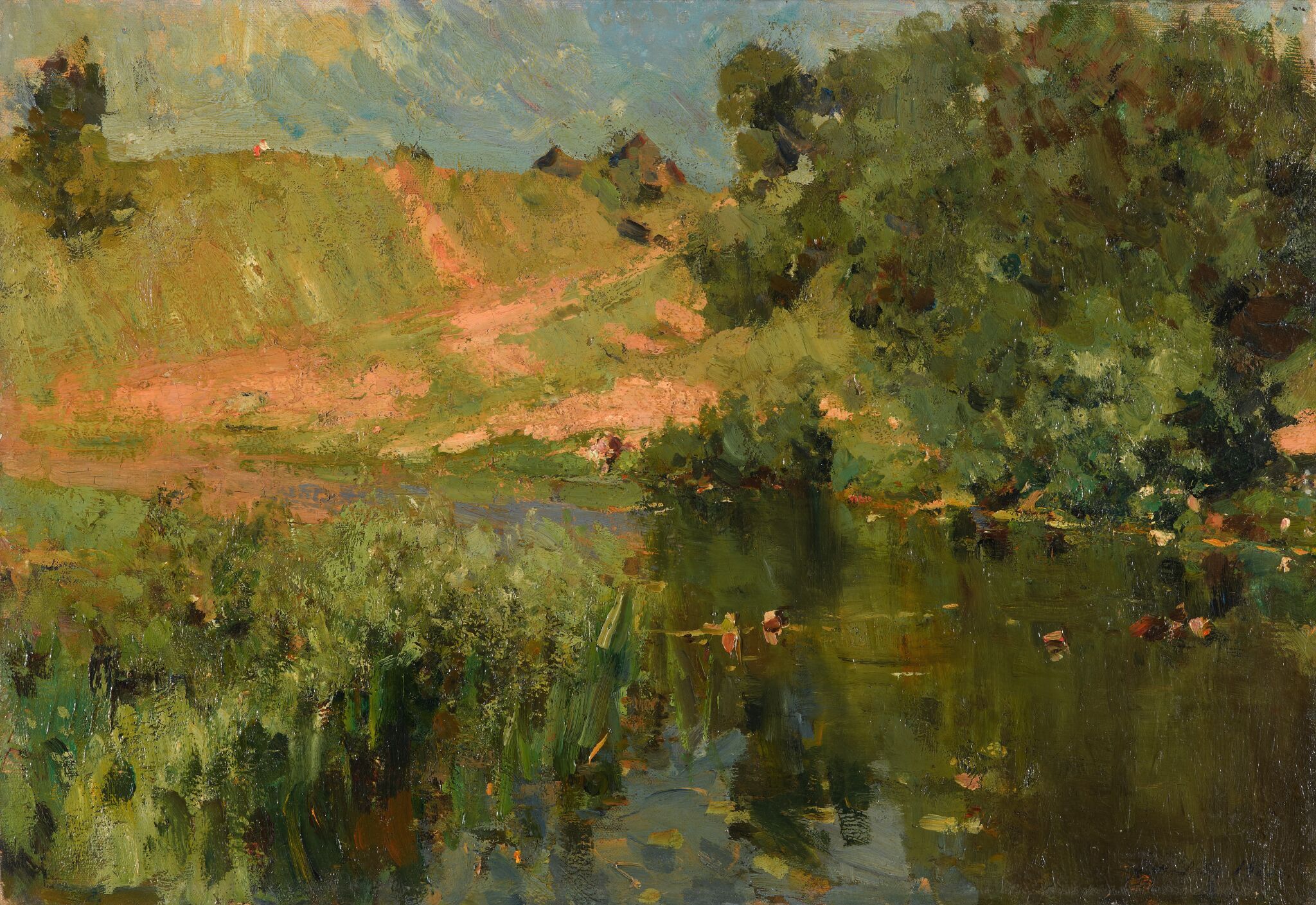
Лето
May one see it?
Unknown

Tretyakov Gallery
Moscow, Russia
The owner is known; whether it is on view today is not.
- Source
- The museum
About the painting
In the museum's own words — in Russian
В творчестве Константина Коровина 1900 год выдался на редкость плодотворным и многообразным: он обращался к разным видам искусства помимо живописи – к архитектуре и декоративно-прикладному творчеству, театральной декорации и книжной иллюстрации. Год был невероятно успешным и по количеству наград, полученных Коровиным на Всемирной выставке в Париже. 1900-й был отмечен также началом сотрудничества с Большим театром, открывшим для мастера новые возможности в области театрально-декорационного искусства, что не могло не повлиять на станковую живопись, появление в ней новых художественных приемов.
Read on
При этом в начале 1900-х годов можно обнаружить немало произведений, в которых отразились поиски мастера, относящиеся к двум предыдущим десятилетиям. Речь идет о тонко выверенной тональной цветовой разработке его картин, благодаря которой формировалось единство колористического решения того или иного произведения. Примером может служить картина «Двор» (1904, ГТГ). Такой целостностью характеризуется и живописно-пластическое воплощение представляемого пейзажа «Лето», построенного на созвучии близких цветов. В картине мельчайшие нюансы оливково-зеленых красок деревьев и травы, отражающихся в темной воде реки, корреспондируют со светлыми зеленовато-коричневыми тонами холмов дальнего плана, ярко освещенных лучами солнца, благодаря чему создается обобщенный эмоционально насыщенный образ знойного жаркого лета.
Tretyakov Gallery
Particulars
- Accession number
- 4981
In the catalog
Sources
- Tretyakov Gallery
- Image: Tretyakov Gallery — © State Tretyakov Gallery
Meanwhile, in the life of Konstantin Korovin
The whole life1881–1923 · Workplace
Moscow
1900
The Russian display at the World’s Fair in Paris
Korovin takes part in designing the Russian section: as an architect he designs the building of the Handicraft department, and as author of the exposition he paints 31 decorative panels (now in the Russian Museum). The fair awards him two gold and seven silver medals; other accounts say he designed the Central Asia section of the Russian Empire pavilion.
1900s
The chief designer of the production and tunics instead of corsets
Together with Alexander Golovin, Korovin introduces at the Bolshoi the figure of a chief designer of the production, working as co-author with the director or choreographer (his creative partner is Alexander Gorsky), and proposes replacing ballerinas’ corsets with looser tunics. The set turns from a mere background into a full object of the performance; Korovin regards work on it as just as much “pure art” as painting shown in exhibitions.
1900
Korovin’s name appears for the first time on a state theatre poster
Korovin’s name appears for the first time on the poster of a state theatre: he produces the sets for Alexander Dargomyzhsky’s opera Rusalka.
early 1900s
Moves to the Mariinsky and creates “mood” sets
At the beginning of the 20th century Korovin moves from Mamontov’s opera to the Mariinsky Theatre in St. Petersburg. Departing from traditional decor that only indicated the place of action, he creates mood decor conveying the general emotions of the performance, and also designs sets for Stanislavsky’s dramatic productions.
1901
Begins teaching at the Moscow School
From 1901 Korovin teaches, together with Valentin Serov, at the Moscow School of Painting, Sculpture and Architecture; his pupils include Saryan, Mashkov, Falk, Krymov and Gerasimov. Other accounts say he was a professor at the school in 1909–1913.


![Пруд. Осень, Konstantin Korovin, [Конец 19 в.]](/api/img?u=https%3A%2F%2Fgoskatalog.ru%2Fmuzfo-imaginator%2Frest%2Fimages%2Fpublic%2F1600%2F29700169%2F29700169.jpg)


