 Eugène DelacroixFrench, 1798–1863
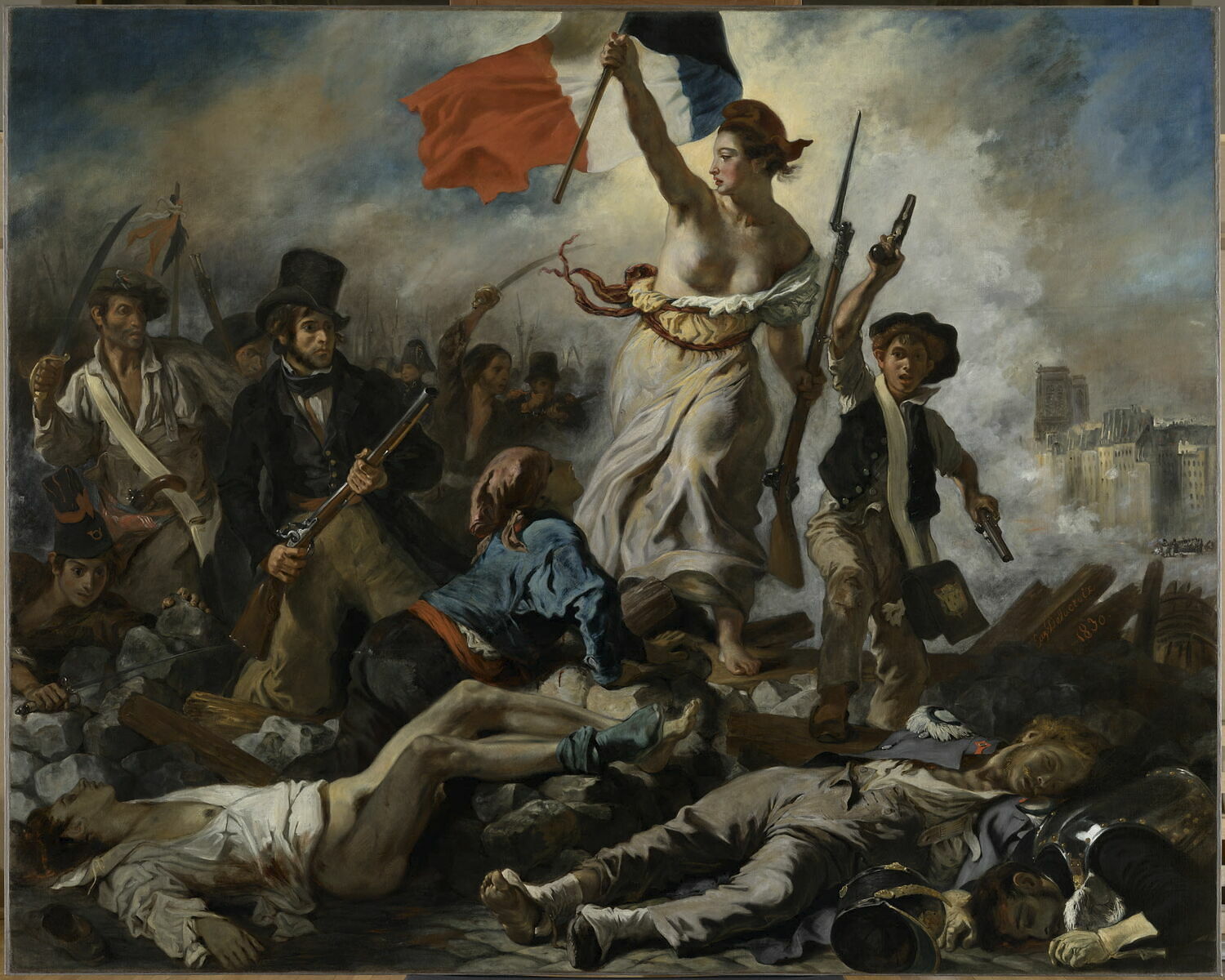
Liberty Leading the People
Le 28 juillet 1830. La Liberté guidant le peuple
May one see it?
Yes, receiving visitors

Musée du Louvre
Room700, Aile Denon, Niveau 1Paris, France
On public display.
- Checked
- 7 days ago
- In this state since
- Sep 26, 2026
- Source
- The museum's own collection data
About the painting
Liberty Leading the People (French: La Liberté guidant le peuple ) is a painting of the Romantic era by the French artist Eugène Delacroix, commemorating the July Revolution of 1830 that toppled King Charles X (r. 1824–1830). A bare-breasted "woman of the people" with a Phrygian cap personifying the concept and Goddess of Liberty, accompanied by a young boy brandishing a pistol in each hand, leads a group of various people forward over a barricade and the bodies of the fallen while holding aloft the flag of the French Revolution—the tricolour, which again became France's national flag after these events—in one hand, and brandishing a bayonetted musket with the other. The figure of Liberty is also viewed as a symbol of France and the French Republic known as Marianne. The painting is sometimes wrongly thought to depict the French Revolution of 1789.
Read on
Liberty Leading the People is exhibited in the Louvre in Paris.
Particulars
- Accession number
- RF 129
Sources
- Musée du Louvre: the museum's own open data · fetched 7 days ago
- Image: Musée du Louvre — © 2024 GrandPalaisRmn (musée du Louvre) / Rabeau/Didierjean
Meanwhile, in the life of Eugène Delacroix
The whole life1831
"Liberty" at the Salon of 1831
Liberty Leading the People was enthusiastically received by the public at the Salon of 1831 and immediately acquired by the state for 3,000 francs for the throne room of the Luxembourg Palace.
14 March 1831 · Award
Knight of the Legion of Honour
1832
Journey to Spain and North Africa
As part of the diplomatic mission of Charles-Edgar de Mornay, Delacroix traveled to Morocco shortly after the French conquest of Algeria. The journey proved a turning point: he made dozens of sketches, and his impressions of North Africa nourished his art for the rest of his life.
1832
"Liberty" Removed from Public Display
By 1832 officials had deemed the painting's glorification of liberty too provocative and removed it from public display; nevertheless Delacroix continued to receive state commissions.