Georges BraqueFrench, 1882–1963
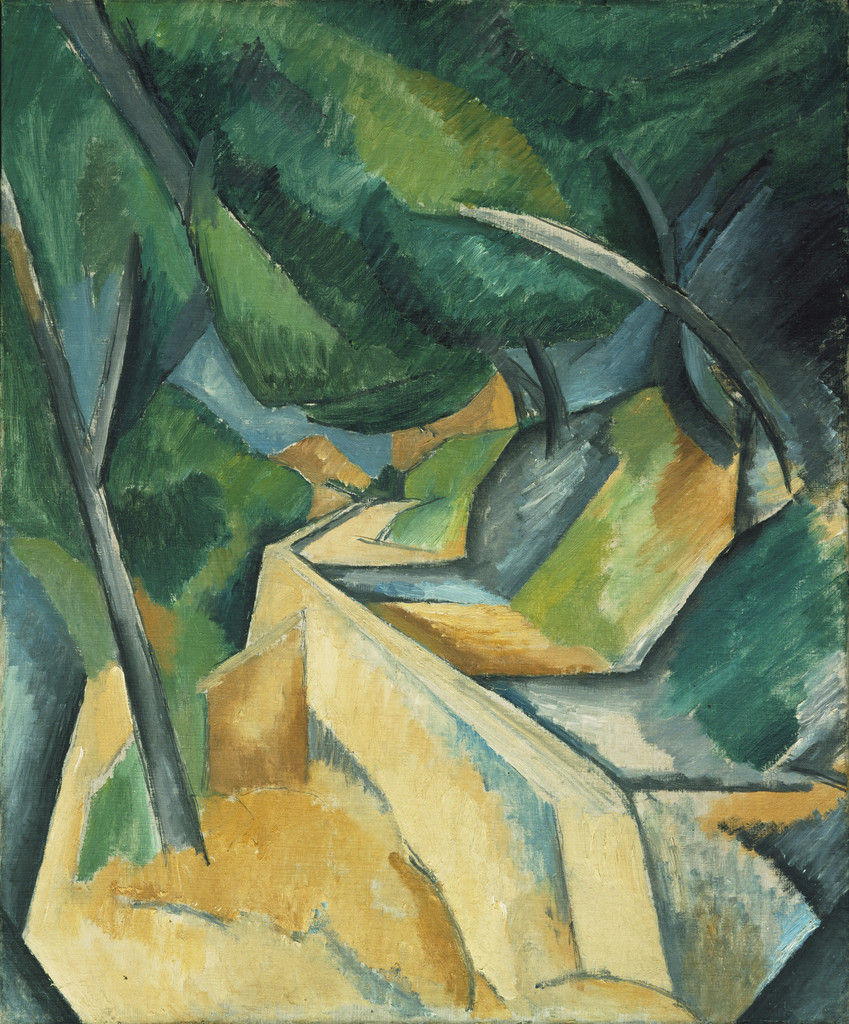
Landscape at L'Estaque
May one see it?
Not receiving at present

Art Institute of Chicago
Chicago, United States
It belongs to the collection, but is not on display at present.
- Checked
- In this state since
- Source
- The museum
About the painting
Born into a family of decorative and house painters, Georges Braque once remarked that his decision to become a painter was no more premeditated than his choosing to breathe. After apprenticing in his father’s shop and studying at an art school in his hometown of Le Havre, he went to Paris. In 1905, at the annual Salon d’Automne, he was confronted by the arresting paintings of Henri Matisse and others who had begun to employ vibrant, unmixed colors and energetic, rhythmic brushwork. The unbridled intensity of these works prompted a disapproving critic to call the artists "fauves" (wild beasts). Braque quickly joined the group.
Read on
Braque painted Landscape at L’Estaque on his first trip to this town on the French Mediterranean coast. He and other young artists were drawn to Provence, in southeastern France, because of its clear light and because of their reverence for the art of Paul Cézanne, who worked in and around the area until his death in 1906. Braque drew upon Cézanne’s use of faceted brushwork, distorted perspectives, and color to structure his compositions for this view down a steep, tree-lined road. Using a palette of highly saturated reds, oranges, and yellows, Braque evoked a sense of turbulent heat, despite the shade provided by the trees. Cézanne’s influence continued to exert itself over Braque in other, critical ways: in early 1908, he would join Pablo Picasso in the development of a revolutionary new style based on the formal construction that constitutes the core of Cézanne’s vision. That style would come to be known as Cubism.
—Entry, Master Paintings in the Art Institute of Chicago, 2013, p.102.
Art Institute of ChicagoCC BY 4.0
Particulars
- Accession number
- 1981.65
In the catalog
Sources
- Art Institute of Chicago
- Image: Art Institute of Chicago — © the artist or rights holder
Meanwhile, in the life of Georges Braque
The whole life1903–1904
Académie Humbert: meets Marie Laurencin and Francis Picabia
The year after receiving his decorator's certificate, Braque enrolled at the Académie Humbert in Paris and painted there until 1904; there he met Marie Laurencin and Francis Picabia.
1905
Conversion to Fauvism
Braque's earliest works were Impressionist, but after seeing the Fauves — Matisse, Derain and others — exhibited in 1905, he adopted their brilliant colour. He worked most closely with his fellow natives of Le Havre, Raoul Dufy and Othon Friesz, developing a somewhat more subdued Fauvism.
1906
With Othon Friesz to L'Estaque and Antwerp
In 1906 Braque travelled with Friesz to paint in L'Estaque, in Antwerp and back home in Le Havre. The same year produced Seascape, L'Estaque, now in the Thyssen-Bornemisza Museum in Madrid.
May 1907
Success at the Salon des Indépendants
In May 1907 Braque successfully exhibited Fauvist works at the Salon des Indépendants.
October – November 1907
Meets Pablo Picasso
In the autumn of 1907 Braque visited Picasso's studio, and after the meeting sharply changed his manner, striving for economy of means and geometric forms (another view holds that the encounter rather accelerated and intensified his pursuit of Cézanne's ideas).
14 November 1908
Exhibition at Kahnweiler's and Vauxcelles's “cubes”
Reviewing Braque's exhibition at Kahnweiler's gallery, the critic Louis Vauxcelles called him a daring man who despises form, “reducing everything, places and figures and houses, to geometric schemas, to cubes”.