Albrecht DürerGerman, 1471–1528
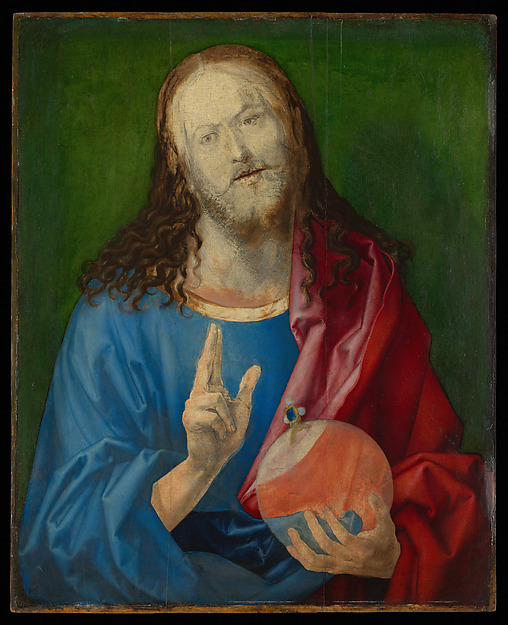
Kristus a matka
Can I see it?
Unknown
Where is “Kristus a matka” now? Collection: Slovak National Gallery, Bratislava. Unknown.

Bratislava, Slovakia
The owner is known; whether it is on view today is not.
- In this state since
- Source
- The museum
Details
In the catalog
Sources
- Slovak National Gallery
- Image: Slovak National Gallery — Public Domain Mark 1.0
In the life of Albrecht Dürer
The whole lifeJuly 1494
Marries Agnes Frey
Soon after returning to Nuremberg the 23-year-old Dürer married Agnes Frey, daughter of a prominent brass worker and amateur harpist; the match had been arranged in his absence, and marriage was required to open a workshop of his own. They had no children, and his letters suggest the marriage was not a happy one.
1494–1495
First journey to Italy
Within three months of the wedding Dürer left alone for Italy, perhaps fleeing an outbreak of plague in Nuremberg. Crossing the Alps he made watercolour landscapes; in Venice he studied its art and judged Giovanni Bellini the best of its painters; Mantegna and Pollaiuolo left their mark on him.
1495
Opens his own workshop
Dürer opened his own workshop in Nuremberg, where over the next ten years he created much of his printmaking. His godfather, the publisher Anton Koberger, helped issue the first series; the city's crafts were governed by the Council rather than guilds, leaving him free to try new techniques and sell his own impressions.
1505
Second journey to Italy
Dürer set off for Italy again — perhaps not only to earn money but also to stop Marcantonio Raimondi from copying his prints. His stay in Venice is known from ten surviving letters to Pirckheimer.
1511
Publishes the Great Passion and the Life of the Virgin
Dürer published two woodcut series as books, the Great Passion and the Life of the Virgin, with a second edition of the Apocalypse and the 37 woodcuts of the Little Passion. His post-Venetian woodcuts developed chiaroscuro modelling.
1512
Emperor Maximilian I becomes his chief patron
From 1512 Emperor Maximilian I was Dürer's chief patron. For him Dürer and his workshop produced the Triumphal Arch, a giant woodcut 295 × 357 cm printed from 192 blocks and modelled on the triumphal arches of ancient Rome.
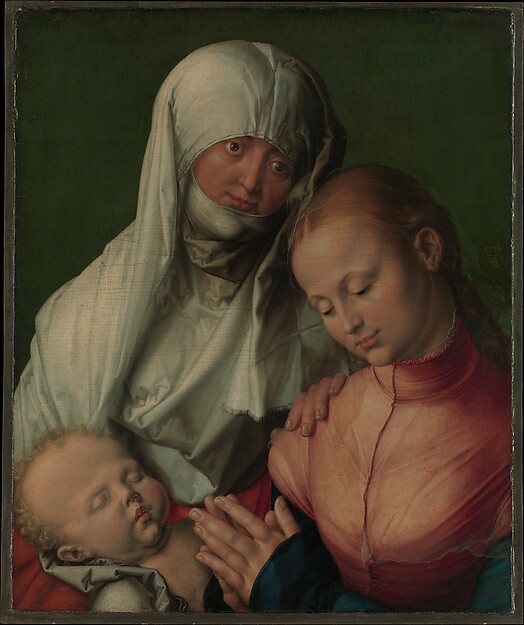
![Madonna and Child [obverse], Albrecht Dürer, c. 1496/1499](https://api.nga.gov/iiif/878db7e6-10ae-4cae-ba5d-6d6f5c413ae8/full/!2400,2400/0/default.jpg)
![Lot and His Daughters [reverse], Albrecht Dürer, c. 1496/1499](https://api.nga.gov/iiif/7565a449-f82a-414b-9bda-c93f55a51b4d/full/!2400,2400/0/default.jpg)