 Viktor Vasnetsov1848–1926
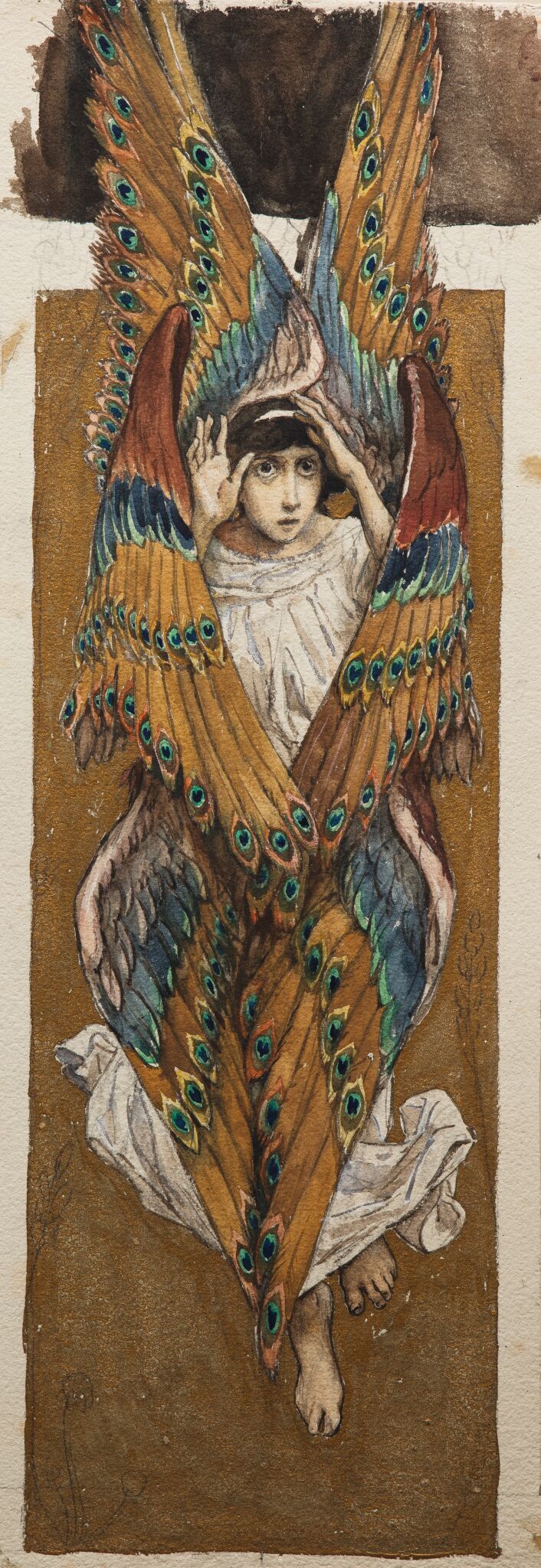
Херувим с поднятыми руками
Can I see it?
Unknown
Where is “Херувим с поднятыми руками” now? Collection: Tretyakov Gallery, Moscow. Unknown.

Moscow, Russia
The owner is known; whether it is on view today is not.
- In this state since
- Source
- The museum
About the work
Museum text in Russian
Владимирский собор – храм-памятник в честь 900-летия Крещения Руси. Его постройка – попытка осуществления планомерного научного подхода к возрождению национальной традиции. Обращенная к самым истокам, к византийскому стилю, программа росписей, соединившая библейские и евангельские сюжеты с композициями на тему крещения Руси, была разработана историком искусства, археологом А.В. Праховым.
Главным художником, определившим облик храма, стал В.М. Васнецов. Соединение реалистически трактованных фигур с фоном, написанным в условной манере русских икон и миниатюр, орнаментальная оправа для всех фигур и сцен – часть того своеобразного стиля, который был выработан Васнецовым во Владимирском соборе и вошел в художественный обиход под названием «васнецовский стиль», где проявились уже черты стиля модерн.
Read on
Херувим – шестикрылый ангел, приближенный к престолу Бога. Изображения двух херувимов должны были располагаться на западной стене по сторонам от композиции «Труды прародителей».
Графические эскизы росписей стали идеальным воплощением синтеза древних традиций, собственного видения автора и требований эпохи. Единственная в своем роде крупнейшая коллекция сюжетных эскизов и превосходная подборка декоративных композиций – гордость собрания Третьяковской галереи.
Tretyakov Gallery
Details
- Accession number
- 1101
In the catalog
Sources
- Tretyakov Gallery
- Image: Tretyakov Gallery — © State Tretyakov Gallery
In the life of Viktor Vasnetsov
The whole life1878–1890 · Career
the Peredvizhniki
From 1878 he belonged to the Society of Travelling Art Exhibitions (the Peredvizhniki): he took part in its activity in 1878–1890 and exhibited with it until 1897; he was admitted for the realism and sharp social subjects of his genre paintings.
1884–1889
Friendship with Mikhail Vrubel in Kiev
While living in Kiev he became friends with Mikhail Vrubel, who was also working on the cathedral; while they worked together Vasnetsov taught the younger artist a great deal.
1885
Rimsky-Korsakov’s “The Snow Maiden”: Berendey’s palace
In 1885 he created sets and costumes for Rimsky-Korsakov’s “The Snow Maiden” at Savva Mamontov’s Private Opera — a three-dimensional design for Berendey’s palace, whose colours came from folk festivities in Vyatka and Moscow; in 1881 he had already prepared sketches and sets for a home production of Ostrovsky’s play.
1885–1895
The controversy over the Kiev frescoes: Stasov, Benois, Filosofov
Contemporaries disagreed: Dmitry Filosofov saw in the frescoes “the first bridge over the 200-year-old gulf” between classes of Russian society, Stasov a sacrilegious play with the religious feelings of the people, and Alexandre Benois a “sumptuous and frivolous féerie”; Vasnetsov himself saw the cathedral as a “Bible for the poor”.
1891–1894
He builds a terem-style house in Troitskaya Sloboda
In 1891 he bought land in Troitskaya Sloboda and himself devised a wooden mansion in the style of an ancient Russian terem; construction, carried out by peasants from Vladimir Governorate, was completed in 1894, and the second-floor studio (110 m², six-metre ceilings) became the place where the “Bogatyrs”, “The Snow Maiden” and the “Poem of Seven Fairy Tales” were painted; Governor-General Grand Duke Sergei Alexandrovich allowed the house to exceed the height limit.
1892
Professor of the Imperial Academy of Arts
From 1892 he was a professor of the Imperial Academy of Arts, and in 1893–1905 a full member of the Academy (under its new statute).