 Mikhail Vrubel1856–1910
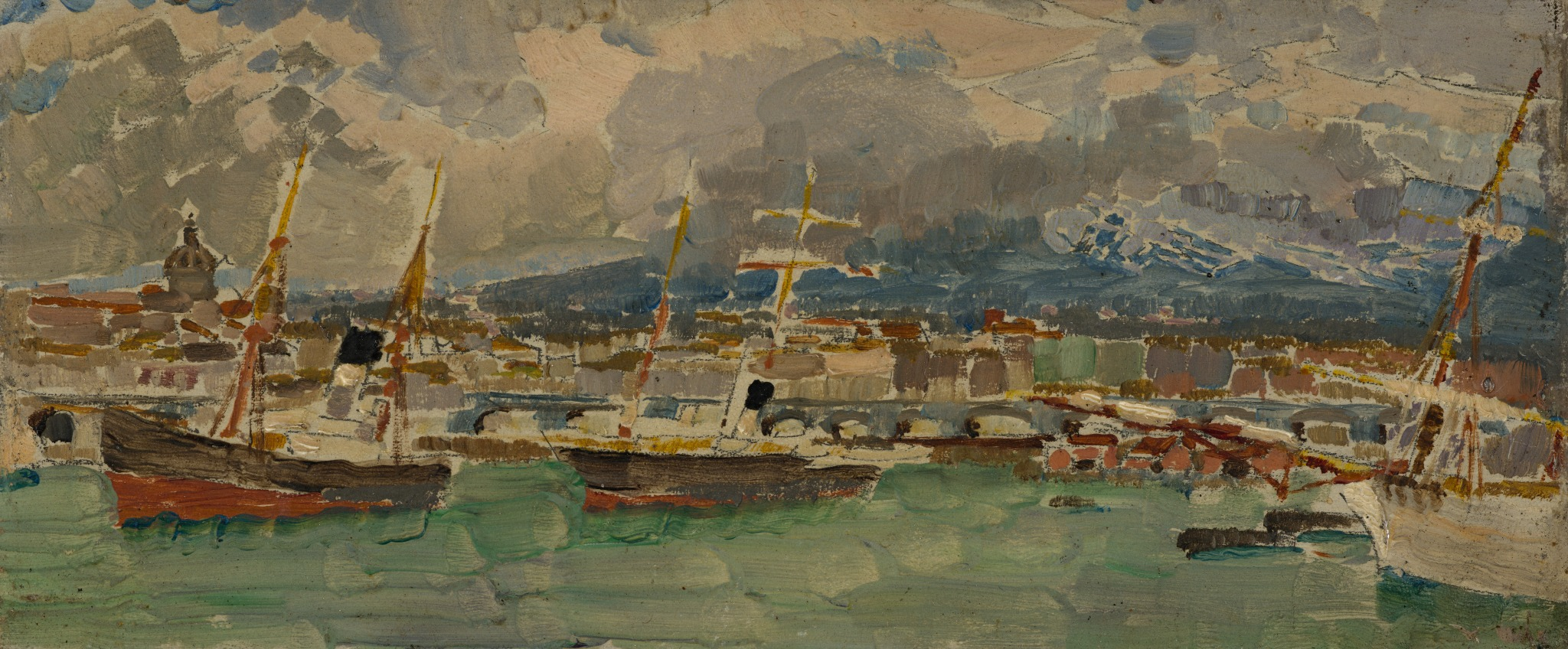
Катанья. Сицилия
Can I see it?
Unknown
Where is “Катанья. Сицилия” now? Collection: Tretyakov Gallery, Moscow. Unknown.

Moscow, Russia
The owner is known; whether it is on view today is not.
- Source
- The museum
About the painting
Museum text in Russian
Этюд «Катанья. Сицилия» был написан Михаилом Врубелем во время его поездки в Италию в марте – начале апреля 1894 года. Художник был, по его словам, «командирован» туда Саввой Мамонтовым для сопровождения его старшего сына Сергея на лечение. Путешественники жили в местечке Стурла близ Генуи. Возвращались они в Россию по морю через Неаполь, Бриндизи, Пирей, Афины и Константинополь. Во время этой поездки Врубель исполнил около 20 пейзажных этюдов. В творчестве художника пейзаж как самостоятельный жанр не занимает сколько-нибудь значительного места. Но море всегда увлекало его своей романтической изменчивостью, и он мастерски изображал его различные состояния. Это увлечение прослеживается в средиземноморских этюдах Врубеля. Среди них этюд «Катанья. Сицилия» отмечен динамичностью в изображении морского порта со множеством судов и их оснасткой, четко вырисовывающейся на фоне гор и неба.
Read on
В нем обращает на себя внимание «граненость» формы, подобная той, какую можно видеть в картинах художника. Он пишет свои этюды в столь же сложной технике, сочетая наложение краски кистевыми мазками и мастихином. Таким образом достигается особая «мозаичность» мазка, которой переданы в этюде вода, корабли, горы. Эта техника придает произведению особое богатство фактуры и трепетность. В «Катанье» она усиливается еще благодаря тому, что Врубель местами оставляет незакрашенными куски холста – например, вокруг мачт. В этой работе можно видеть также и своеобразное перенесение в масляную живопись приемов акварельной техники. Особенно это заметно в том, как написана вода: длинные мазки в изображении воды представляются по-акварельному прозрачными. Эта сложная смешанная техника с использованием кисти и мастихина, примененная Врубелем по отношению к этюду, предполагающему непосредственность и живость в восприятии пейзажного мотива, была новым словом для художника и влекла за собой привнесение в работу элементов декоративности
Tretyakov Gallery
Details
- Accession number
- 6129
In the catalog
Sources
- Tretyakov Gallery
- Image: Tretyakov Gallery — © State Tretyakov Gallery
In the life of Mikhail Vrubel
The whole life1891–1892
A second journey to Italy
Vrubel accompanied the Mamontovs to Italy as an adviser to the Abramtsevo pottery, but quarrelled with Elizaveta Mamontova and left with Savva Mamontov for Milan, where his half-sister Lilya was studying singing. He spent the winter in Rome, where he was to carry out Mamontov’s commissions — sets for “The Merry Wives of Windsor” and a new curtain for the Private Opera: he lodged with the Svedomsky brothers and later worked in the studio of Alexander Rizzoni.
mid-1890s
With Schechtel on the Morozov mansions
His work for Mamontov secured Vrubel’s reputation in Moscow, and together with Fyodor Schechtel he decorated S. T. Morozov’s mansion on Spiridonovka Street and A. V. Morozov’s house in Podsosensky Lane. His most important sculpture is held to be the “Gothic” group “Robert and the Nuns”, which adorns the staircase lantern of the Morozov mansion.
early 1896
Meeting Nadezhda Zabela
In St Petersburg Vrubel stepped in for the ailing Korovin as designer of Humperdinck’s opera “Hansel and Gretel”, which Mamontov was financing, and at a rehearsal he first heard, then saw, the singer of Gretel — Nadezhda Zabela. Rushing up to her in the interval with the cry “What a lovely voice!”, he proposed almost on the day they met, and later told his sister that had she refused, he would have killed himself on the spot.
22 May 1896
The Academy rejects his Nizhny Novgorod panels
Mamontov secured Vrubel a commission for two huge panels for the art section of the All-Russian Exhibition — “Mikula Selyaninovich” and “The Princess of the Dream”, a hundred square metres in three months. But the academician Albert Benois, in charge of the pavilion, demanded sketches, a telegram went to St Petersburg — “Vrubel’s panels are monstrous, they must be removed” — the Academy’s commission ruled them unfit to show, and on 22 May the works were carried out of the pavilion.
July 1896
Mamontov’s pavilion for the “rejected” panels
Mamontov bought both panels for 5,000 roubles: Polenov and Korovin finished “Mikula”, Vrubel completed “The Princess of the Dream” in a shed at the Abramtsevo pottery, and in time for the imperial couple’s visit on 15–17 July the canvases were shown in a specially built pavilion signposted “Exhibition of decorative panels by the artist M. A. Vrubel, rejected by the jury of the Imperial Academy of Arts” — the words naming the Academy’s jury soon had to be painted over. A newspaper battle followed: Nikolai Garin-Mikhailovsky offered the first balanced analysis of Vrubel’s art, while Maxim Gorky mocked his panels in five articles.
28 July 1896
Marries Nadezhda Zabela in Geneva
Meeting Zabela’s family went badly — the age gap troubled them (he was 40, she 28), and the bride herself knew that Vrubel drank and squandered money — but on 28 July the couple were married in the Cathedral of the Exaltation of the Holy Cross in Geneva. They spent their honeymoon in a guesthouse in Lucerne, where Vrubel went on working on panels for A. V. Morozov’s Gothic study: by the wedding he was literally penniless and had walked from the station to his bride’s.