Julia Margaret CameronBritish, 1815–1879
Julia Jackson
May one see it?
Not receiving at present

Chicago, United States
It belongs to the collection, but is not on display at present.
- Checked
- In this state since
- Source
- The museum
About the work
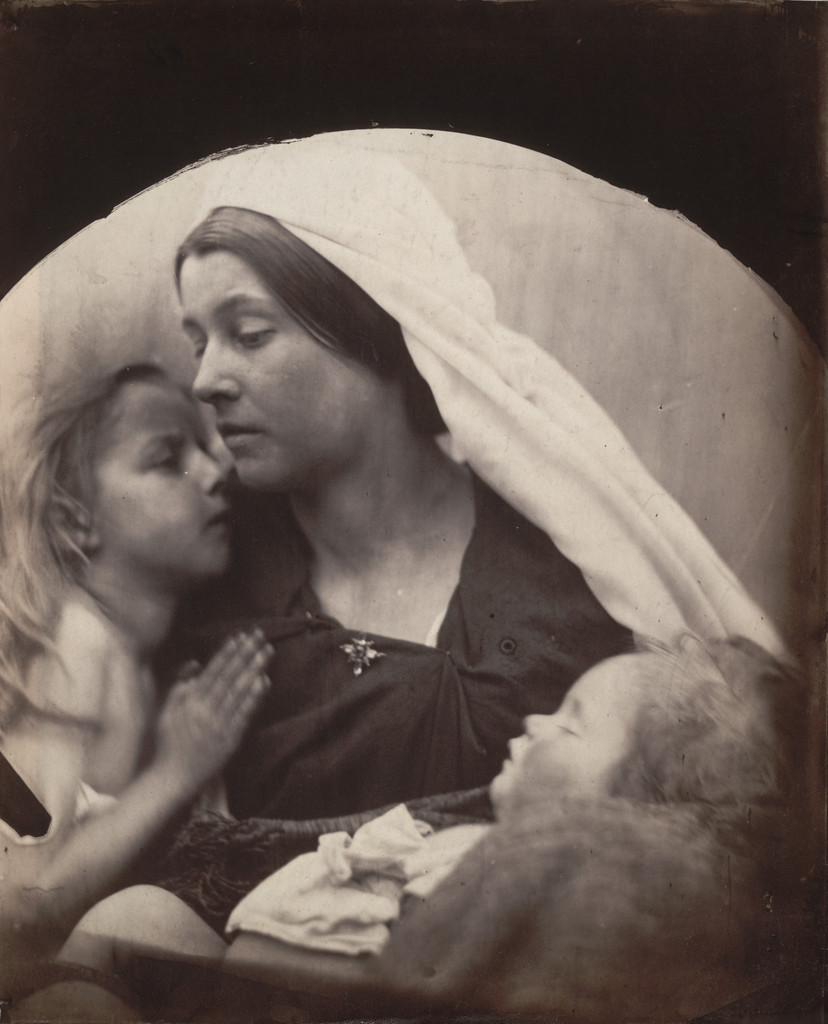
Julia Margaret Cameron began photographing at age 48, when her daughter and son-in-law gave her a camera for her amusement. She soon made a name for herself with large-format, often allegorical compositions and portraits that defied the conventions of Victorian photography. A typical commercial portrait of the time presented a small standing figure, sharply focused and evenly lit. By contrast, Cameron's photograph of her niece Julia Jackson concentrates on the subject's head, showing clearly only limited planes of her face and leaving half of it shrouded in shadow. Known as a great beauty, Jackson was a favorite subject for Cameron, who made dozens of photographs of her. In April 1867, a month before Jackson's wedding to her first husband, Herbert Duckworth, Cameron photographed the young bride-to-be. With her hair down and eyes wide, she is unsentimental, looking forward with purpose to her own personal and social transformation.
Art Institute of ChicagoCC BY 4.0
Particulars
- Accession number
- 1968.227
What it shows
In the catalog
Sources
- Art Institute of Chicago
- Image: Art Institute of Chicago — CC0
Meanwhile, in the life of Julia Margaret Cameron
The whole life1864–1875
Eleven years of photography
Cameron's career as a photographer lasted from 1864 to 1875: in that time she made more than 900 photographs, portraying great Victorians — Darwin, Tennyson, Browning, Longfellow, Herschel, Watts, Trollope, Carlyle and the actress Ellen Terry. The Virgin Mary in her religious scenes was most often played by her housekeeper, Mary Hillier.
1865
Sales through P. & D. Colnaghi
In 1865 Cameron joined the Photographic Society of Scotland and arranged for her prints to be sold through the London dealers P. & D. Colnaghi; demand for them was strong.
1865
The press derides her “out-of-focus portraits”
In 1865 The Photographic Journal wrote of her “series of out-of-focus portraits of celebrities”, crediting her daring originality at the expense of all other photographic qualities. Critics mocked her soft focus and unretouched prints, though The Illustrated London News saw in them a bold and successful application of the principles of fine art to photography.
August 1865
The South Kensington Museum buys 80 photographs
In August 1865 the South Kensington Museum (now the Victoria and Albert Museum) bought 80 of her photographs.
November 1865
First solo exhibition
In November 1865 Cameron held her first solo exhibition; her work was shown throughout Europe.
1868
First artist-in-residence of the South Kensington Museum
In 1868 the South Kensington Museum gave her two rooms to use as a portrait studio, making her its first artist-in-residence. By then her prints were being sold by two London agents, P. & D. Colnaghi and William Spooner.