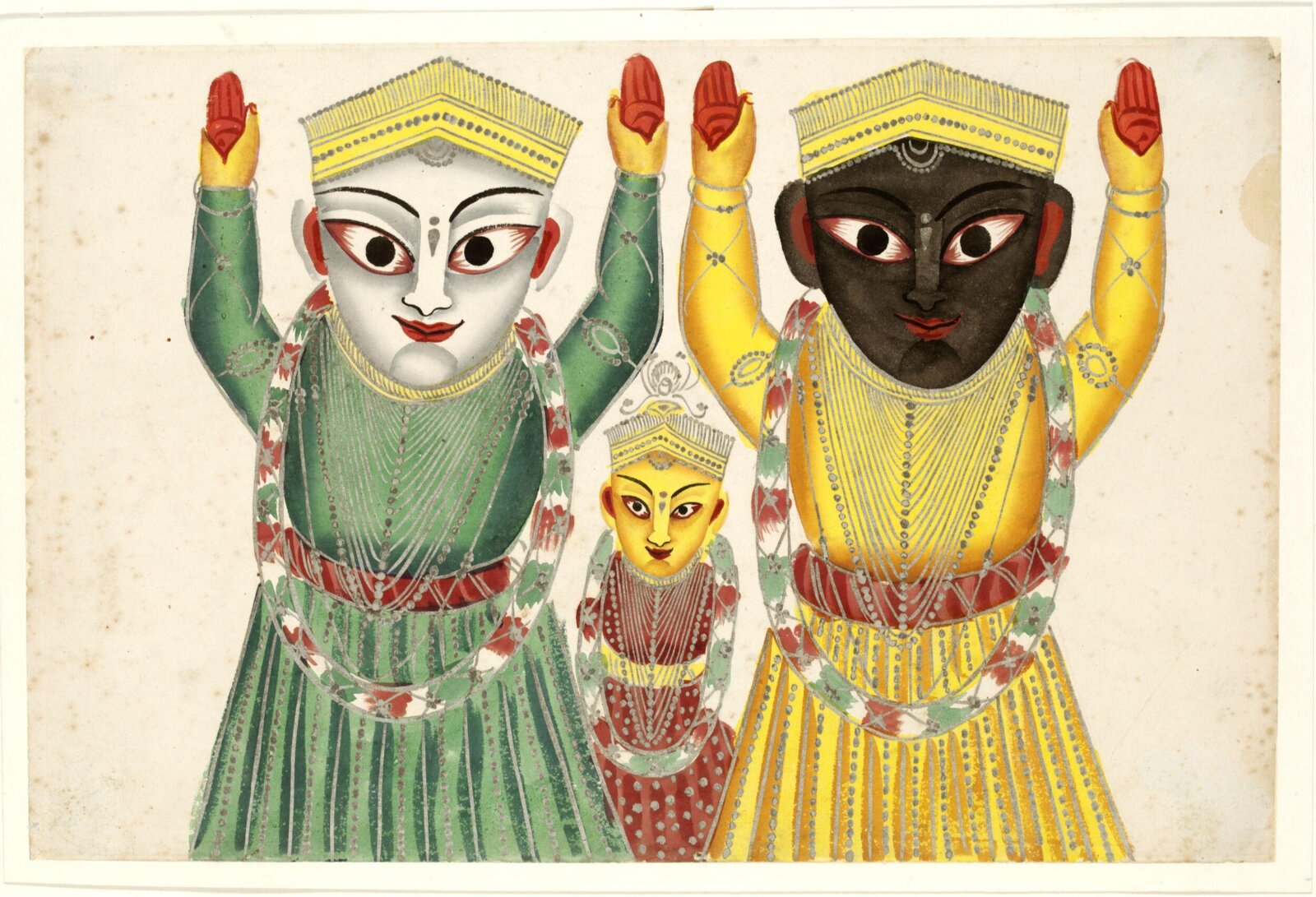
Jagannatha, Balabhadra and Subhadra
Can I see it?
Not on view at present
Where is “Jagannatha, Balabhadra and Subhadra” now? Collection: Victoria and Albert Museum, London. Not on view at present. Checked September 25, 2026.

London, United Kingdom
It belongs to the collection, but is not on display at present.
- Checked
- In this state since
- Source
- The museum
About the painting
"Jagannatha is worshipped particualry at Puri in Orissa. According to Legend, Krishna was killed by a hunter. His bones were found and vishnu directed a king, Indrayumna, to make an image of Jagannatha and place the bones inside it. The carpenter of the gods, Viswakarma, agreed to make the image is he was left undisturbed. On being interrupted by Indrayumna, Viswakarma lost his temper and refused to finish the image. This is said to explain the crude form taken by the Jagannatha image at Puri, where the body resembles a wooden stump with a large blunt head. In appearance, the three often conform to the simplified images in teh temple, but at times are shown more realistically with developed bodies, hands and feet". (Archer, 1971, p100)
Read on
Calcutta was the capital of British India from 1833-1912. By the 1830s, artists had arrived in Calcutta from rural villages in Bengal and began to produce paintings that reflected the local history, mythology, customs and conflicts of a colonised society. As a popular art form, these artists are recognised for their use of brilliant colour, simplified images and swift brushstrokes that became the hallmark of Kalighat painting in the 19th and early 20th century.
Victoria and Albert Museum
Details
- Accession number
- IS.197-1950
What it shows
In the catalog
Sources
- Victoria and Albert Museum
- Image: Victoria and Albert Museum — © Victoria and Albert Museum, London










