 Auguste RodinFrench, 1840–1917
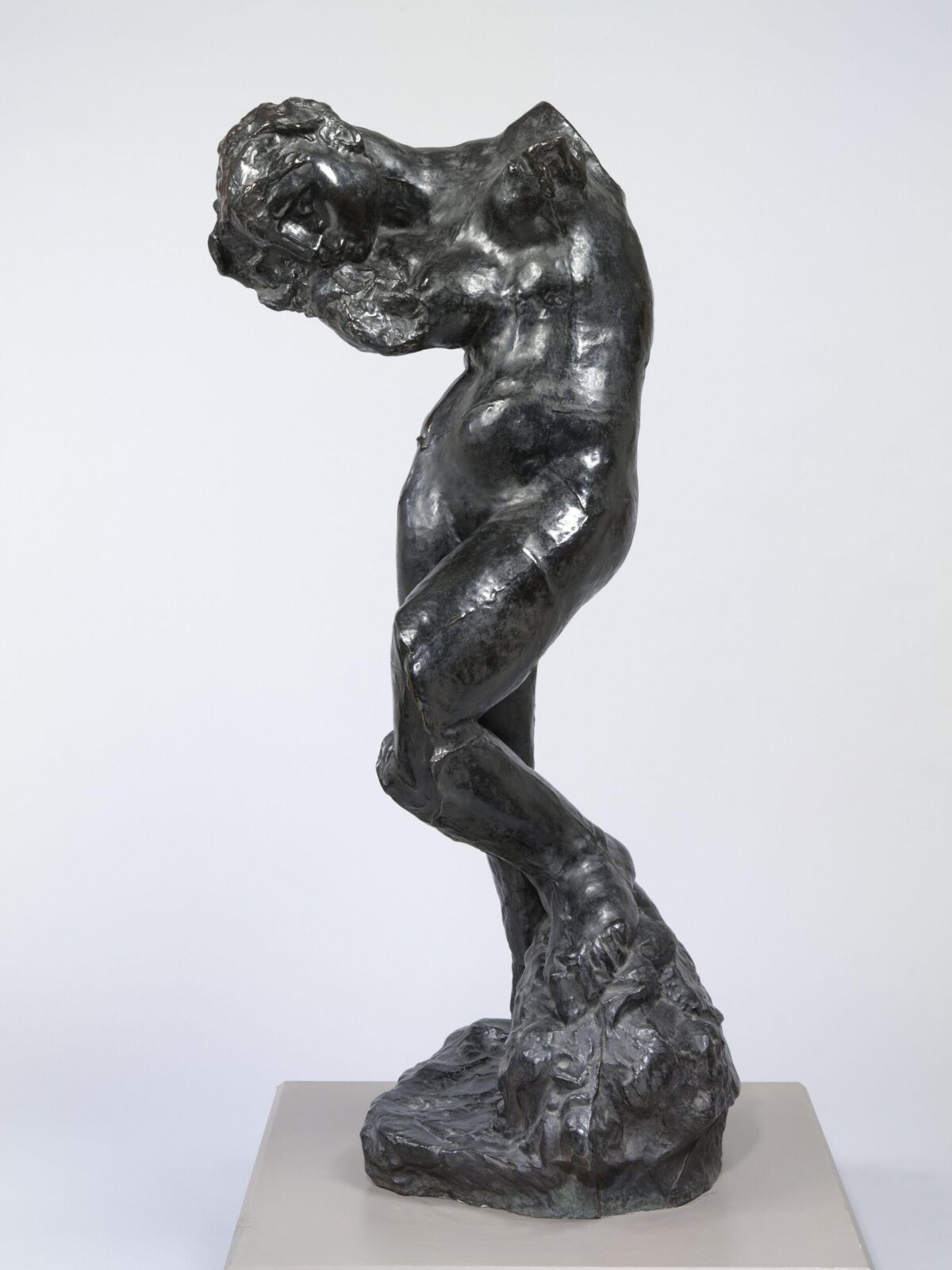
Inner Voice (The Muse)
May one see it?
Yes, receiving visitors

Victoria and Albert Museum
London, United Kingdom
RoomSculpture, Room 21, The Dorothy and Michael Hintze Galleries
On public display.
- Checked
- In this state since
- Source
- The museum
About the sculpture
Rodin frequently explored the further possibilities that arose from existing projects, revisiting the form, scale, material and, most significantly, the intention of his ideas. 'The Muse' began as small-scale figure on the tympanum (rectangular panel) immediately above the bronze 'Gates of Hell' doors for the new Museum of Decorative Arts, Paris, which Rodin was asked to design in 1880.
Rodin later developed the figure as 'The Inner Voice', one of two muses intended for the monument in Paris to the writer Victor Hugo, commissioned in 1886. His composition showed a naked Hugo flanked by two naked muses. The commissioners rejected this proposal as unsuitable for its proposed location in the Panthéon, though they allowed him to continue with the project.
Read on
After many revisions, Rodin ended up producing this figure. He cut off the arms and removed drapery that covered the knee, which signalled Rodin's increasingly conceptual approach to sculpture. The poet Rainer Maria Rilke, who worked as Rodin's secretary for a time, wrote of it, …'again and again in his figures Rodin returned to this bending inward, to this intense listening to one's own depth… Never was human body assembled to such an extent about its inner self, so bent by its own soul'. Rodin himself said of it: 'My figure represents 'Meditation'. That is why it has neither arms to act nor legs to walk. Haven't you noticed that reflection, when persisted in, suggests so many plausible arguments for opposite directions that it ends in inertia?'
Victoria and Albert Museum
Particulars
- Accession number
- A.36-1914
In the catalog
Sources
- Victoria and Albert Museum
- Image: Victoria and Albert Museum — © Victoria and Albert Museum, London
Meanwhile, in the life of Auguste Rodin
The whole life1890s–1900s
Young sculptors in Rodin's studio
His income let him hire gifted young sculptors, among them Antoine Bourdelle, Charles Despiau, Jules Desbois, François Pompon and Aristide Maillol. Constantin Brancusi left after two months, convinced that nothing grows under a big tree.
1895
Buys the Villa des Brillants at Meudon
Rodin bought the Villa des Brillants estate near Paris and moved his studio there, but there was not enough room and two years later it went back to Paris. His income let him collect: Egyptian, Greek and Roman sculpture, Persian miniatures and paintings by his contemporaries, including Van Gogh's “Portrait of Père Tanguy”.
1895
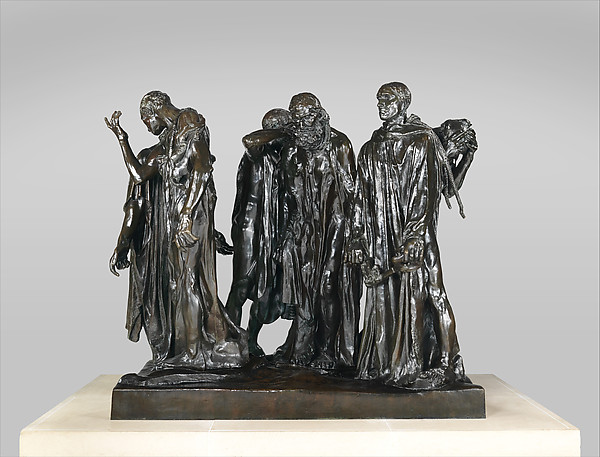
“The Burghers of Calais” installed in Calais
Against Rodin's wishes — he had hoped to place the group at ground level near the town hall — Calais chose a high platform in front of a public garden, with a cast-iron railing. Rodin had proposed doing without a pedestal so that viewers could “penetrate to the heart of the subject”.
1897
An album of Rodin's drawings
The industrialist and collector Maurice Fenaille published an album of 147 reproductions of Rodin's drawings in an edition of 125 copies. It sold out at once.
1898
Parts from Camille Claudel
Rodin never gave up Rose Beuret, his companion of the lean years and the mother of his son; in 1898 he and Claudel parted. A few years later Claudel suffered what is called a nervous breakdown, and her family confined her to an institution for thirty years.
1898
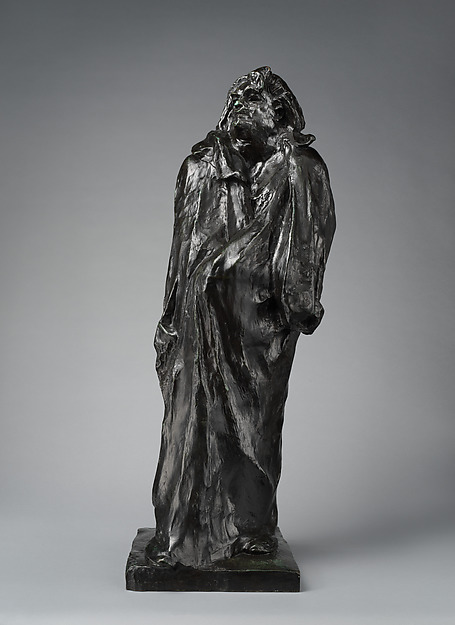
The scandal over “Balzac”
The monument's showing in 1898 caused a storm: the Société des Gens de Lettres rejected it, the press ran parodies, and Monet, Debussy and the future premier Clemenceau signed a manifesto in Rodin's defence. Rodin repaid the commission and moved the statue to his garden; he never completed another public commission.