 Ludwig Mies van der RoheAmerican, 1886–1969
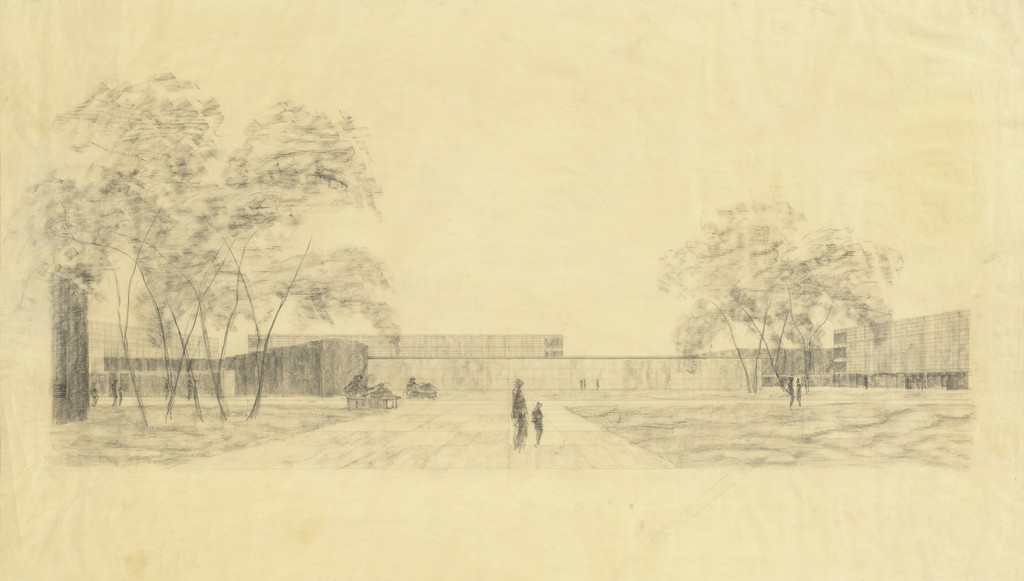
IIT Master Plan, Chicago, Illinois, Campus, perspective, first version
Can I see it?
Not on view at present
Where is “IIT Master Plan, Chicago, Illinois, Campus, perspective, first version” now? Collection: The Museum of Modern Art, New York. Not on view at present. Checked September 22, 2026.

New York, United States
It belongs to the collection, but is not on display at present.
- Checked
- Source
- The museum
Details
- Accession number
- 720.1963
In the catalog
Sources
- The Museum of Modern Art
- Image: The Museum of Modern Art — © the artist or rights holder
In the life of Ludwig Mies van der Rohe
The whole life1933–1937
Attempts to get along with the Nazis
Some of his designs, such as autobahn service stations, found favour with Hitler; Mies and Gropius joined the visual arts section of the Reich Culture Chamber, entered early Nazi architectural competitions with designs showing structures decorated with swastikas, and signed an artists’ manifesto supporting Hitler’s succession to Hindenburg. His design for a Reichsbank building in Berlin won one of six prizes but was rejected by Hitler.
1937–1938
Emigration to the United States
His modernist designs of glass and steel were not considered suitable for state buildings by the Nazis, and in 1937 or 1938 Mies reluctantly followed Gropius to the United States, where he accepted a residential commission in Wyoming and then an offer to head the department of architecture of the Armour Institute of Technology in Chicago.
1940
The Armour Institute becomes IIT: Mies stays
When the Armour Institute merged with the Lewis Institute in 1940 to form the Illinois Institute of Technology, Mies stayed to head its architecture department and was hired to design the new buildings and master plan of the campus; he replaced the traditional École des Beaux-Arts curriculum with a three-step education — from the crafts of drawing and construction through planning skills to the theory of architecture.
1940
Lora Marx, his companion to the end
From 1940 until his death the artist Lora Marx (1900–1989) was his primary companion.