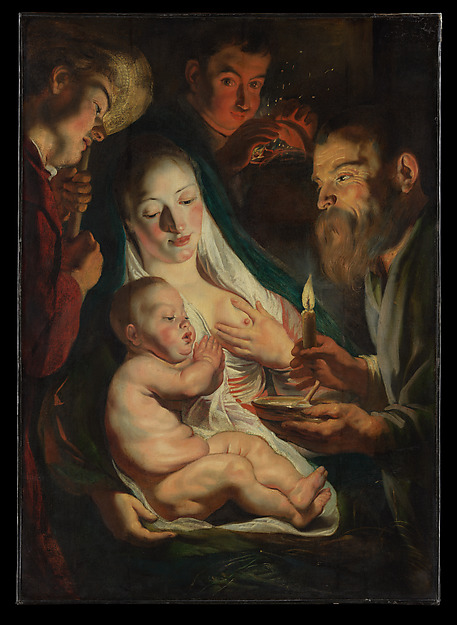
Jacques JordaensFlemish, 1593–1678
Het wapen van Van der Linden
Can I see it?
Unknown
Where is “Het wapen van Van der Linden” now? Collection: Rijksmuseum, Amsterdam. Unknown.

Amsterdam, Netherlands
The owner is known; whether it is on view today is not.
- Source
- The museum
About the work
Museum text in Dutch
Modello met een wapenschild en allegorische figuren.
Rijksmuseum
Details
- Accession number
- RP-T-1889-A-1926
What it shows
In the catalog
Sources
- Rijksmuseum
- Image: Rijksmuseum — public domain
In the life of Jacques Jordaens
The whole life1621–1667
His workshop: fifteen pupils in the guild records
Between 1621 and 1667 the guild registered fifteen pupils with Jordaens (the best known being Jan Boeckhorst), and six more are named in court documents; his son Jacob and his cousin Arnoldus also trained with him. His fame drew foreigners: after 1642 the Polish painter Aleksander Jan Tricius became his pupil, and in 1645 Queen Christina of Sweden meant to send her protégé Georg Waldau, but the threat of war in Flanders prevented it.
1629
Daughter born: Anna Catharina Jordaens
1633–1634
Inherits his birth house, “Het Paradijs”
When his parents' estate was divided among Jacob, his brother Izaak and his sisters Anna, Magdalena and Elisabeth, he received the house where he was born, “Het Paradijs” (“Paradise”). In 1634 he bought two more houses on the Verversrui.
1635
Decorations for the entry of Cardinal-Infante Ferdinand
For the Joyous Entry into Antwerp of the new governor of the Habsburg Netherlands, designed by Rubens, Jordaens painted decorative pictures after Rubens's designs and, with Cornelis de Vos, completed the triumphal Arch of Philip on the Huidenvetterstraat. The arch was temporary and has not survived.
c. 1635 – 1645
Publishes prints after his own designs
Like Rubens and van Dyck, Jordaens realised that prints spread an artist's fame and on his own initiative issued 14 engravings under privilege (cum privilegio), cut by Marinus Robyn van der Goes, Schelte a Bolswert, Paulus Pontius and other Antwerp engravers. Beneath each image stood his name as inventor and a short explanation in Latin verse.
1637–1638
Paintings for Philip IV's hunting lodge
In 1636 Rubens received a commission for a mythological series after Ovid's Metamorphoses for the Torre de la Parada near Madrid and enlisted Antwerp painters. Jordaens painted “Apollo and Pan” (1637, after a sketch by Rubens) and “Vertumnus and Pomona” (1638).