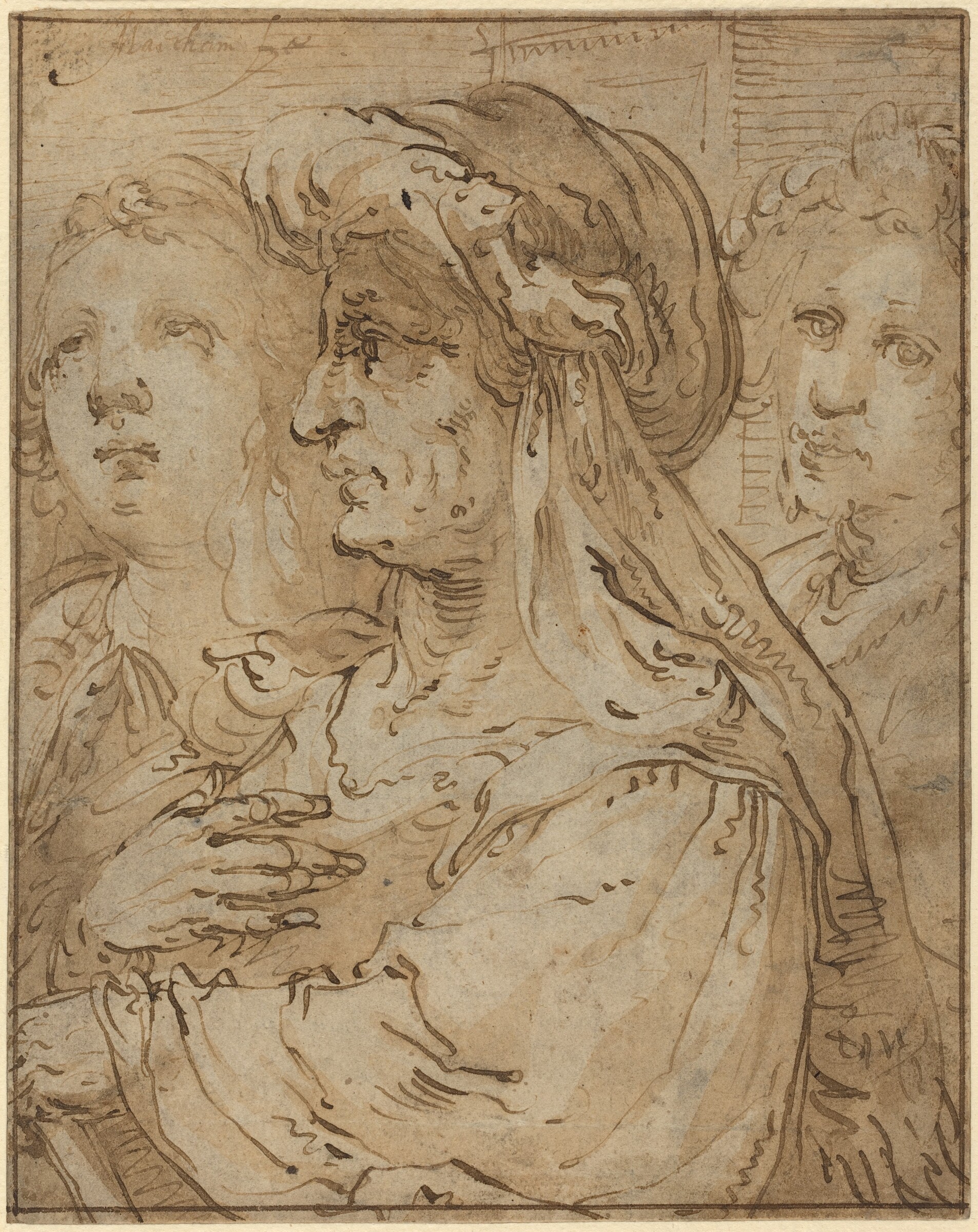
Jacob MathamDutch, 1571–1631
Hendrick Goltzius
May one see it?
Not receiving at present

Harvard Art Museums
Cambridge, United States
It belongs to the collection, but is not on display at present.
- Checked
- In this state since
- Source
- The museum
About the work
When Hendrick Goltzius died in 1617, he left behind two painted self-portraits, described by his wife in her inventory of his estate. One of the self-portraits pictured him as being "completely bourgeois, with a small black cap on his head." Using the painting as his model, his stepson and protégé, Jacob Matham, engraved the portrayal within an elaborate, architectural framework. The tomblike ornamentation, including the two torches at top and the skull above his head, identify the image as a funerary portrait. The image of Goltzius is flanked by allegorical representations of Spirito (artist inspiration) and Disegno (design), the two qualities that drove Goltzius' artistic genius. Impressions of the print are very rare, perhaps because it was intended as a tribute circulated within a small group of intimates and admirers.
Harvard Art Museums
Particulars
- Accession number
- 2006.168
In the catalog
Sources
- Harvard Art Museums
- Image: Harvard Art Museums — © President and Fellows of Harvard College