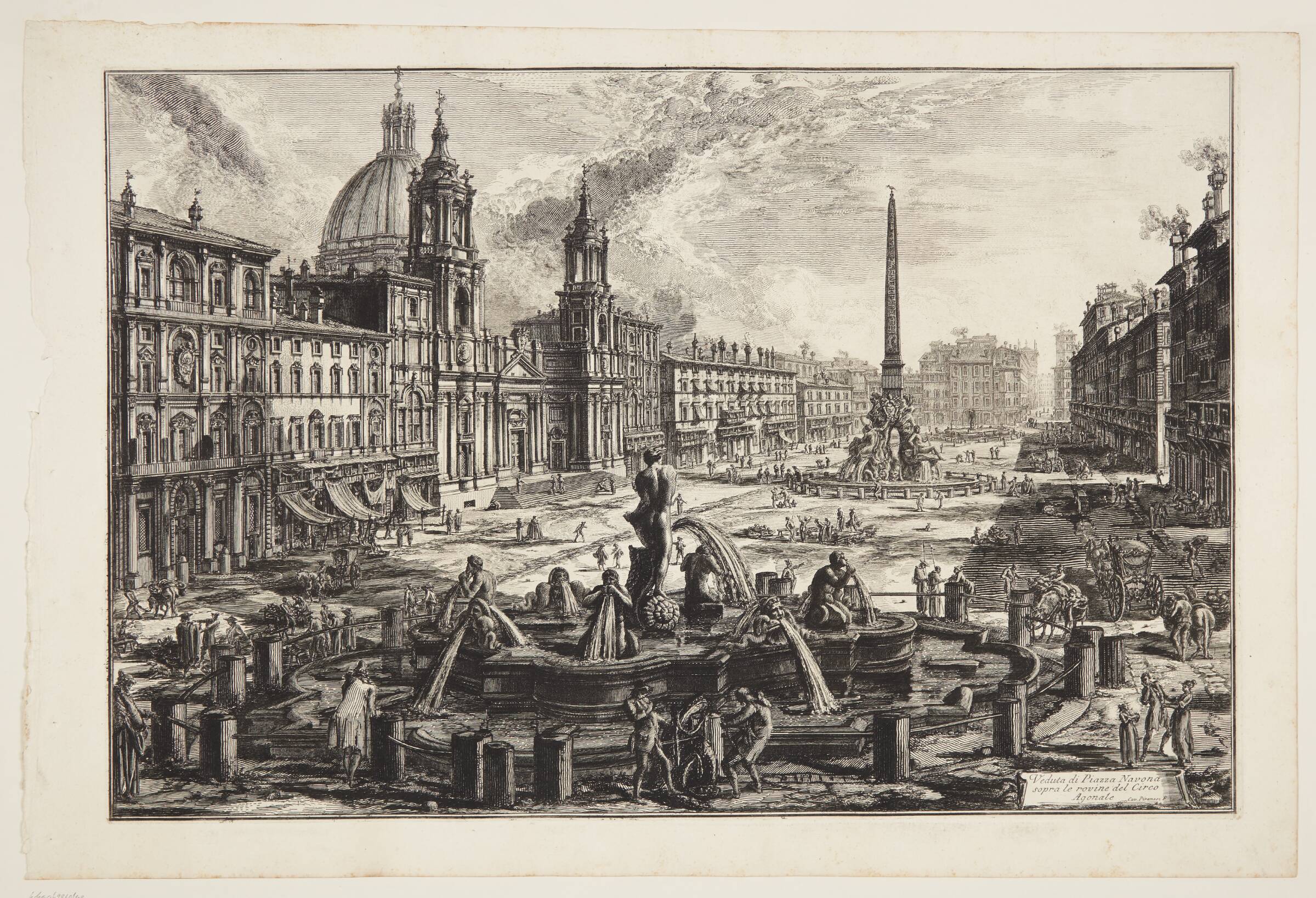
Giovanni Battista PiranesiItalian, 1720–1778
Front elevation and plan
May one see it?
Not receiving at present

Cambridge, United States
It belongs to the collection, but is not on display at present.
- Checked
- In this state since
- Source
- The museum
Particulars
- Accession number
- M2869.9.20
In the catalog
Sources
- Harvard Art Museums
- Image: Harvard Art Museums — © President and Fellows of Harvard College
Meanwhile, in the life of Giovanni Battista Piranesi
The whole life4 October 1720
Born
1740
Arrives in Rome with the Venetian ambassador
In 1740 Piranesi came to Rome as a draughtsman for Marco Foscarini, the Venetian ambassador to Pope Benedict XIV, lived in the Palazzo Venezia and studied with the engraver and view-maker Giuseppe Vasi, who introduced him to etching and to the monuments of Rome. Vasi found his talent far greater than an engraver's: “You are too much of a painter, my friend, to be an engraver.”
c. 1747
Back in Rome: a workshop on the Via del Corso
From Venice Piranesi returned to Rome and opened his own workshop on the Via del Corso; from then until his death he lived in Rome. Studying Marco Ricci and Giovanni Paolo Panini, he produced a vast number of etchings of the monuments of ancient Rome and views of the city of his own day.
1756
Publishes “Le Antichità Romane”
The multi-volume edition of etchings “Roman Antiquities” gathered the monuments of ancient Rome, capitals, sarcophagi, vases, funerary inscriptions and plans of buildings. In it Piranesi was the first to distort the real proportions of well-known buildings and to “ruin” them, and on the frontispiece, dedicated to the Vatican librarian G. G. Bottari, he depicted a street with a phantasmagoric jumble of vases, busts, obelisks, pyramids and statues of pharaohs.
1761
The treatise “On the Magnificence and Architecture of the Romans”
In 1761 Piranesi set out his ideas in a treatise that provoked a Europe-wide scholarly debate: a champion of the pan-Roman theory, he held the architecture of the ancient Romans to be a direct continuation of Egyptian rather than Greek building, and the highest achievement of the classical world.
9 November 1778
Died

![View of the Remains of the Praetorian Fort [the Poecile] in Hadrian’s Villa at Tivoli, Giovanni Battista Piranesi, 1770](https://nrs.harvard.edu/urn-3:HUAM:INV165626_dynmc/full/!2400,2400/0/default.jpg)